
Investigation · Method and the future
Corrective Action After an Investigation: Learning and Verification
An investigation that ends with a report but no lasting change has wasted most of its value. This article explains how to turn findings into effective corrective actions, why many actions fail, how to verify that they worked, and how organisations learn from investigations.
Investigations are usually judged by their findings, but their value lies in what happens next. A safety investigation that identifies a faulty procedure, a fraud investigation that reveals weak payment controls, or a complaint investigation that exposes a management failure all point to changes that could prevent a repeat. Too often the report is accepted, actions are listed, and a year later the same problem recurs. This article explains how to design corrective actions, why they often fail, and how to verify that they have worked.
From findings to actions
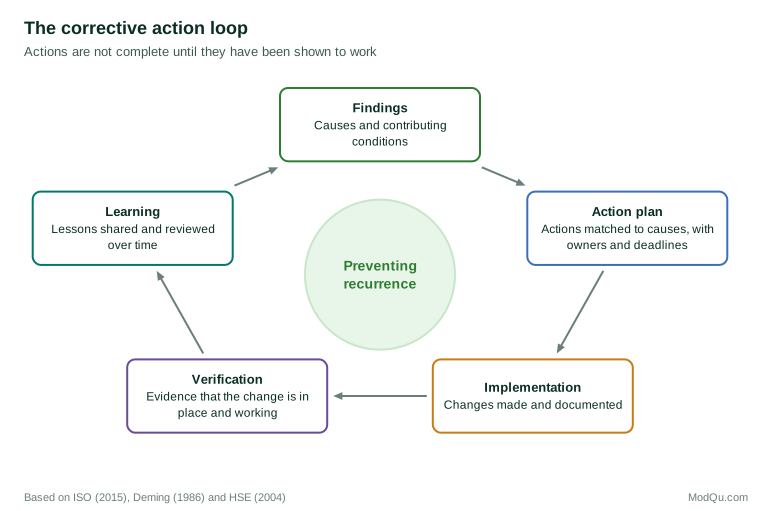
Corrective action is action taken to remove the cause of a problem and prevent it from happening again. Quality management standards require organisations to react to a nonconformity, evaluate the need to eliminate its causes, implement the action needed and review its effectiveness (International Organization for Standardization [ISO], 2015). Each action should follow from a specific finding, address a cause rather than a symptom, and have a named owner and deadline.
Reason (1997) distinguished between the active failures of people at the front line and the latent conditions, such as poor design, inadequate training or production pressure, that make those failures likely. Actions that address only individuals, such as retraining or discipline, leave latent conditions in place. Reason (2000) argued that an approach focused on the system rather than on blaming individuals is more likely to prevent recurrence. Dekker (2014) similarly argues that "human error" is a starting point for investigation, not a conclusion.
Stronger and weaker actions
Not all actions are equally effective. Safety practice ranks controls from strongest to weakest: eliminating a hazard, substituting something safer, engineering controls such as physical barriers or forcing functions, administrative controls such as procedures and training, and finally personal protection or warnings (Health and Safety Executive [HSE], 2004). The same logic applies outside safety. Redesigning a payment system so that one person cannot both create and approve a supplier is stronger than a policy telling staff not to do so, which in turn is stronger than a reminder email.
Studies of healthcare investigations show that weak actions dominate. Wu et al. (2008) questioned whether root cause analyses in medicine led to effective improvements. Hibbert et al. (2018) reviewed recommendations from root cause analyses in Australian hospitals and found that most were weak, such as new policies or training, and that stronger system changes were uncommon. Kellogg et al. (2017) found that the same types of event recurred at one hospital despite years of investigations, because recommended actions were mostly weak. Peerally et al. (2017) argue that investigations often focus on single root causes and produce actions that are too narrow or never implemented.
Why actions fail
Common reasons include:
- Actions that address symptoms. Fixing the specific error without changing what made it likely.
- Too many actions. Long lists dilute effort, and the important actions are lost among the trivial.
- No owner or resources. Actions assigned to a committee or to "management" are rarely completed.
- Closure on paper. An action is marked complete when a policy is issued, not when practice changes.
- No follow-up. Nobody checks whether the change has lasted.
Large-scale failures show the cost. The Columbia Accident Investigation Board (2003) concluded that organisational causes identified after the loss of the space shuttle Challenger in 1986 had re-emerged at NASA and contributed to the loss of Columbia in 2003.
Verifying effectiveness
Verification asks two questions: has the action been implemented as intended, and has it reduced the risk? The first can be checked by inspecting the changed system, sampling records or observing practice. The second requires measuring outcomes over time, such as recurrence of the problem, related incidents or audit results. Deming (1986) emphasised that improvement depends on studying the results of a change, not on assuming it worked. Verification should be planned when the action is agreed, with a measure, a date and a person responsible for checking, and should be done by someone other than the action's owner where possible.
Involving the people affected
Actions are more likely to work when the people who do the work help design them. Front-line staff often know why a procedure is ignored or a system is worked around, and can spot unintended effects of a proposed change before it is introduced. Involving them also signals that the investigation is about improvement rather than blame, which makes people more willing to report problems in future. Where an investigation affected customers, respondents or members of the public, telling them what has changed is part of putting things right and helps rebuild trust.
Learning beyond the case
Argyris and Schön (1978) distinguished between single-loop learning, which corrects an error within existing assumptions, and double-loop learning, which questions the assumptions themselves. An investigation that finds a supplier fraud and tightens one control is single-loop; one that asks why the organisation's risk assessment failed to anticipate the fraud is double-loop. Organisations can support deeper learning by collecting findings across investigations, looking for recurring themes, sharing anonymised lessons, and reviewing whether previous actions are still in place.
A short example
The following hypothetical case illustrates the loop. A survey company's investigation finds that a respondent data file was sent to the wrong client because two projects had similar names and the file transfer screen showed only the first few characters. The first draft action list includes retraining staff and reminding them to check names. The reviewer rejects these as weak and adds two stronger actions: changing the system to require selection of the client from a list linked to the project, and adding an automated check that blocks transfer if the client and project do not match. Six months later, a verification review confirms that the changes are in place and that no misdirected transfers have occurred, and the lesson is shared with other teams that use similar systems.
Conclusion
Corrective action turns investigation findings into prevention. Effective actions address causes, prefer system changes over reminders, have clear owners and deadlines, and are verified to confirm that they have been implemented and have worked. Organisations that review patterns across investigations and question their own assumptions learn more than those that close each case on its own.
References
Argyris, C., & Schön, D. A. (1978). Organizational learning: A theory of action perspective. Addison-Wesley.
Columbia Accident Investigation Board. (2003). Report (Vol. 1). National Aeronautics and Space Administration.
Dekker, S. (2014). The field guide to understanding 'human error' (3rd ed.). Ashgate.
Deming, W. E. (1986). Out of the crisis. MIT Center for Advanced Engineering Study.
Health and Safety Executive. (2004). Investigating accidents and incidents: A workbook for employers, unions, safety representatives and safety professionals (HSG245). HSE Books.
Hibbert, P. D., Thomas, M. J. W., Deakin, A., Runciman, W. B., Braithwaite, J., Lomax, S., Prescott, J., Gorrie, G., Szczygielski, A., Surwald, T., & Fraser, C. (2018). Are root cause analyses recommendations effective and sustainable? An observational study. International Journal for Quality in Health Care, 30(2), 124–131. https://doi.org/10.1093/intqhc/mzx181
International Organization for Standardization. (2015). Quality management systems — Requirements (ISO 9001:2015).
Kellogg, K. M., Hettinger, Z., Shah, M., Wears, R. L., Sellers, C. R., Squires, M., & Fairbanks, R. J. (2017). Our current approach to root cause analysis: Is it contributing to our failure to improve patient safety? BMJ Quality & Safety, 26(5), 381–387. https://doi.org/10.1136/bmjqs-2016-005991
Peerally, M. F., Carr, S., Waring, J., & Dixon-Woods, M. (2017). The problem with root cause analysis. BMJ Quality & Safety, 26(5), 417–422. https://doi.org/10.1136/bmjqs-2016-005511
Reason, J. (2000). Human error: Models and management. BMJ, 320(7237), 768–770. https://doi.org/10.1136/bmj.320.7237.768
Reason, J. (1997). Managing the risks of organizational accidents. Ashgate.
Wu, A. W., Lipshutz, A. K. M., & Pronovost, P. J. (2008). Effectiveness and efficiency of root cause analysis in medicine. JAMA, 299(6), 685–687. https://doi.org/10.1001/jama.299.6.685