
Share your experience of renting a car
Tell us which company you rented from, how you booked and whether you have used car sharing instead. Your answers are combined with other people's and reported only as totals.
Start the car rental surveyAbout 5 minutes. No account needed. You can stop at any time.
What this topic covers
This topic covers short-term vehicle rental by individuals:
- Traditional car rental from airport and neighbourhood locations.
- Truck and van rental for moving and carrying large items.
- Car sharing, where members book a car by the hour or day through an app.
- Peer-to-peer rental, where private owners rent out their own cars through a platform.
- Replacement vehicles provided while a car is being repaired, often through insurance.
- Long-term and subscription rentals for weeks or months.
Ride-hailing and taxis are covered on a separate page.
Why people rent cars
People rent cars for many reasons:
- travel: picking up a car at the airport on arrival;
- road trips in a larger or more reliable car than their own;
- not owning a car, common among city residents who use transit, cycling and walking day to day;
- special needs: a van for moving, a larger vehicle for a family visit, or a pickup truck for a project;
- while their car is in for repairs after an accident or breakdown;
- trying a vehicle, such as an electric car, before buying one.
Example
A family that lives downtown and does not own a car rents a minivan four times a year: twice for camping trips, once to visit relatives in another province, and once for a big shopping trip to a warehouse store. They say owning a car would cost far more than four rentals.
What affects the price
Rental prices vary widely. Factors include:
- location: airport locations often cost more because of extra fees, while neighbourhood branches can be cheaper;
- season and demand: holidays, long weekends and summer are busier and more expensive;
- vehicle class, from small economy cars to SUVs, minivans and luxury cars;
- length of rental, since weekly rates are often lower per day;
- one-way rentals, which usually add a drop-off charge;
- driver age, with extra charges for young drivers, often under 25;
- how far ahead the car is booked.
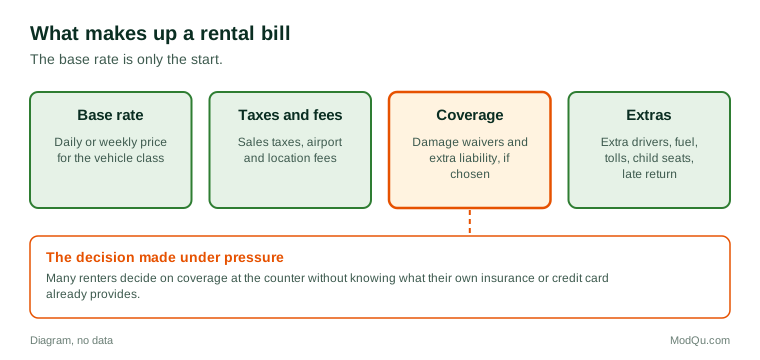
The base rate is only part of the total. Taxes, airport fees, insurance options and extras can add a large amount.
Insurance and coverage
Insurance is the part of car rental that confuses many people. At the counter, renters are usually offered:
- a collision damage waiver (CDW) or loss damage waiver (LDW), which reduces or removes the renter's responsibility for damage to or theft of the rental car;
- liability coverage above the legal minimum;
- personal accident and effects coverage.
Many renters already have some coverage through their own car insurance policy or through a credit card used to pay for the rental, but the details vary. In Canada, some provinces' auto insurance includes coverage for rented vehicles, and many credit cards include a damage waiver if the renter declines the rental company's waiver. People are often unsure what they have, and decide at the counter under pressure.
Example
A traveller at an airport counter is asked whether they want the damage waiver for $32 a day. They are not sure whether their credit card covers it. They buy the waiver for peace of mind. Later, reading their card's benefits guide, they find it would have covered damage to the car on a rental of that length.
Extra charges and common disputes
Other charges that can surprise renters include:
- fuel: a charge for returning the car with less fuel than at pickup, often at a high price per litre, or a prepaid fuel option;
- toll roads, with an administration fee added by the rental company;
- additional drivers;
- child seats, GPS units and winter tires;
- late returns;
- cleaning fees for smoking, pet hair or excessive dirt;
- damage claims after the return.
Damage disputes are a common complaint. Renters are often advised to inspect the car closely at pickup, photograph or video any scratches and dents, and do the same at return.
Example (hypothetical figures)
A renter books a mid-size car for five days at $55 a day, $275 in total. Airport fees and taxes add $80. They add a second driver at $12 a day, $60 in total, and return the car with a quarter tank missing, which the company charges at $40. The final bill is $455, compared with the $275 shown when they booked.
Car sharing as an alternative
Car sharing services let members book a car for an hour, a few hours or a day. The price usually includes fuel and insurance. Cars are parked in set spots or, with some services, anywhere within a zone, and are unlocked with an app or card. Many Canadian cities have car sharing, including co-operative services and commercial ones.
Car sharing suits short local trips, such as a grocery run, an appointment or moving a few boxes. Traditional rental usually suits longer trips, travel from airports and trips out of town.
Peer-to-peer rental platforms let people rent a car from a private owner. Prices and vehicles vary, and insurance is usually arranged through the platform.
Example
A student without a car uses a car sharing service twice a month for groceries and once for a trip to a hardware store, each time for about two hours. For a weekend visit to a friend in another city, they book a traditional rental instead, because it costs less for a two-day trip with many kilometres.
Electric vehicles and changes in rental
Rental fleets now include more electric vehicles. Renters who have never driven one may need help with charging, range and finding chargers on the road. Some return EVs with less charge than expected and are surprised by charging fees, while others enjoy the chance to try one before buying. Rental companies also now use apps for faster pickup, keyless entry and digital receipts.
What people disagree about
Opinion is divided on whether rental insurance offered at the counter is worth it, whether young driver charges are fair, whether car sharing can replace owning a car, and how damage claims should be handled. Survey questions help show how these views differ between frequent and occasional renters.
Key terms
- Collision damage waiverOptional cover that reduces a renter's responsibility for damage to the car.
- Liability coverageInsurance for damage or injury caused to others.
- One-way rentalPicking up a car in one place and returning it in another.
- Young driver feeAn extra charge for drivers under a set age, often 25.
- Prepaid fuelPaying for a full tank in advance and returning the car empty.
- Car sharingA membership service for renting cars by the hour or day.
- Peer-to-peer rentalRenting a car from a private owner through a platform.
- Vehicle classThe size or type of car, such as economy, SUV or minivan.
Full glossary: travel tourism terms on EditingTests.com.
Car rental vocabulary test
How well do you know the language of this topic? Try 8 quick questions. Your score is shown straight away and is not saved.
What the car rental survey asks
This survey is part of ModQu's Travel and Hospitality survey. The car rental part takes about five minutes and covers:
- Which company or service you rented from most recently, and why.
- How you booked: online, through an app, by phone or at the counter.
- What the rental cost, including fees and extras.
- How you decided on insurance and coverage.
- Whether you have used car sharing or peer-to-peer rental instead.
- Any problems at pickup or return, and how they were handled.
After that you can choose to continue with other short parts of the Travel and Hospitality survey, such as holiday and leisure travel or air travel, or stop.
Ready to take part?
Your answers help show what people really think and do. Results are only ever reported as totals; no one can see your individual answers.
Start the surveyQuestions about this survey
Who can take part?
Adults who rented a car in the last two years.
Do I have to give my name?
No. You may be asked for your age group, region and similar details so results can be broken down, but not your name. ModQu never asks for passwords, card numbers or account numbers.
How are the results used?
Answers are combined into totals and percentages and published in ModQu reports. Individual answers are never shown.
Is the vocabulary test part of the survey?
No. It is optional and separate, and your score is not stored.
Does renting a moving truck count?
Yes. The survey asks about any vehicle you rented, including vans and trucks.