
Share your experience of car maintenance and repair
Tell us where you service your vehicle, what you spent this year and how much you trust mechanics. Your answers are combined with other people's and reported only as totals.
Start the car maintenance and repair surveyAbout 5 minutes. No account needed. You can stop at any time.
What maintenance and repair cover
Car care falls into two broad kinds of work.
Maintenance is the regular work that keeps a vehicle in good condition and helps prevent breakdowns. It is usually done on a schedule set by the manufacturer, based on time or distance. Common maintenance items include:
- oil and filter changes;
- tire rotations, and in much of Canada, switching between winter and all-season tires;
- brake inspections and replacing brake pads and rotors when worn;
- replacing air filters, cabin filters and wiper blades;
- checking and topping up fluids such as coolant, brake fluid and washer fluid;
- replacing the battery every few years;
- timing belt, spark plug and transmission fluid service at longer intervals.
Repair is work to fix something that has broken, worn out or been damaged, such as a failed alternator, a leaking water pump, a check-engine warning, rust damage or collision damage.
The line between the two is not always clear. Worn brakes found during an inspection are usually described as maintenance, but if they are left too long they can damage other parts and become a larger repair.
Where people take their vehicles
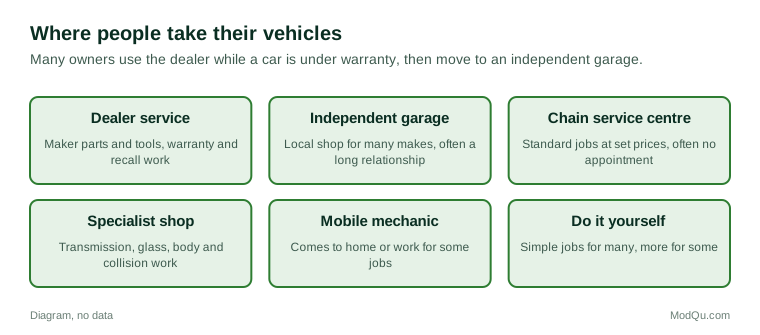
People choose from several kinds of service provider:
- Dealer service departments, linked to a vehicle brand. They use the maker's parts and diagnostic tools, handle warranty and recall work, and often offer loaner cars or shuttles. Prices are often higher.
- Independent garages, local shops that work on many makes. Many people value a long relationship with one mechanic. Prices are often lower, and some specialize in particular makes or kinds of work.
- Chain and franchise service centres, including quick-lube and tire shops, which offer standard services with set prices and often without an appointment.
- Specialist shops, such as transmission, muffler, glass, and auto body or collision repair shops.
- Mobile mechanics, who come to the customer's home or workplace for some jobs.
- Doing it yourself, which many owners do for simple jobs such as changing wiper blades, and some do for much more.
Many owners go to the dealer while the car is under warranty and then move to an independent garage once it is older. Others stay with the dealer throughout, and some never use a dealer at all.
Example
A couple bought a new car and had every service done at the dealer for the first four years. When the warranty ended, the dealer quoted for a large scheduled service that cost more than they expected. They asked a neighbour for a recommendation, got a second quote from an independent garage, and moved their servicing there. They still take the car to the dealer when there is a recall.
What drives repair costs
Repair bills are made up of a few main parts.
- Labour: the time a technician spends, charged at the shop's hourly rate. Many shops charge by a standard time for each job taken from a labour guide, called flat-rate or book time, rather than by the actual time spent.
- Parts: these can be OEM (original equipment manufacturer) parts made for the vehicle's maker, or aftermarket parts made by other companies, which are often cheaper and vary in quality. Some shops also use used or rebuilt parts.
- Diagnostic fees: a charge to find out what is wrong, often for electrical problems or warning lights.
- Shop supplies and environmental fees: small charges for fluids, cleaners and disposal of old parts and oil.
- Taxes.
Modern vehicles have many electronic systems and sensors, and repairs can involve calibrating cameras and sensors after even small jobs such as a windshield replacement. That has raised the cost of some repairs.
Example (hypothetical figures)
A shop quotes a front brake job. Labour is 1.5 hours of book time at $140 an hour, which is $210. Pads and rotors cost $260. Shop supplies add $15. The total before tax is $485. A second shop quotes the same labour time at $120 an hour ($180) with aftermarket parts at $190 and no supplies charge, for $370 before tax. The difference is $115, mainly from parts.
Estimates, approvals and warranties
A written estimate sets out the work a shop proposes and what it expects to charge. In several provinces, consumer protection laws give customers rights around estimates and repairs, such as the right to a written estimate, a limit on how much the final bill can exceed it without the customer's approval, and the return of replaced parts on request. The rules differ by province, so people check the rules where they live.
Good practice that customers often describe includes:
- asking for the estimate in writing before work starts;
- asking the shop to call before doing any extra work;
- asking which items are urgent and which can wait;
- asking whether parts are new, used or aftermarket, and what warranty the work carries.
Vehicles may be covered by several kinds of warranty. A new-vehicle warranty from the maker covers defects for a set time or distance. An extended warranty, also called a vehicle service contract, is an extra product bought separately. Repairs done by a shop usually carry the shop's own warranty on parts and labour.
Recalls
A recall is issued when a manufacturer or a regulator finds a safety defect or a failure to meet a safety standard. In Canada, Transport Canada oversees vehicle safety recalls and keeps a public recall database that owners can search by vehicle. Recall repairs are done by the maker's dealers at no charge to the owner.
Some owners never have recall work done, because they did not receive a notice, bought the car used, or did not get around to it. Questions that businesses and safety bodies want answered here include how owners learn about recalls, what stops them acting, and how quickly they book the repair.
Trust in mechanics
Trust is central to car repair, because most owners cannot easily check whether work was needed or done well. This is a classic case of what economists call information asymmetry: the mechanic knows more than the customer.
People build trust in a shop in several ways:
- a recommendation from friends, family or neighbours;
- a long history with the same mechanic;
- online reviews;
- clear explanations, photos of worn parts, or being shown the problem;
- technician certifications and trade qualifications;
- membership in an automobile association's approved repair program.
Trust is lost quickly. Common complaints include being sold work that was not needed, being charged more than the estimate, repairs that do not fix the problem, and long waits for parts.
Example
A driver's check-engine light comes on. A quick-lube shop's code reader shows an oxygen sensor fault, and the shop offers to replace the sensor. The driver's regular mechanic does a fuller diagnosis and finds a small exhaust leak causing the reading. Fixing the leak costs less than the sensor, and the driver says they now go to that mechanic for anything beyond an oil change.
Trends and what people disagree about
Several changes are reshaping car service. Vehicles go longer between oil changes than they once did. Electric vehicles need less routine maintenance, which affects the business of service departments and garages. Connected cars can report problems and service needs directly to the driver or the dealer. And there is a shortage of trained technicians in many areas.
One live debate is the right to repair. Independent garages and many owners argue that makers should be required to share the repair information, software and tools needed to fix modern vehicles, so owners can choose where to go. Makers point to safety, security and intellectual property. In Canada, an agreement between makers and the aftermarket industry has governed access to repair information, and the topic has been debated in Parliament. People also disagree on whether extended warranties are worth buying, and whether dealer servicing is worth the extra cost.
Key terms
- Scheduled maintenanceRegular servicing done at times or distances set by the maker.
- OEM partsParts made for or by the vehicle's original manufacturer.
- Aftermarket partsReplacement parts made by companies other than the vehicle's maker.
- Book timeThe standard labour time for a job, used to set the labour charge.
- Diagnostic feeA charge for finding the cause of a problem.
- RecallA notice that a vehicle has a safety defect that the maker will fix free.
- Extended warrantyAn extra contract bought to cover repairs after or beyond the maker's warranty.
- Right to repairThe idea that owners and independent shops should have access to repair information and tools.
Full glossary: vehicle fleet operations terms on EditingTests.com.
Car maintenance and repair vocabulary test
How well do you know the language of this topic? Try 8 quick questions. Your score is shown straight away and is not saved.
What the car maintenance and repair survey asks
This survey is part of ModQu's Cars and Getting Around survey. The car maintenance and repair part takes about five minutes and covers:
- Where you usually have your vehicle serviced and repaired, and why.
- How much you spent on maintenance and repairs in the past year.
- How you choose a garage or mechanic, and how you check the work.
- How much you trust mechanics and what affects that trust.
- Whether you have had recall work done, and how you heard about it.
- Which jobs, if any, you do yourself.
After that you can choose to continue with other short parts of the Cars and Getting Around survey, such as buying a car or electric vehicles, or stop.
Ready to take part?
Your answers help show what people really think and do. Results are only ever reported as totals; no one can see your individual answers.
Start the surveyQuestions about this survey
Who can take part?
Vehicle owners.
Do I have to give my name?
No. You may be asked for your age group, region and similar details so results can be broken down, but not your name. ModQu never asks for passwords, card numbers or account numbers.
How are the results used?
Answers are combined into totals and percentages and published in ModQu reports. Individual answers are never shown.
Is the vocabulary test part of the survey?
No. It is optional and separate, and your score is not stored.
Can I take part if someone else looks after my car?
Yes. If you own or mainly drive a vehicle, your views count, and you can say that someone else arranges the servicing.