
Share your views on cannabis
Tell us whether you use cannabis, which products and where you buy them. Your answers are combined with other people's and reported only as totals.
Start the cannabis surveyAbout 5 minutes. No account needed. You can stop at any time.
Legal cannabis in Canada
The Cannabis Act came into force on October 17, 2018, making it legal for adults to possess, buy and grow limited amounts of cannabis for non-medical use. Canada was the second country, after Uruguay, to legalize adult non-medical use nationally. Edibles, extracts and topical products were added to the legal market in October 2019.
The federal government licenses producers and sets rules on products, packaging, labelling and advertising. Provinces and territories decide how cannabis is sold, the minimum age, where it can be used and how many plants can be grown at home, within federal limits. As a result, rules differ across Canada:
- Minimum age is 18 in Alberta, 21 in Quebec, and 19 in most other provinces and territories.
- Retail: some provinces run public stores, others license private stores, and some do both. Every province has a legal online channel.
- Public use: some allow smoking where tobacco smoking is allowed; others ban it in all public places.
Medical cannabis has been legal in Canada with authorization from a health care practitioner since before 2018 and has its own access rules. In the United States, cannabis remains illegal under federal law, though many states have legalized medical or adult use.
Product types
Legal cannabis comes in several forms:
- Dried flower, smoked in joints or pipes or heated in a vaporizer.
- Pre-rolls, ready-made joints.
- Vapes, cartridges of cannabis oil used with a battery device.
- Edibles: gummies, chocolates, baked goods and drinks.
- Oils and capsules, swallowed.
- Concentrates and extracts, such as hash and rosin.
- Topicals: creams and lotions applied to the skin.
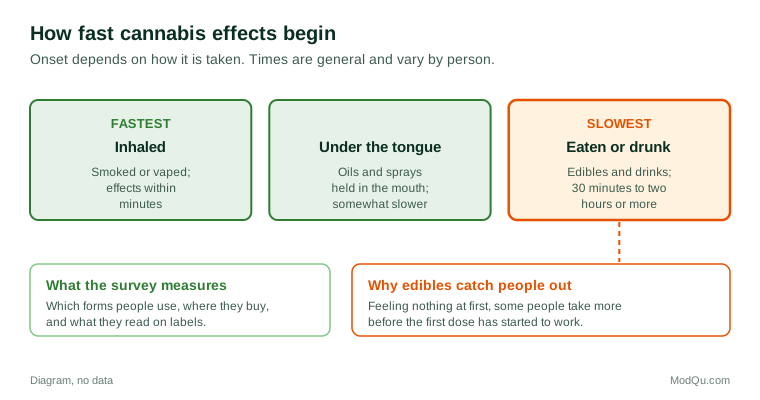
Each form acts differently. Smoked and vaped cannabis is felt within minutes. Edibles and drinks can take from 30 minutes to two hours or more to take effect and last longer, which is why people new to edibles are often warned not to take more too soon.
THC, CBD and labels
Cannabis contains many compounds called cannabinoids. The two best known are:
- THC (delta-9-tetrahydrocannabinol), which causes the "high".
- CBD (cannabidiol), which does not cause a high in the same way.
Legal products in Canada list the amount of THC and CBD on the label. Edibles are limited to 10 mg of THC per package. Packages must be plain, child-resistant and carry a standard red cannabis symbol and a health warning. Advertising and branding are tightly limited.
Example (hypothetical figures)
A package of gummies says it contains 10 mg of THC in total and holds 5 gummies. Each gummy therefore contains 2 mg of THC. A first-time user who eats three gummies because they feel nothing after 20 minutes has taken 6 mg, three times what they meant to take.
Legal and other sources
Since legalization, the share of cannabis bought from legal sources has grown, according to Statistics Canada surveys. People still buy from other sources, including unlicensed online sellers, unlicensed storefronts, dealers and friends. Some people grow their own where the province allows.
Reasons people give for buying legally include safety, knowing the THC content, convenience and wanting to stay within the law. Reasons for buying elsewhere include lower prices, habit, product choice and stronger products.
Example
A man who used cannabis before legalization kept buying from the same person for two years afterwards, out of habit and because it was cheaper. When a legal store opens a few blocks away, he tries it, finds the prices closer than he expected and likes knowing what he is buying. He switches for most purchases.
Questions that businesses and governments want answered include where people buy, why, and what would move more buyers to legal stores.
Prices and taxes
Legal cannabis is taxed in two ways: a federal excise duty, part of which is shared with the provinces, and the usual sales taxes. Some provinces add their own markups through their wholesale agencies. Prices vary by province, product and store, and have fallen in many places since the early years of legalization as more stores opened and competition grew. Value-priced products sold in larger sizes are now common alongside premium products.
Price is one of the main reasons people give for buying from unlicensed sources, so how legal prices compare with illegal ones is closely watched by governments and the industry. Surveys ask what people pay, how much they buy at a time and how they judge value.
Health and safety information
Health Canada and other public health bodies publish information about the risks of cannabis. Points commonly made include:
- Effects can include impaired attention, memory and coordination.
- Driving while impaired by cannabis is a criminal offence, and police can test drivers.
- Use that starts young and is frequent carries higher risks.
- Cannabis use during pregnancy is advised against.
- Edibles can be mistaken for ordinary food by children and pets, so storage matters.
- Some people develop problems with their use and may seek help.
Canada's Lower-Risk Cannabis Use Guidelines, developed by researchers and endorsed by health organizations, describe ways to reduce risks for people who choose to use. This page describes cannabis in general and is not medical advice.
Example
Parents who use edibles occasionally keep them in a locked box on a high shelf after reading about children eating gummies they mistook for candy. They also tell their teenagers the legal age and what they know about the risks, rather than avoiding the subject.
Use and attitudes
Who uses cannabis, how often and why vary widely. Some people use it occasionally at social events, some regularly to relax or help sleep, and some for medical reasons. Others have never used it and never would. Statistics Canada and Health Canada run regular surveys on cannabis use, and their results are widely cited in policy debates.
Attitudes have shifted as legal cannabis has become part of everyday life. Even so, people often under-report use, especially in face-to-face interviews, so survey wording and privacy matter a great deal.
What people disagree about
Debates about cannabis include whether legalization has worked, whether legal prices are low enough to compete with illegal sellers, how strong products should be allowed to be, how to keep cannabis away from young people, whether public consumption should be allowed, how impaired driving should be detected, and how cannabis compares with alcohol in risk.
Key terms
- THCDelta-9-tetrahydrocannabinol, the main compound in cannabis that causes a high.
- CBDCannabidiol, a compound in cannabis that does not cause a high in the same way.
- EdibleA cannabis product eaten or drunk, such as a gummy or beverage.
- Pre-rollA ready-made cannabis joint.
- OnsetThe time it takes for effects to begin.
- Licensed retailerA store authorized by the province to sell cannabis.
- Cannabis ActThe federal law that legalized adult non-medical cannabis in Canada in 2018.
- MicrodoseA very small dose, taken to feel mild effects or none.
Full glossary: medical cannabis compliance terms on EditingTests.com.
Cannabis vocabulary test
How well do you know the language of this topic? Try 8 quick questions. Your score is shown straight away and is not saved.
What the cannabis survey asks
This survey is part of ModQu's Leisure and Lifestyle survey. The cannabis part takes about five minutes and covers:
- Whether you have used cannabis in the last year, and how often.
- Which forms you use most: flower, pre-rolls, vapes, edibles, oils or others.
- Where you buy cannabis: legal stores, legal online, other sources or home-grown.
- Why you choose the source you use.
- What you look for on labels, such as THC and CBD content.
- Your views on how legalization has worked.
After that you can choose to continue with other short parts of the Leisure and Lifestyle survey, such as gambling and lotteries or tobacco and vaping, or stop.
Ready to take part?
Your answers help show what people really think and do. Results are only ever reported as totals; no one can see your individual answers.
Start the surveyQuestions about this survey
Who can take part?
Adults of legal age.
Do I have to give my name?
No. You may be asked for your age group, region and similar details so results can be broken down, but not your name. ModQu never asks for passwords, card numbers or account numbers.
How are the results used?
Answers are combined into totals and percentages and published in ModQu reports. Individual answers are never shown.
Is the vocabulary test part of the survey?
No. It is optional and separate, and your score is not stored.