
Share your experience of business travel
Tell us how often you travel for work, who books your trips and what the worst part is. Your answers are combined with other people's and reported only as totals.
Start the business travel surveyAbout 5 minutes. No account needed. You can stop at any time.
What this topic covers
Business travel means trips taken for work and paid for, at least in part, by an employer or a business. This topic covers:
- Meetings with clients, customers and partners.
- Internal meetings at other offices or with teams that work remotely.
- Conferences, trade shows and training.
- Site visits, inspections and installations.
- Sales trips.
- Travel by self-employed people and small business owners, who pay their own costs.
- Work in remote locations, such as mining camps and northern projects, which may involve regular rotations.
It covers how trips are booked, policies and expenses, and the experience of the traveller.
Why people travel for work
Even with video calls, many people and employers believe some work goes better in person:
- building and keeping relationships with clients;
- winning new business;
- complex negotiations;
- training and onboarding new staff;
- team building, especially for teams that usually work remotely;
- hands-on work that cannot be done from a distance;
- learning and networking at conferences.
Video meetings replaced much business travel during the COVID-19 pandemic. Business travel has returned since, but many organizations now travel less often or more selectively, and expect a clear reason for each trip.
Example
A software company with staff working from home across Canada brings each team together twice a year for three days. The company sees the trips as the main time for planning and getting to know new colleagues, while routine meetings stay on video.
Who books the trip
How a trip is booked depends on the size of the organization:
- Large employers often use a travel management company or a corporate booking tool, with negotiated rates and a travel policy built in.
- Medium-sized organizations may have an office administrator book travel, or let employees book themselves within a policy.
- Small businesses and self-employed people usually book themselves, often through the same sites and apps they use for personal travel.
Travellers often have mixed feelings about corporate booking tools. They help with policy and safety, but some people find them slower or more expensive than booking directly. Self-employed travellers, by contrast, have full freedom to choose but carry the whole cost themselves, and must keep receipts for tax purposes.
Travel policies and expenses
A travel policy sets rules for business trips. Common elements include:
- which class of travel is allowed for flights and trains;
- hotel price limits for different cities;
- daily allowances for meals, called per diems, or limits on meal expenses;
- whether employees can use their own car, and the rate paid per kilometre;
- approvals needed before booking;
- rules about points and loyalty programs;
- duty of care: the employer's responsibility for travellers' safety and wellbeing.
After the trip, employees submit expenses with receipts for reimbursement, or use a company credit card. Paperwork, lost receipts and slow reimbursement are common complaints, and many employers now use apps that let travellers photograph receipts on the spot.
Example (hypothetical figures)
An employee drives 320 km round trip to a client site and stays one night. Their employer pays $0.68 per kilometre for personal vehicle use, a $75 per diem for meals, and a hotel limit of $180. The claim is $217.60 for mileage, $75 for meals and $165 for the hotel, a total of $457.60. They wait three weeks to be reimbursed.
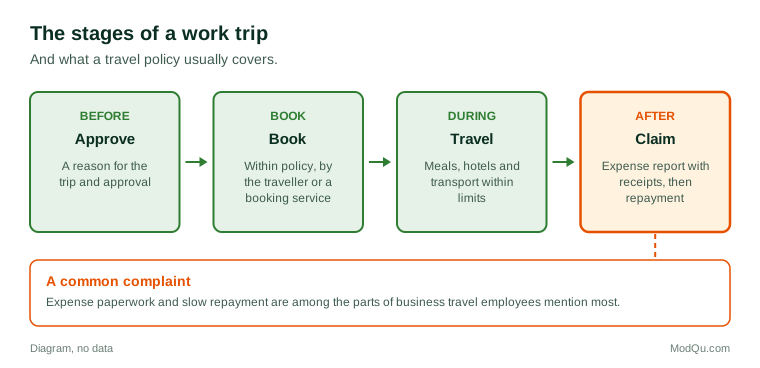
The hardest parts of business travel
Travellers often mention:
- early flights and long days, followed by evening work and dinners;
- delays and missed connections that cut into meetings or time at home;
- time away from family, especially for parents and carers;
- poor sleep in hotels and across time zones;
- eating well and exercising while away;
- catching up on regular work after the trip;
- safety concerns, for women travelling alone, LGBTQ+ travellers in some countries, and anyone visiting high-risk places;
- expense paperwork.
For frequent travellers, these can add up to stress and burnout. Some employers now pay attention to traveller wellbeing, for example by allowing a rest day after long flights or avoiding red-eye flights.
Example
A sales manager travels three weeks out of four. After missing a child's school concert because of a cancelled flight, they ask to reorganize their territory so that more meetings can be grouped into fewer trips. Their manager agrees, and they now travel two weeks a month.
Bleisure and extending trips
Bleisure, a mix of business and leisure, means adding personal time to a work trip, such as staying for a weekend in the city after a conference or bringing a partner. Employers usually pay only the business costs, and policies vary on whether this is allowed and how the costs are split. Many travellers say it makes travel feel more worthwhile.
Example
An engineer attends a three-day conference in another province that ends on a Thursday. Their partner flies in on Thursday evening at their own cost, and the couple stay until Sunday. The employer pays the original return flight and the conference nights, and the couple pay for the extra hotel nights and meals.
Costs, sustainability and the future
Business travel is a large cost for many organizations, and travel budgets are often among the first to be cut when money is tight. Organizations also face pressure to reduce emissions from travel, leading some to set travel budgets based on carbon, choose trains for shorter trips or limit flying for internal meetings.
Hotels, airlines and conference organizers watch business travel closely because business travellers often pay higher fares and rates, travel on weekdays and travel in all seasons. Questions these businesses want answered include how often employees expect to travel next year, which parts of the trip matter most to them, and what would make them choose one airline or hotel over another.
What people disagree about
Opinion is divided on whether in-person meetings are worth the cost, whether video meetings can replace most travel, whether employees should keep points earned on work trips, how much travel is reasonable to expect, and whether employers do enough for travellers' safety and wellbeing.
Key terms
- Travel policyAn employer's rules for booking and paying for work trips.
- Per diemA daily allowance for meals and incidental costs.
- Expense reportA claim for repayment of work costs, with receipts.
- Travel management companyA firm that books and manages travel for organizations.
- Duty of careAn employer's responsibility for travellers' safety and wellbeing.
- BleisureAdding personal leisure time to a business trip.
- Red-eye flightAn overnight flight that arrives early in the morning.
- Mileage rateThe amount paid per kilometre for using a personal vehicle for work.
Full glossary: travel technology terms on EditingTests.com.
Business travel vocabulary test
How well do you know the language of this topic? Try 8 quick questions. Your score is shown straight away and is not saved.
What the business travel survey asks
This survey is part of ModQu's Travel and Hospitality survey. The business travel part takes about five minutes and covers:
- How many work trips you took this year, and how long they were.
- Who books your travel, and which tools you use.
- What your employer's travel policy allows, and how you feel about it.
- What the worst part of business travel is for you.
- Whether you add leisure time to work trips.
- Whether you expect to travel more or less for work next year.
After that you can choose to continue with other short parts of the Travel and Hospitality survey, such as holiday and leisure travel or air travel, or stop.
Ready to take part?
Your answers help show what people really think and do. Results are only ever reported as totals; no one can see your individual answers.
Start the surveyQuestions about this survey
Who can take part?
Employees who travel for work.
Do I have to give my name?
No. You may be asked for your age group, region and similar details so results can be broken down, but not your name. ModQu never asks for passwords, card numbers or account numbers.
How are the results used?
Answers are combined into totals and percentages and published in ModQu reports. Individual answers are never shown.
Is the vocabulary test part of the survey?
No. It is optional and separate, and your score is not stored.
Can self-employed people take part?
Yes. If you travel for your own business, the survey asks how you book and pay for trips.