
Share your experience of business insurance
Tell us what business insurance you have, whether you use a broker and whether you have made a claim. Your answers are combined with other people's and reported only as totals.
Start the business insurance surveyAbout 5 minutes. No account needed. You can stop at any time.
What business insurance covers
Business insurance is a group of policies that pay for certain losses a business suffers or causes. Unlike personal insurance, it is usually built from several types of cover that match the business's activities, premises and risks. Many small businesses buy a package, sometimes called a business owner's policy or commercial package, that combines the most common types.
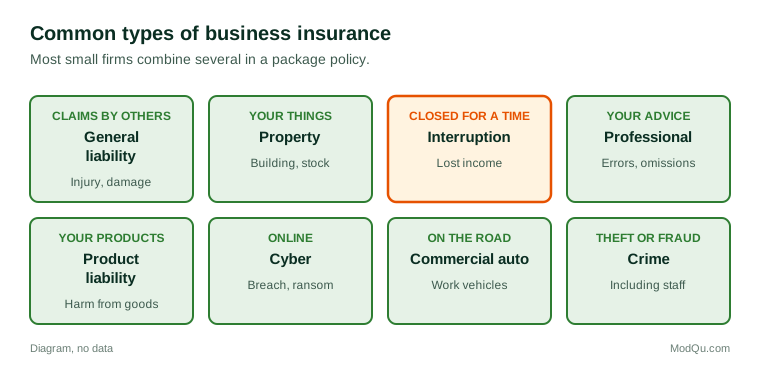
The main types are:
- Commercial general liability (CGL): covers claims that the business caused injury to someone or damage to their property, such as a customer slipping in a store.
- Commercial property: covers the building (if owned), equipment, stock and furniture against fire, theft and other named or covered events.
- Business interruption: covers lost income and ongoing costs when a covered event forces the business to close for a time.
- Professional liability (errors and omissions): covers claims that advice or professional services caused a client financial loss.
- Product liability: covers claims that a product the business made or sold caused harm.
- Cyber insurance: covers costs of data breaches, ransomware and other cyber incidents.
- Commercial auto: covers vehicles used for business.
- Equipment breakdown: covers sudden mechanical or electrical failure of machinery.
- Directors and officers (D&O): covers claims against the people who run a company.
- Crime and fidelity cover: covers theft or fraud, including by employees.
Workplace injury is usually handled separately. In Canada, most provinces and territories run workers' compensation boards that employers in covered industries must register with, rather than private insurance.
Who needs what
The right mix depends on the business. Some cover is required: commercial auto insurance is required by law for vehicles, and many landlords, clients, lenders and licensing bodies require proof of liability insurance. Professionals such as lawyers, accountants and some health practitioners must carry professional liability insurance through their regulator.
Example
A home-based bakery that sells at farmers' markets assumes its home insurance covers the business. When the market organizer asks for proof of $2 million in liability insurance, the owner learns that most home policies exclude business activity. She buys a small business policy with general and product liability and adds cover for her equipment.
Buying insurance: brokers, agents and direct
Businesses buy insurance in three main ways:
- Through a broker, who represents the business, compares policies from several insurers and helps with claims. In Canada, brokers are licensed by provincial regulators.
- Through an agent, who works for one insurer and sells its products.
- Directly from an insurer, often online for simple policies.
Many small businesses use a broker because business policies are complex and differ in what they cover. Industry associations sometimes offer group insurance programs for members. Owners often say they rely on their broker to explain what a policy covers, and many admit they have never read their full policy wording, which can run to dozens of pages.
What affects the price
Insurers set premiums based on the risk they are taking. Factors include:
- the type of business and its activities;
- revenue, payroll and number of employees;
- the location, building type and age, and fire protection;
- the value of property and stock;
- claims history;
- safety measures, such as alarms, sprinklers and training;
- the limits chosen and the size of the deductible.
Premiums can rise at renewal even without a claim, because of changes in the insurance market, more frequent severe weather, or higher costs to rebuild.
Example (hypothetical figures)
A small retail store pays a yearly premium of $2,400 for a package policy with a $1,000 deductible. Its broker quotes $2,040 if the store raises the deductible to $2,500, a saving of $360 a year. The owner works out that the saving would take more than four years to cover the extra $1,500 the store would pay out of pocket on a single claim, and keeps the lower deductible.
Making a claim
When a loss happens, the business usually contacts its broker or insurer as soon as possible, records the damage with photos and lists, takes steps to prevent further damage, and keeps receipts for emergency costs. An adjuster then assesses the claim and the amount payable under the policy.
Claims can be straightforward or long and disputed. Common points of disagreement include whether an event is covered, how property is valued (replacement cost or actual cash value), how much income was lost, and whether the business was underinsured. In Canada, the General Insurance OmbudService helps resolve some complaints with home, auto and business insurers, and provincial regulators also accept complaints.
Example
A burst pipe floods a dental clinic over a long weekend. The clinic is closed for three weeks. The property section of the policy pays to dry the building and replace damaged cabinets. The business interruption section pays part of the lost income, but the owner learns that the policy had a 72-hour waiting period and a limit that did not cover all staff wages.
Common gaps and problems
Owners often discover gaps only after a loss. Common examples include:
- running a business from home under a home policy;
- property limits that are too low to rebuild or replace equipment;
- no business interruption cover, or too short a period;
- no cyber cover, or limits too low for the cost of a breach;
- flood or earthquake not included in a property policy;
- liability limits below what clients now require;
- policies that have not been updated as the business grew or changed.
Reviewing a policy at each renewal with a broker, and when the business adds a location, product or service, is common practice.
Trends and debates
Trends include more businesses buying cyber insurance, stricter requirements from insurers for security measures, rising property premiums in areas with more frequent wildfires, floods and storms, and online buying of simple policies. Owners and insurers debate the cost of cover, how clearly policies explain exclusions, and whether pandemics and other wide events can be insured at all, a question raised by business interruption claims during the COVID-19 pandemic. Questions businesses want answered include what cover small firms hold, whether they use a broker, how premiums are changing and how claims were handled.
Key terms
- PremiumThe price paid for an insurance policy, usually yearly or monthly.
- DeductibleThe amount the business pays on a claim before the insurer pays.
- General liabilityCover for claims that the business caused injury or property damage.
- Business interruptionCover for lost income when a covered event forces a closure.
- Errors and omissionsProfessional liability cover for claims of faulty advice or service.
- BrokerA licensed professional who compares insurers on the client's behalf.
- AdjusterThe person who assesses a claim and how much is payable.
- ExclusionSomething a policy states it does not cover.
Full glossary: insurance brokerage terms on EditingTests.com.
Business insurance vocabulary test
How well do you know the language of this topic? Try 8 quick questions. Your score is shown straight away and is not saved.
What the business insurance survey asks
This survey is part of ModQu's Business and Professional Services survey. The business insurance part takes about five minutes and covers:
- What business insurance your business has, and what it covers.
- Whether you use a broker, an agent or buy directly.
- What you pay in premiums, and how that has changed.
- Whether you have made a claim, and how it was handled.
- Whether you have found a gap in your cover.
- What would make business insurance easier to understand or buy.
After that you can choose to continue with other short parts of the Business and Professional Services survey, such as small business owners or accounting and bookkeeping, or stop.
Ready to take part?
Your answers help show what people really think and do. Results are only ever reported as totals; no one can see your individual answers.
Start the surveyQuestions about this survey
Who can take part?
Small business owners.
Do I have to give my name?
No. You may be asked for your age group, region and similar details so results can be broken down, but not your name. ModQu never asks for passwords, card numbers or account numbers.
How are the results used?
Answers are combined into totals and percentages and published in ModQu reports. Individual answers are never shown.
Is the vocabulary test part of the survey?
No. It is optional and separate, and your score is not stored.