
Share your drinking habits
Tell us how often you drink alcohol, whether you have tried alcohol-free beer or wine and where you usually buy alcohol. Your answers are combined with other people's and reported only as totals.
Start the beer, wine and spirits surveyAbout 5 minutes. No account needed. You can stop at any time.
Who this topic is for
This topic is for adults of legal drinking age. In Canada, provinces and territories set the legal drinking age: 18 in Alberta, Manitoba and Québec, and 19 in the rest of the country. The survey is open only to people of legal drinking age where they live, including those who do not drink.
This page describes drinking habits and products. It does not encourage drinking, and it does not give health advice.
Kinds of alcoholic drinks
The main kinds of alcoholic drinks are:
- Beer: lagers, ales, stouts, sours and many more, from large breweries and from craft breweries, smaller independent brewers that grew rapidly in Canada in the 2010s.
- Wine: red, white, rosé, sparkling and fortified wines. Canada produces wine mainly in Ontario and British Columbia, with smaller industries in Québec and Nova Scotia, and is known for icewine.
- Spirits: whisky (including Canadian whisky, often called rye), vodka, gin, rum, tequila, brandy and liqueurs. Craft distilleries have also grown.
- Cider: fermented apples or other fruit, popular in several provinces.
- Ready-to-drink (RTD) beverages: pre-mixed cocktails, hard seltzers and coolers in cans or bottles, one of the fastest-growing categories in recent years.
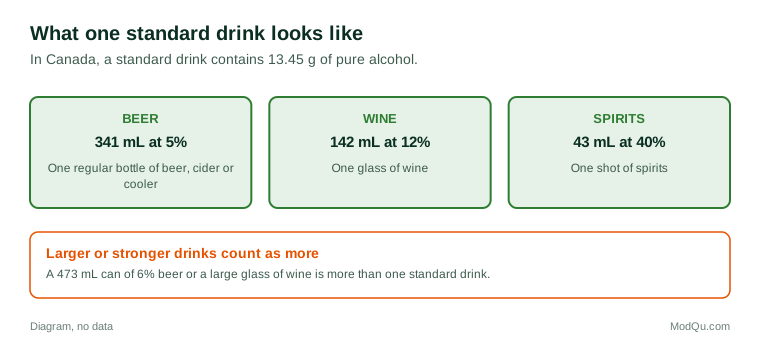
A standard drink in Canada contains 13.45 g of pure alcohol. That is about one 341 mL bottle of 5% beer, one 142 mL glass of 12% wine or one 43 mL shot of 40% spirits.
How drinking habits are changing
Drinking habits vary widely between people and over a lifetime. Some patterns and changes people often describe include:
- Drinking less: many adults say they are drinking less than before, for health, money, sleep or other reasons.
- Younger adults: surveys in several countries have found younger adults drinking less than earlier generations at the same age, although the reasons are debated.
- Mindful drinking: paying attention to how much and why one drinks.
- Taking breaks: such as a month without alcohol in January or October.
- Drinking at home more and in bars and restaurants less, partly because of cost.
- Trading up: drinking less but choosing more expensive drinks.
Example
A person in their thirties notices they are having two or three glasses of wine most weeknights while cooking and relaxing. After a month without alcohol, they decide to keep weeknights alcohol-free and have a drink or two on weekends. They say they sleep better and spend less, and they buy better wine for the weekends.
Questions that businesses want answered here include how often adults drink, what they drink, where they buy it, and how many are cutting down.
Low and no alcohol drinks
Low and no alcohol drinks have grown quickly. They include:
- Alcohol-free beer, which has improved a lot in taste and is now sold by many breweries;
- Alcohol-free or dealcoholized wine;
- Alcohol-free spirits and mocktails;
- Low-alcohol beers, wines and RTDs with less alcohol than standard versions.
In Canada, "non-alcoholic" or "alcohol-free" products generally contain no more than 0.5% alcohol by volume. People choose them to drink less while still taking part in social occasions, when driving, during pregnancy, for health or religious reasons, or because they like the taste.
How alcohol is sold in Canada
Alcohol sales are controlled by provinces and territories, so how people buy differs a lot across the country:
- In some provinces, a provincial liquor board runs most retail stores.
- In Alberta, retail alcohol sales are privatized.
- In others, there is a mix of government stores, private stores, and beer and wine sales in grocery and convenience stores. Ontario, for example, expanded beer, wine and ready-to-drink sales to convenience and more grocery stores in 2024.
- Breweries, wineries and distilleries often sell directly from their premises, and many provinces allow some online sales and delivery.
- Bars, pubs and restaurants sell under provincial licences.
Rules also differ on hours of sale, delivery, minimum prices and bringing alcohol across provincial borders, although several provinces have moved to ease interprovincial sales.
Example (hypothetical figures)
A shopper buys a 6-pack of 355 mL craft beer at 6% alcohol for $17.50. That is 6 × 355 = 2,130 mL of beer, containing 6% × 2,130 = 127.8 mL of pure alcohol, about 101 g at 0.789 g per mL. At 13.45 g per standard drink, the 6-pack holds about 7.5 standard drinks, so each can is about 1.25 standard drinks, at about $2.33 per standard drink.
Health guidance
In 2023 the Canadian Centre on Substance Use and Addiction published Canada's Guidance on Alcohol and Health. It describes health risks on a scale by the number of standard drinks per week, from low risk at two or fewer, to moderate risk at three to six, to increasingly high risk above that. It also says that drinking less is better, and that for some people, such as those who are pregnant, not drinking is safest. This replaced earlier, higher low-risk drinking guidelines from 2011.
The guidance received wide attention. Some people welcomed the clear information; others found it confusing or felt it did not match their experience. There have also been calls for health warnings on alcohol labels in Canada, as some other countries have adopted.
This page summarizes public guidance for information only. People with questions about their own drinking can speak to a health professional.
Example
A couple who have a bottle of wine together on Friday and Saturday nights read about the 2023 guidance and count their standard drinks for the first time. Two bottles of 12% wine shared between them comes to about 10 or 11 standard drinks a week between them, or about 5 each. They decide to share one bottle a week, and buy alcohol-free beer for other evenings.
What people disagree about
Alcohol raises lively debates:
- Health guidance: how strong public messages should be, and whether labels should carry health warnings.
- Access: whether alcohol should be sold more widely in grocery and convenience stores, or kept in fewer outlets.
- Price: whether minimum prices and taxes should be higher to reduce harm, or lower for consumers.
- Local producers: how to support Canadian breweries, wineries and distilleries, and whether interprovincial trade barriers should be removed.
- Social life: how to make social events welcoming for people who do not drink.
Key terms
- Standard drinkA drink containing 13.45 g of pure alcohol in Canada.
- Alcohol by volumeThe percentage of a drink that is alcohol, shown as ABV.
- Craft breweryA small, independent brewery.
- Ready-to-drinkPre-mixed alcoholic drinks sold in cans or bottles.
- Dealcoholized wineWine made normally, then with the alcohol removed.
- Mindful drinkingPaying attention to how much and why one drinks.
- Liquor boardA provincial or territorial body that controls alcohol sales.
- IcewineA sweet wine made from grapes frozen on the vine.
Full glossary: brewing distilling terms on EditingTests.com.
Beer, wine and spirits vocabulary test
How well do you know the language of this topic? Try 8 quick questions. Your score is shown straight away and is not saved.
What the beer, wine and spirits survey asks
This survey is part of ModQu's Food and Drink survey. The beer, wine and spirits part takes about five minutes and covers:
- How often you drink alcohol, and how many drinks on a typical occasion.
- Which kinds of drinks you choose most: beer, wine, spirits, cider or ready-to-drink.
- Whether you have tried alcohol-free or low-alcohol drinks, and what you thought.
- Where you usually buy alcohol.
- Whether your drinking has changed in the past year, and why.
- What you know about current health guidance on alcohol.
After that you can choose to continue with other short parts of the Food and Drink survey, such as eating habits or coffee, tea and beverages, or stop.
Ready to take part?
Your answers help show what people really think and do. Results are only ever reported as totals; no one can see your individual answers.
Start the surveyQuestions about this survey
Who can take part?
Adults of legal drinking age.
Do I have to give my name?
No. You may be asked for your age group, region and similar details so results can be broken down, but not your name. ModQu never asks for passwords, card numbers or account numbers.
How are the results used?
Answers are combined into totals and percentages and published in ModQu reports. Individual answers are never shown.
Is the vocabulary test part of the survey?
No. It is optional and separate, and your score is not stored.
I do not drink alcohol. Can I take part?
Yes, if you are of legal drinking age. Answers from people who do not drink help show how habits are changing.