
Share your back-to-school spending
Tell us how much you spent on back-to-school items, what the biggest cost was and where you shopped. Your answers are combined with other people's and reported only as totals.
Start the back-to-school shopping surveyAbout 5 minutes. No account needed. You can stop at any time.
What back-to-school shopping covers
The school year starts at different times around the world: in late summer in much of the Northern Hemisphere, around January or February in many Southern Hemisphere countries, and at other times elsewhere. Whenever it starts, families prepare with a similar list:
- Uniform or school clothes: shirts, trousers, skirts, jumpers, blazers, sportswear.
- Shoes: school shoes and trainers for sport.
- Bags: backpacks, lunch boxes, water bottles and pencil cases.
- Stationery: notebooks, pens, pencils, rulers, calculators, art supplies.
- Books and materials: textbooks or workbooks where families must buy them.
- Technology: laptops, tablets, headphones and software, increasingly required in some schools.
- Other costs: haircuts, name labels, sports equipment, instruments, and fees for trips or materials.
Some schools send families a detailed supply list; others provide most materials themselves.
What drives the cost
The total depends on:
- The child's age and stage: starting school, moving to secondary school or starting a new course often brings a full new set of items.
- Uniform rules: schools that require branded items from one supplier cost more than those that allow generic items from any shop.
- Growth: children who have outgrown last year's clothes and shoes need new ones.
- Technology requirements: a required laptop or tablet can be the largest single cost.
- Number of children: costs multiply, though hand-me-downs help.
- Country and school system: in some countries textbooks and supplies are free; in others families pay.
Example (hypothetical figures)
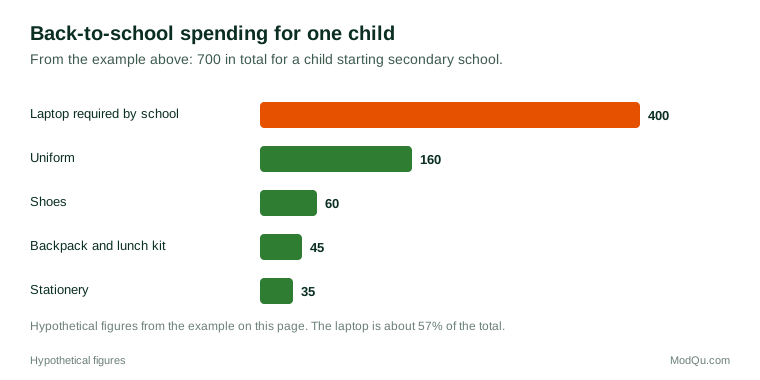
A family preparing one child for secondary school spends: 160 on uniform (including 70 for a branded blazer and jumper), 60 on shoes, 45 on a backpack and lunch kit, 35 on stationery and 400 on a laptop the school requires. The total is 700, and the laptop is 400 of it, about 57%.
Uniforms and school clothes
School uniforms are common in many countries across Asia, Africa, Latin America, the Caribbean, the United Kingdom, Ireland and Australia, and less common in others such as much of continental Europe and North America, where children usually wear their own clothes. Where uniforms are worn, families debate whether they save money, because children do not need fashionable clothes for school, or cost more, because items must come from particular suppliers. Some governments have issued guidance asking schools to limit branded items and allow cheaper generic options.
Example
A school changes its rules so that only the jumper must carry the school logo; plain trousers, skirts and shirts can be bought anywhere. A parent of two children buys the plain items at a supermarket and finds the change saves them a noticeable amount.
Where families shop
Back-to-school items are sold through:
- supermarkets and discount stores, which often run back-to-school promotions;
- clothing and shoe chains;
- specialist uniform shops and school suppliers;
- stationery and office supply shops;
- electronics shops for devices;
- online shops and marketplaces;
- second-hand uniform sales run by schools and parent groups.
Many families split their shopping: the uniform from a school supplier, the shoes from a shoe shop where feet can be measured, and stationery from a supermarket.
Timing
Some families shop months early to spread the cost and avoid crowds; others wait until the last week, partly so children have not grown out of new clothes before term starts. Retailers often run sales just before term. Some countries and states have tax-free shopping days for school supplies or clothing at certain times of year.
How families manage the cost
Common strategies include:
- reusing items from last year that are still in good condition;
- using hand-me-downs and second-hand uniform;
- buying store brands rather than branded items;
- setting a budget and a priority list;
- saving through the year or using a budget for school costs;
- buying in bulk with other families;
- applying for help from schools, local authorities or charities.
Several governments provide school clothing grants, free textbooks, device-loan schemes or back-to-school payments for families on low incomes; eligibility and amounts vary.
Example
A parent with three children keeps a box of outgrown uniform items in good condition. Before term, the younger children try on items from the box first, and the parent buys only what is missing. They also pick up two jumpers at the school's second-hand sale.
Starting school for the first time
Families preparing a child for their very first year of school often face the largest list. Along with uniform and a bag, they may need shoes suitable for school, a lunch box, a water bottle, indoor shoes, a change of clothes for younger children, name labels for everything and, in some countries, a set of supplies requested by the teacher. Some cultures mark the first day with special gifts, such as a decorated cone of sweets and school items given to children starting school in parts of central Europe. Moving to secondary school brings another peak, with new uniforms, more books and often a device.
Pressure and debates
- Brands and peer pressure. Children may want branded bags, shoes or pencil cases, and parents may feel pressure to buy them.
- Technology requirements. Some families struggle with the cost of required devices, and schools take different approaches, from lending devices to asking families to buy them.
- Hidden costs. Trips, materials fees and sports kit add to the start-of-year bill.
- Teacher spending. In some countries teachers report buying classroom supplies with their own money when families or schools cannot.
Questions that retailers, schools and policymakers want answered include what families spend, what they spend most on, where they shop and how many find the cost hard to meet.
Key terms
- Supply listA list from a school of the items each pupil needs to bring.
- Branded uniformSchool uniform items with the school's logo, often sold by one supplier.
- Generic uniformPlain uniform items that can be bought from any shop.
- School clothing grantMoney from a government or local authority to help families buy school uniforms.
- Device-loan schemeA program where a school lends laptops or tablets to pupils.
- Tax-free shopping dayA day when certain items, such as school supplies, are not taxed in some places.
- Second-hand uniform saleA sale of used uniform items, often run by schools or parent groups.
- Store brandProducts sold under a shop's own name, often cheaper than branded goods.
Full glossary: retail operations terms on EditingTests.com.
Back-to-school shopping vocabulary test
How well do you know the language of this topic? Try 8 quick questions. Your score is shown straight away and is not saved.
What the back-to-school shopping survey asks
This survey is part of ModQu's Parenting and Children survey. The back-to-school shopping part takes about five minutes and covers:
- How much you spent on back-to-school items for each child.
- What the biggest cost was: uniform, shoes, bags, stationery, books or devices.
- Where you shopped, and whether you shopped online, in store or second-hand.
- When you did most of your back-to-school shopping.
- How you kept costs down, and whether you received any help.
- How hard it was to meet the cost this year compared with last year.
After that you can choose to continue with other short parts of the Parenting and Children survey, such as baby products and nappies or baby food and formula, or stop.
Ready to take part?
Your answers help show what people really think and do. Results are only ever reported as totals; no one can see your individual answers.
Start the surveyQuestions about this survey
Who can take part?
Parents of school-age children.
Do I have to give my name?
No. You may be asked for your age group, region and similar details so results can be broken down, but not your name. ModQu never asks for passwords, card numbers or account numbers.
How are the results used?
Answers are combined into totals and percentages and published in ModQu reports. Individual answers are never shown.
Is the vocabulary test part of the survey?
No. It is optional and separate, and your score is not stored.
Do all schools require uniforms?
No. Uniforms are common in some countries and rare in others, and rules vary between schools in the same country.
Is help available with back-to-school costs?
In some places governments, councils, schools or charities offer grants, free textbooks or device loans to families on low incomes.