
Share your experience of AI chatbots
Tell us whether you have used an AI chatbot, what you used it for and how much you trust its answers. Your answers are combined with other people's and reported only as totals.
Start the ai chatbots and assistants surveyAbout 5 minutes. No account needed. You can stop at any time.
What AI chatbots and assistants are
An AI chatbot is a computer program that holds a conversation in ordinary language. Many current chatbots are based on large language models, systems trained on very large amounts of text to predict and generate language. They can answer questions, write and edit text, translate, summarise documents, help with coding, and in some cases work with images, audio and files.
Voice assistants on phones, smart speakers, cars and TVs respond to spoken commands, such as setting reminders, playing music, controlling smart home devices and answering simple questions. Newer assistants increasingly use the same kind of language model as chatbots.
AI assistants are also built into other software: email and document tools, search engines, customer service chats, phones' keyboards and photo apps. Many people use AI features without thinking of them as "using a chatbot".
What people use them for
Common uses include:
- Answering questions and explaining topics.
- Writing: drafting emails, messages, letters, reports and social media posts.
- Editing: improving grammar, tone and clarity.
- Summarising long documents, articles or meetings.
- Learning: explanations, practice questions and language learning.
- Work tasks: brainstorming, planning, coding and analysing data.
- Everyday help: recipes, travel plans, gift ideas and comparing options.
- Translation between languages.
- Conversation and company, which some people use for practice or to feel less alone.
Example
A small business owner who finds writing difficult uses a chatbot to turn notes into a polite email to a customer about a delayed order. They read the draft, change one detail the chatbot got wrong about the delivery date, and send it.
How far people trust the answers
Chatbots can produce fluent, confident answers that are wrong. This is often called hallucination: the tool states something false as if it were true, such as inventing a reference, a quotation or a fact. Answers may also be out of date, incomplete or reflect biases in the data the model was trained on.
People's trust varies:
- some check important answers against other sources;
- some trust answers for low-stakes tasks, such as recipes, but not for health, legal or money questions;
- some trust answers too much because they sound authoritative;
- some avoid chatbots altogether because of accuracy concerns.
Health, legal and financial bodies generally advise treating chatbot answers as a starting point, not a substitute for professional advice.
Example (hypothetical figures)
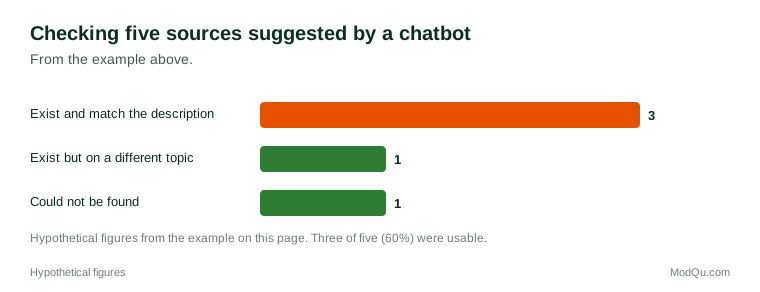
A student asks a chatbot for five sources on a history topic. When they look them up in the library catalogue, 3 exist and match the description, 1 exists but is about a different topic, and 1 cannot be found at all. Only 3 of the 5 (60%) are usable, so they ask the librarian for help with the rest.
Getting better results
People who use chatbots often find that the way they ask makes a difference. Common tips include giving context, saying who the answer is for, asking for a particular format, breaking large tasks into steps and asking the tool to show its sources. Many users treat the first answer as a draft and ask follow-up questions. Some services let people upload documents so that answers are based on a specific text, which can reduce but not remove errors.
Work and study
Many workplaces and schools are working out rules for AI tools. Some encourage their use for drafting and research; some limit what information can be entered, to protect confidential data; some ban them for certain tasks. In education, schools and universities differ on whether students may use chatbots for assignments and how use must be declared. Teachers report both benefits, such as personalised explanations, and problems, such as students submitting AI-written work as their own.
Example
A company allows staff to use an approved AI assistant for drafting documents but forbids pasting customer names or account details into it. Staff are asked to check facts and figures in any AI-drafted text before sending it.
Privacy and data
What happens to information typed into a chatbot depends on the service and its settings. Some services may store conversations, use them to improve their models, or have staff review them, while others offer settings to turn this off or business versions that do not use customer data for training. People are often advised not to share sensitive personal, medical, financial or confidential work information unless they understand how it will be handled. Data protection authorities in several countries have examined how AI services handle personal data.
Concerns and debates
People raise many concerns:
- Accuracy and hallucinations.
- Misinformation, including AI-generated text, images and audio used to mislead.
- Jobs: whether AI will replace or change work.
- Learning: whether relying on AI weakens people's own skills.
- Bias in answers.
- Copyright questions about training data and AI-generated content.
- Energy use of large AI systems.
- Emotional reliance on chatbots for company.
- Safety and misuse.
Governments and international bodies are developing rules for AI. The European Union has adopted an AI Act, and other countries have introduced guidelines, voluntary codes or their own laws. Views differ on how strict rules should be.
How use is changing
Use of AI chatbots has grown quickly since they became widely available, and features change frequently. Questions that technology companies, employers, educators and governments want answered include who uses AI chatbots, for which tasks, how often, how much they trust them, and what would make them use these tools more or less.
Key terms
- AI chatbotA computer program that holds a conversation in ordinary language.
- Large language modelAn AI system trained on large amounts of text to understand and generate language.
- Voice assistantSoftware that responds to spoken commands on phones, speakers and other devices.
- PromptThe instruction or question a person gives an AI tool.
- HallucinationWhen an AI tool states something false as if it were true.
- Training dataThe material used to build an AI model.
- BiasA systematic slant in results, which can come from training data or design.
- AI ActThe European Union's law regulating artificial intelligence.
Full glossary: conversational ai terms on EditingTests.com.
AI chatbots and assistants vocabulary test
How well do you know the language of this topic? Try 8 quick questions. Your score is shown straight away and is not saved.
What the ai chatbots and assistants survey asks
This survey is part of ModQu's Digital Life and the Internet survey. The ai chatbots and assistants part takes about five minutes and covers:
- Whether you have used an AI chatbot or voice assistant, and how often.
- What you used it for: questions, writing, learning, work, translation or other tasks.
- How much you trust its answers, and whether you check them.
- Whether you have noticed mistakes or invented information.
- Whether your workplace or school has rules about AI tools.
- What concerns you most about AI chatbots.
After that you can choose to continue with other short parts of the Digital Life and the Internet survey, such as internet use habits or search engines, or stop.
Ready to take part?
Your answers help show what people really think and do. Results are only ever reported as totals; no one can see your individual answers.
Start the surveyQuestions about this survey
Who can take part?
Adults.
Do I have to give my name?
No. You may be asked for your age group, region and similar details so results can be broken down, but not your name. ModQu never asks for passwords, card numbers or account numbers.
How are the results used?
Answers are combined into totals and percentages and published in ModQu reports. Individual answers are never shown.
Is the vocabulary test part of the survey?
No. It is optional and separate, and your score is not stored.
Do I need to pay to use an AI chatbot?
Many services offer free versions with limits, and paid plans with more features or usage. Some AI features are built into apps people already use.
Are AI chatbots always right?
No. They can give fluent answers that are wrong or out of date, so checking important information against reliable sources is widely advised.
Is it safe to type personal information into a chatbot?
It depends on the service and its settings. Many experts advise not sharing sensitive personal, financial or confidential information unless you know how it will be used.