
Share your plans for later life
Tell us where you expect to live as you age, what help you or your relatives use and what would help you stay at home longer. Your answers are combined with other people's and reported only as totals.
Start the ageing and senior living surveyAbout 5 minutes. No account needed. You can stop at any time.
What ageing and senior living covers
This topic is about where and how people live as they grow older, and the help they use along the way. It includes plans made in middle age, changes to a home, help from family, paid home care, community programs, retirement residences, assisted living and long-term care homes. It also covers the role of adult children, who often help parents find and pay for care.
Ageing is not one stage. A healthy, active 66-year-old and a frail 92-year-old have very different needs. Many people move through several living arrangements over their later years, sometimes slowly and sometimes after a sudden event such as a fall, a stroke or the death of a spouse.
Ageing in place
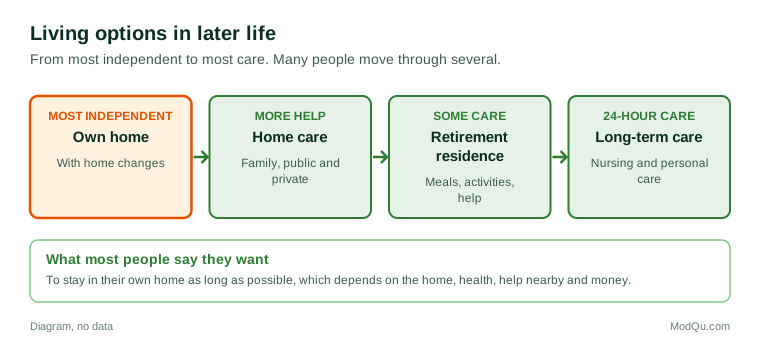
Ageing in place means staying in one's own home and community for as long as possible. Surveys in Canada and other countries consistently find that this is what most older adults say they want. Making it work often depends on:
- The home itself: stairs, bathroom layout, entrances and lighting.
- Health and mobility, and whether conditions are stable or changing.
- Help nearby: a spouse, children, friends or neighbours.
- Transportation once driving becomes difficult.
- Money for repairs, changes and paid help.
Common home changes include grab bars, walk-in showers, stair lifts, ramps, better lighting, and moving a bedroom to the main floor. Some people downsize to a smaller home, a condominium or a bungalow while they are still able to manage the move.
Example
A couple in their early seventies live in a two-storey house with the only bathroom upstairs. After one of them has a knee replacement, they add a main-floor bathroom and move their bedroom to the den. They say the change cost less than they feared and lets them stay in the neighbourhood where their friends live.
Help at home
When people need more help, it can come from several sources:
- Family and friends, who provide much of the care older adults receive, often without pay.
- Publicly funded home care, arranged in Canada through provincial and territorial health systems, which may include nursing, personal support and therapy, with eligibility and hours set by assessment.
- Private home care paid by the person or family, for extra hours, housekeeping or companionship.
- Community services such as meal delivery, adult day programs, transportation and friendly visiting.
- Technology, including medical alert devices, medication reminders and video calls.
Waiting lists, limits on publicly funded hours and the cost of private care are common concerns. Families often combine several sources to cover the week. Many people also do not know what publicly funded help exists or how to ask for an assessment, which is why hospital discharge planners, family doctors and community agencies often become the starting point.
Example (hypothetical figures)
An 85-year-old receives 7 hours a week of publicly funded personal support. Her daughter wants a total of 20 hours of help so she can keep working. They hire a private agency for the remaining 13 hours at $35 an hour, which costs $455 a week, or about $1,970 a month over 4.33 weeks.
Retirement residences and assisted living
Retirement residences (often called retirement homes in Canada and independent or assisted living in the United States) are private homes for older adults who can live mostly on their own but want meals, social activities, housekeeping and someone on hand if something goes wrong. Many offer levels of care, from independent apartments to assisted living with help in bathing, dressing and medication.
Residences are usually paid for privately, and rent depends on the size of the suite, the location and the care package. In several provinces they are licensed or regulated by a provincial body. People choose a residence by visiting, eating a meal there, asking about extra charges and checking what happens if their needs increase.
Long-term care
Long-term care homes (also called nursing homes) provide 24-hour nursing and personal care for people who can no longer live safely at home or in a residence. In Canada, admission is usually arranged through a provincial or regional health authority after an assessment, and residents pay an accommodation fee set by the province, with the care itself publicly funded. Waiting times can be long, and people may not get their first choice of home.
The COVID-19 pandemic drew wide attention to conditions in long-term care, including staffing, shared rooms and infection control, and led to reviews and reforms in several provinces.
Example
After a fall and a hospital stay, a 90-year-old man cannot return home safely. The hospital arranges an assessment, and he is placed in a long-term care home 40 minutes from his family while he waits for a bed closer to them. His son visits twice a week and says the hardest part was making decisions quickly while his father was in hospital.
How families decide
Decisions about later life are often made by several people at once: the older person, a spouse, adult children and sometimes health professionals. Common points of tension include safety versus independence, who provides care, how to pay, and whether to move closer to family. Some families plan years ahead; many make decisions during a crisis.
Legal and financial planning often runs alongside these choices, such as naming a substitute decision-maker through a power of attorney for personal care and for property, or the equivalent in each province. This page describes these arrangements in general and is not legal or financial advice.
Trends and debates
Several changes are shaping senior living:
- an ageing population in Canada, the United States and many other countries;
- more interest in home care and community supports over institutional care;
- new housing models, such as co-housing, life-lease buildings and naturally occurring retirement communities;
- staff shortages in home care and long-term care;
- debate over the balance of public and private funding, and over for-profit ownership of care homes.
Questions businesses and planners want answered include where people expect to live at 80, what they would need to stay home, how many adult children help their parents and what people know about the cost of residences and care.
Key terms
- Ageing in placeStaying in one's own home and community while growing older.
- Home careHealth and support services provided in a person's home.
- Personal support workerA trained worker who helps with bathing, dressing and daily tasks.
- Retirement residenceA private home for older adults offering meals, activities and some care.
- Long-term care homeA home providing 24-hour nursing and personal care.
- Respite careShort-term care that gives a family caregiver a break.
- Power of attorneyA legal document naming someone to make decisions if a person cannot.
- DownsizingMoving to a smaller or easier home.
Full glossary: senior living services terms on EditingTests.com.
Ageing and senior living vocabulary test
How well do you know the language of this topic? Try 8 quick questions. Your score is shown straight away and is not saved.
What the ageing and senior living survey asks
This survey is part of ModQu's Life Stages and Family survey. The ageing and senior living part takes about five minutes and covers:
- Where you live now, and where you expect to live at 80.
- Whether you help care for an older relative, and what kind of help you give.
- Which services you or your relative use: home care, meals, day programs or others.
- What changes you have made, or would make, to your home.
- What you would need to stay at home longer.
- How you would decide on a retirement residence or care home.
After that you can choose to continue with other short parts of the Life Stages and Family survey, such as weddings and celebrations or end-of-life planning, or stop.
Ready to take part?
Your answers help show what people really think and do. Results are only ever reported as totals; no one can see your individual answers.
Start the surveyQuestions about this survey
Who can take part?
Adults aged 55 and over, and adult children of older parents.
Do I have to give my name?
No. You may be asked for your age group, region and similar details so results can be broken down, but not your name. ModQu never asks for passwords, card numbers or account numbers.
How are the results used?
Answers are combined into totals and percentages and published in ModQu reports. Individual answers are never shown.
Is the vocabulary test part of the survey?
No. It is optional and separate, and your score is not stored.