
Share how your business keeps its books
Tell us who does your bookkeeping, which software you use and what you find hardest about finances. Your answers are combined with other people's and reported only as totals.
Start the accounting and bookkeeping surveyAbout 5 minutes. No account needed. You can stop at any time.
Bookkeeping and accounting: the difference
Bookkeeping is the day-to-day recording of a business's financial transactions: sales, purchases, payments, receipts, payroll and bank activity. It produces organized, up-to-date records.
Accounting uses those records to prepare financial statements, file tax returns, give advice on taxes and structure, and help owners understand how the business is doing. Accountants may also review or audit statements for lenders or investors.
In a small business, the two often blend. An owner may do bookkeeping in the evenings and send the year's records to an accountant for the tax return. Larger small businesses may have an in-house bookkeeper and an outside accounting firm.
What has to be tracked
A business's books usually cover:
- Income: sales, invoices sent and payments received.
- Expenses: supplies, rent, utilities, vehicles, advertising, professional fees and more.
- Receipts and invoices to support each expense.
- Bank and credit card statements, matched to the records.
- Sales tax: GST/HST collected and paid, plus provincial sales tax where it applies.
- Payroll: wages, source deductions, vacation pay and year-end slips.
- Assets and debts: equipment, vehicles, loans and amounts owed to and by the business.
- Inventory, for businesses that sell goods.
The Canada Revenue Agency requires businesses to keep books and records, generally for six years, so that income and expenses can be verified. Similar rules apply in the United States and other countries.
Who does the work
Owners use several approaches:
- The owner does it, often with software, a spreadsheet or a shoebox of receipts.
- A family member or partner keeps the books.
- An employee handles bookkeeping as part of an office role.
- A freelance or contract bookkeeper works monthly or quarterly.
- An accounting firm does bookkeeping, payroll and year-end work together.
- Online bookkeeping services work remotely using shared software.
Choice depends on cost, the owner's comfort with numbers, the business's size and how complicated its finances are.
Example
A freelance graphic designer kept her books in a spreadsheet for three years and gave it to an accountant each spring. When she registered for GST/HST and started hiring a part-time assistant, the spreadsheet became hard to manage. She now uses accounting software, and a bookkeeper checks it once a quarter.
Software and tools
Accounting software has moved largely online. Typical features include:
- creating invoices and tracking who has paid;
- connecting to bank and card accounts so transactions appear automatically;
- matching transactions to categories;
- photographing receipts with a phone;
- calculating sales tax;
- running payroll, or connecting to a payroll service;
- producing reports such as profit and loss statements and balance sheets.
Owners choose software by price, ease of use, what their accountant prefers, and whether it connects with their point-of-sale system, online store or bank. Switching software is often avoided because of the work of moving past records.
Deadlines and year-end
Key dates in a small business's financial year include sales tax filing periods (monthly, quarterly or yearly depending on the business), payroll remittance dates, the deadline for employee tax slips, instalment payments, and the income tax return. For sole proprietors and partners in Canada, business income is reported on the personal tax return; corporations file a separate corporate return. This page describes these in general and does not give tax advice.
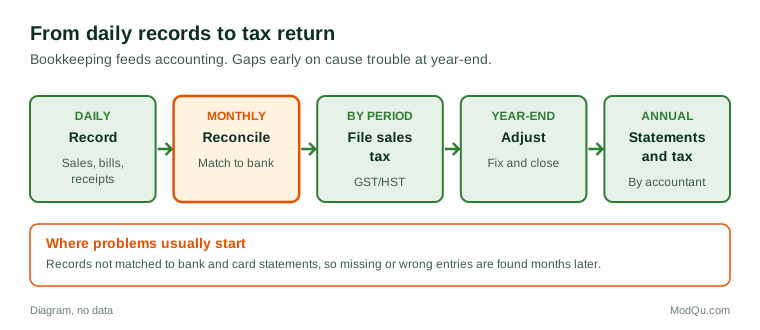
Year-end is the busiest time for many owners and accountants. Records are reconciled, missing receipts are found, and adjustments are made before statements and tax returns are prepared.
Example (hypothetical figures)
A small retailer in Ontario, where HST is 13%, makes $120,000 in taxable sales in a year and collects $15,600 in HST. It pays $6,500 in HST on its own business purchases, which it can claim as input tax credits. It remits the difference, $15,600 minus $6,500, which is $9,100. The owner had spent part of the collected tax on stock and has to find the money at filing time.
Payroll
Once a business has employees, payroll becomes one of its most regular financial tasks. Each pay period the employer calculates gross pay, withholds income tax, Canada Pension Plan contributions and Employment Insurance premiums (with Quebec having its own pension and parental insurance plans), adds its own employer share, and sends the total to the Canada Revenue Agency by set dates. Employers also track vacation pay and statutory holidays under provincial employment standards, and issue T4 slips after the year ends.
Many small businesses use a payroll service or the payroll feature in their accounting software to reduce errors, since late or wrong remittances can lead to penalties.
Choosing an accountant or bookkeeper
Owners often find an accountant through a recommendation from another owner, a bank or a family member. In Canada, Chartered Professional Accountants (CPAs) are regulated by provincial bodies; bookkeepers do not need a licence, though some hold certifications from professional associations. Owners commonly look at:
- experience with their industry and business size;
- whether the firm offers bookkeeping, payroll and tax under one roof;
- fees, and whether they are fixed or hourly;
- how quickly the firm responds to questions;
- which software the firm works with.
Example
A contractor whose accountant retires asks three other tradespeople who they use. Two recommend the same small firm, which works with the contractor's software and charges a fixed monthly fee for bookkeeping review plus a year-end fee. He says the fixed fee made him more willing to call with questions.
Common pain points
Owners often say the hardest parts of managing finances are:
- finding time to keep records up to date;
- understanding tax rules and what counts as a business expense;
- keeping business and personal spending separate;
- chasing unpaid invoices;
- setting money aside for sales tax and income tax;
- understanding financial reports well enough to make decisions;
- the cost of professional help.
Example
A restaurant owner sends a box of receipts to the accountant every April. In one year the accountant finds that several months of supplier invoices were never recorded and a sales tax return was filed late, leading to interest. The owner hires a bookkeeper to come in every two weeks.
Trends and debates
Trends include automation of data entry, bank feeds, receipt scanning, and accountants offering advisory services alongside tax returns. Many accountants work with clients entirely online. Debates include whether automation will reduce the need for bookkeepers, how far owners can rely on software without professional review, and how simple tax rules for small businesses should be. Questions businesses want answered include who does the bookkeeping, which software is used, how much owners pay for help and what they find hardest.
Key terms
- BookkeepingDay-to-day recording of a business's financial transactions.
- ReconciliationChecking that records match bank and card statements.
- Accounts receivableMoney customers owe the business.
- Accounts payableMoney the business owes suppliers.
- Input tax creditA credit for GST/HST a business paid on its own purchases.
- Profit and loss statementA report of income minus expenses over a period.
- Balance sheetA report of what a business owns and owes at a point in time.
- Fiscal yearThe 12-month period a business uses for its accounts.
Full glossary: accounting software platforms terms on EditingTests.com.
Accounting and bookkeeping vocabulary test
How well do you know the language of this topic? Try 8 quick questions. Your score is shown straight away and is not saved.
What the accounting and bookkeeping survey asks
This survey is part of ModQu's Business and Professional Services survey. The accounting and bookkeeping part takes about five minutes and covers:
- Who does your business's bookkeeping, and how often.
- Which accounting software or tools you use.
- Whether you use an accountant, and for what.
- What you pay for bookkeeping and accounting help.
- What you find hardest about managing the business's finances.
- What would make bookkeeping easier for you.
After that you can choose to continue with other short parts of the Business and Professional Services survey, such as small business owners or marketing and advertising, or stop.
Ready to take part?
Your answers help show what people really think and do. Results are only ever reported as totals; no one can see your individual answers.
Start the surveyQuestions about this survey
Who can take part?
Small business owners and managers.
Do I have to give my name?
No. You may be asked for your age group, region and similar details so results can be broken down, but not your name. ModQu never asks for passwords, card numbers or account numbers.
How are the results used?
Answers are combined into totals and percentages and published in ModQu reports. Individual answers are never shown.
Is the vocabulary test part of the survey?
No. It is optional and separate, and your score is not stored.