
Statistics · Communication and misuse
Official Statistics: Independence, Trust and Quality Standards
What makes official statistics trustworthy, how international principles and codes protect their independence and quality, and what businesses using census, labour market and economic data should know.
Businesses rely on official statistics every day, often without noticing. Population estimates set the weighting targets for consumer surveys. Consumer price indices adjust contracts and wages. Labour force figures, retail sales and gross domestic product (GDP) shape investment decisions and interest rates. These numbers are useful only if users can trust that they were produced competently, honestly and without political interference. This article explains the principles and standards that national statistical offices follow to earn that trust, and what they mean for anyone who uses official data.
What makes statistics "official"
Official statistics are the statistics produced by national statistical offices and other public bodies as a public good: information about the economy, society and environment made available to governments, businesses and citizens alike. Their value depends on a peculiar feature. Most users cannot check them. A retailer cannot recount the population or recompute the consumer price index, so it must rely on the producer's competence and integrity.
Porter (1995) argues that quantification became central to public life precisely because numbers produced under impersonal, rule-bound procedures can command trust among strangers. Desrosières (1998) shows how national statistical systems grew up alongside the modern state, and how the categories they use, such as unemployment or social class, are the result of administrative and political choices as well as technical ones. Both points matter. Official statistics are powerful because they appear objective, and that power creates a temptation to influence them.
Fellegi (1996), then Chief Statistician of Canada, argued that an effective statistical system needs not only technical skill but also relevance to users, credibility, a strong legal and institutional basis, and a reputation for independence built up over time. Holt (2008) makes the link explicit: public trust depends on the integrity of the producing institution, the quality of its statistics and the way they are communicated, and once lost it is very hard to recover.
The UN Fundamental Principles of Official Statistics
The most widely recognised international statement of these ideas is the United Nations Fundamental Principles of Official Statistics. First developed in Europe in the early 1990s and adopted by the UN Statistical Commission in 1994, they were endorsed by the UN General Assembly in January 2014 (United Nations General Assembly, 2014). The ten principles can be summarised as follows:
- Relevance, impartiality and equal access. Official statistics are compiled and made available on an impartial basis to honour citizens' entitlement to public information.
- Professional standards and ethics. Methods and procedures are decided on strictly professional grounds, including scientific principles and professional ethics.
- Accountability and transparency. Agencies present information on sources, methods and procedures.
- Prevention of misuse. Agencies are entitled to comment on erroneous interpretation and misuse of statistics.
- Sources of official statistics. Data may come from all types of sources, chosen with regard to quality, timeliness, cost and the burden on respondents.
- Confidentiality. Individual data are strictly confidential and used exclusively for statistical purposes.
- Legislation. The laws and regulations under which statistical systems operate are made public.
- National coordination among statistical agencies.
- Use of international standards, concepts and classifications.
- International cooperation.
The first two principles carry the idea of independence: decisions about what to measure, how to measure it and when to publish should rest with statisticians, not ministers. The sixth carries the idea that underpins respondents' willingness to take part: what they report will never be used against them.
Codes of practice
Principles become operational through codes of practice. The European Statistics Code of Practice, first adopted in 2005 and most recently revised in 2017, sets out 16 principles in three groups covering the institutional environment, statistical processes and statistical output (Eurostat, 2018). Each principle is backed by indicators of good practice against which national statistical authorities are peer-reviewed (Figure 1).
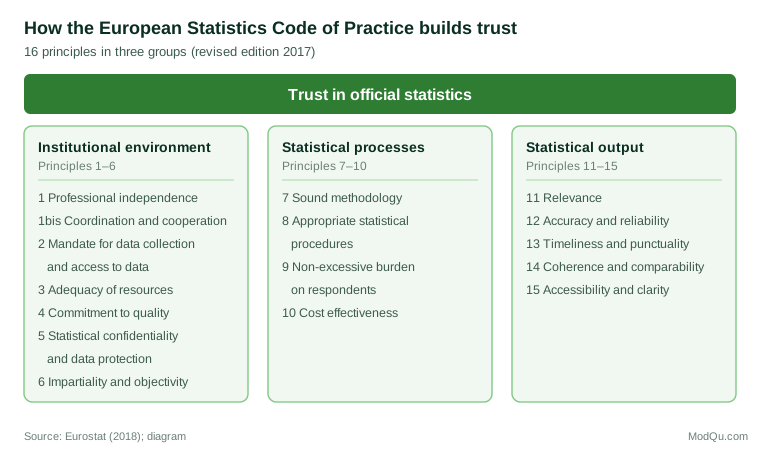
Professional independence comes first for a reason. The code expects the head of the statistical authority to be appointed on professional competence, statistical release calendars to be published in advance, and any privileged pre-release access to be limited, controlled and publicised. Impartiality means that all users receive releases at the same time, and that errors are corrected and announced openly.
The Recommendation of the Council on Good Statistical Practice of the OECD (2015) sets out comparable expectations for its member countries, including a clear legal and institutional framework, professional independence, adequate resources, protection of confidentiality, and quality commitments covering methods, timeliness and accessibility. In the United Kingdom, the Code of Practice for Statistics (UK Statistics Authority, 2018) is built on three pillars: trustworthiness, quality and value. In the United States, the National Academies of Sciences, Engineering, and Medicine (2021) set out principles that include relevance to policy issues, credibility among data users, trust among the public and data providers, and independence from political and other undue external influence.
Quality: more than accuracy
Statistical quality is often equated with accuracy, but official statisticians use a broader, user-focused definition. Brackstone (1999) described six dimensions of data quality that a statistical agency must manage: relevance, accuracy, timeliness, accessibility, interpretability and coherence. Statistics Canada (2019) uses a closely related set in its quality guidelines, as does the European code's output principles. The dimensions often pull against each other:
| Dimension | Question for the user | Typical trade-off |
|---|---|---|
| Relevance | Does it measure what I need? | New topics cost money and respondent time |
| Accuracy and reliability | How close is it to the true value? | Higher accuracy needs larger samples and more time |
| Timeliness and punctuality | Is it available soon enough, and on schedule? | Early estimates use less complete data |
| Accessibility and clarity | Can I find, obtain and understand it? | Detail must be balanced against confidentiality |
| Interpretability | Are concepts and methods documented? | Documentation takes effort that users rarely see |
| Coherence and comparability | Does it fit with other statistics and over time? | Methodological improvements can break time series |
Accuracy itself has many components. The total survey error framework separates sampling error from errors of coverage, nonresponse, measurement and processing (Biemer, 2010; Groves & Lyberg, 2010). Statistics Canada (2010) sets out how each is controlled in practice, from frame construction to editing and imputation. A quality report that states only a margin of error therefore describes only part of the uncertainty.
Revisions are a feature, not a flaw
Timeliness and accuracy meet most visibly in revisions. Early estimates of GDP, employment or retail sales are based on incomplete returns and are revised as more data arrive. Well-run statistical offices plan these revisions, announce them in advance and publish analyses of their size and direction. Figure 2 shows the pattern for a hypothetical quarter.
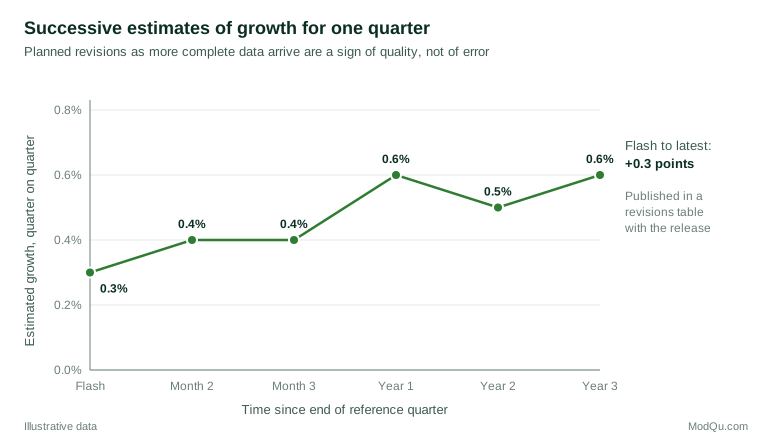
For users, the lesson is to treat early estimates as provisional, to check the revisions history before reacting to small changes, and to record which vintage of a series was used in any analysis.
When independence fails
The importance of these safeguards is clearest when they are absent. In January 2010 the European Commission reported on Greek government deficit and debt statistics after the Greek authorities had revised their planned deficit ratio for 2009 from 3.7% to 12.5% of GDP. The report found severe irregularities in the data reported to the European Union and identified weaknesses in the institutional set-up, including a lack of independence and accountability of the bodies involved (European Commission, 2010). The episode showed how quickly confidence in a country's statistics, and in its public finances, can collapse when institutional safeguards are weak.
Interference rarely needs to be dramatic. Delaying an unfavourable release, changing a definition without explanation, briefing selected journalists early or cutting a statistical programme's budget can each erode confidence. That is why codes of practice focus as much on institutional arrangements as on methods.
Trust is earned, measured and fragile
Trust in official statistics depends on the trustworthiness of the producer, not just the accuracy of individual numbers. The OECD (2017) guidelines on measuring trust treat trust in institutions as something that can itself be measured through surveys, and many statistical offices now monitor public confidence in their own outputs. The American Statistical Association (2022) ethical guidelines add a professional dimension: statisticians should report results honestly, disclose methods and limitations, and resist pressure to produce particular conclusions.
Pressures are also changing. Response rates to household surveys have fallen, and statistical offices are making more use of administrative and transaction data (Groves, 2011). Citro (2014) argues that agencies must move from a survey-centred model to one that combines multiple data sources. Hand (2018) points out that such data bring their own challenges: definitions set for administrative purposes, changes in the systems that generate them, and errors that are hard to detect. Maintaining trust will require the same transparency about these new sources that was built up for surveys.
Why this matters for survey and market research
Commercial surveys depend on official statistics more directly than many users realise. Weighting adjusts a sample so that its profile by age, sex, region and other characteristics matches the population, and the population totals almost always come from a census or from official population estimates. If those totals are biased, every weighted survey estimate inherits the bias.
Consider a hypothetical consumer tracker weighted to official regional population estimates. After a new census, the statistical office rebases its estimates and the share of adults living in one fast-growing region rises from 12% to 14%. When the tracker's weights are updated, its national results shift slightly, even though nothing changed in the market. A team that records which population estimates it used, and when they changed, can explain the shift; a team that does not may mistake it for a real trend.
The same logic of trust applies to commercial research. Respondents take part because they expect confidentiality, and clients act on results because they expect methods to be sound and disclosed. The standards that protect official statistics are a useful model for any organisation that publishes numbers for others to rely on.
Practical guidance for business users
- Prefer statistics produced under a code of practice. Look for an official statistics designation, a published release calendar and quality documentation.
- Read the quality and methods notes, not only the headline. They describe definitions, coverage, sample sizes and known limitations.
- Check for breaks in series when definitions or methods change, before comparing over long periods.
- Record the vintage of any official series used in forecasting, weighting or contract indexation.
- Use official population totals as weighting targets for surveys, and note which estimates and which year were used.
- Distinguish official statistics from other government numbers. Ministerial press releases and administrative performance figures do not always follow the same standards.
Common mistakes
- Over-reading early estimates. A change of 0.1 percentage points in a flash estimate is often within the range of later revisions.
- Treating revisions as evidence of manipulation. Planned, documented revisions are normal practice; unannounced or unexplained changes are the warning sign.
- Ignoring non-sampling error. Official estimates are subject to coverage, nonresponse and measurement error, which the published margin of error may not reflect.
- Assuming comparability across countries. International standards improve comparability, but national definitions and methods still differ.
Key takeaways
Official statistics are trusted because they are produced under rules designed to keep them independent, professional and transparent. The UN Fundamental Principles set out the core commitments; codes, recommendations and guidelines in Europe, the OECD, the United Kingdom, Canada and the United States make them operational through institutional safeguards, quality dimensions and published documentation. Quality means more than accuracy: relevance, timeliness, accessibility, interpretability and coherence all matter to users. For businesses, the practical response is to use official data knowingly: read the quality notes, respect revisions, record vintages and value the independence that makes these numbers worth relying on.
References
American Statistical Association. (2022). Ethical guidelines for statistical practice. American Statistical Association, Committee on Professional Ethics.
Biemer, P. P. (2010). Total survey error: Design, implementation, and evaluation. Public Opinion Quarterly, 74(5), 817–848. https://doi.org/10.1093/poq/nfq058
Brackstone, G. (1999). Managing data quality in a statistical agency. Survey Methodology, 25(2), 139–149.
Citro, C. F. (2014). From multiple modes for surveys to multiple data sources for estimates. Survey Methodology, 40(2), 137–161.
Desrosières, A. (1998). The politics of large numbers: A history of statistical reasoning (C. Naish, Trans.). Harvard University Press.
European Commission. (2010). Report on Greek government deficit and debt statistics (COM(2010) 1 final). https://ec.europa.eu/eurostat/web/products-eurostat-news/-/COM_2010_REPORT_GREEK
Eurostat. (2018). European statistics code of practice for the national statistical authorities and Eurostat (EU statistical authorities) (Revised ed., adopted 16 November 2017). Publications Office of the European Union. https://doi.org/10.2785/798269
Fellegi, I. P. (1996). Characteristics of an effective statistical system. International Statistical Review, 64(2), 165–187. https://doi.org/10.2307/1403738
Groves, R. M. (2011). Three eras of survey research. Public Opinion Quarterly, 75(5), 861–871. https://doi.org/10.1093/poq/nfr057
Groves, R. M., & Lyberg, L. (2010). Total survey error: Past, present, and future. Public Opinion Quarterly, 74(5), 849–879. https://doi.org/10.1093/poq/nfq065
Hand, D. J. (2018). Statistical challenges of administrative and transaction data. Journal of the Royal Statistical Society Series A: Statistics in Society, 181(3), 555–605. https://doi.org/10.1111/rssa.12315
Holt, D. T. (2008). Official statistics, public policy and public trust. Journal of the Royal Statistical Society Series A: Statistics in Society, 171(2), 323–346. https://doi.org/10.1111/j.1467-985X.2007.00523.x
National Academies of Sciences, Engineering, and Medicine. (2021). Principles and practices for a federal statistical agency (7th ed.). The National Academies Press. https://doi.org/10.17226/25885
OECD. (2015). Recommendation of the Council on Good Statistical Practice (OECD/LEGAL/0417). https://legalinstruments.oecd.org/en/instruments/OECD-LEGAL-0417
OECD. (2017). OECD guidelines on measuring trust. OECD Publishing. https://doi.org/10.1787/9789264278219-en
Porter, T. M. (1995). Trust in numbers: The pursuit of objectivity in science and public life. Princeton University Press.
Statistics Canada. (2010). Survey methods and practices (Catalogue No. 12-587-X). https://www150.statcan.gc.ca/n1/en/catalogue/12-587-X
Statistics Canada. (2019). Statistics Canada quality guidelines (6th ed., Catalogue No. 12-539-X). https://www150.statcan.gc.ca/n1/en/catalogue/12-539-X
UK Statistics Authority. (2018). Code of practice for statistics (Edition 2.0). https://code.statisticsauthority.gov.uk/
United Nations General Assembly. (2014). Fundamental Principles of Official Statistics (Resolution A/RES/68/261, adopted 29 January 2014). https://undocs.org/A/RES/68/261