
Intelligence · Analysis and tradecraft
Key Assumptions Checks
Every intelligence judgement rests on assumptions, many of them unstated. A key assumptions check makes them explicit, tests them and identifies which ones would change the conclusion if they proved wrong. This article explains the method, its origins, the evidence for it and how to apply it in business.
Every judgement depends on things the analyst takes for granted. A forecast that a competitor will launch a product next year assumes that its factory is on schedule, that regulators will approve the product and that the company's leaders still want to proceed. An estimate that a government will remain stable assumes that the army stays loyal and that the economy does not collapse. Most of these premises are reasonable. A few are not, and those few can turn a careful analysis into a serious error. The key assumptions check is a simple, structured technique for finding them before they cause harm.
This article explains what a key assumptions check is, where the idea came from, how to carry one out, what the research says about its value and how it can be applied to business intelligence.
What counts as an assumption
An assumption is a premise treated as true for the purpose of reaching a judgement, without being fully established by evidence. Pherson and Heuer (2021) distinguish assumptions from facts and from judgements. A fact is something directly supported by reliable evidence. A judgement is the conclusion the analyst draws. An assumption sits between them: it links the evidence to the conclusion, often silently.
A key assumption is one that, if it proved false, would change the conclusion. Many assumptions are harmless because the judgement would survive even if they were wrong. The purpose of the check is to separate these from the load-bearing ones and to give the load-bearing ones the scrutiny they deserve.
Assumptions come in several kinds. Some concern the actors: that a rival is rational, that a government wants to avoid war, that a customer will behave as in the past. Some concern conditions: that interest rates stay low, that supply chains operate normally, that a technology works as advertised. Some concern the analyst's own information: that sources are honest, that a data series measures what it claims to measure, that the absence of reporting means the absence of activity. This last kind is especially dangerous, because it is rarely noticed.
Why assumptions go unexamined
Heuer (1999) explained that analysts work from mental models built over years of experience. These models allow rapid interpretation of new information, but they also contain assumptions that the analyst no longer recognises as assumptions. New evidence is read through the model, and evidence that does not fit is easily discounted. Nickerson (1998) reviewed extensive research on confirmation bias, the tendency to seek and favour information that supports existing beliefs, and showed how pervasive it is across professions.
Organisations reinforce the problem. Argyris (1977) distinguished single-loop learning, in which an organisation corrects errors within its existing framework, from double-loop learning, in which it questions the framework itself. Most organisations, Argyris found, are good at the first and poor at the second, because questioning basic premises feels threatening. Davis (2006) described how close relationships between analysts and policymakers bring benefits but can also lead analysts to adopt the premises of the people they serve.
Lessons from intelligence failures
Investigations of major intelligence failures repeatedly identify unexamined assumptions as a central cause.
Before the 1973 Yom Kippur War, Israeli military intelligence relied on what it called "the concept": a belief that Egypt would not go to war until it could strike Israel's air force, and that Syria would not attack without Egypt. Bar-Joseph (2005) shows how this assumption, once fixed, led analysts to explain away mounting evidence of preparations for attack.
The American commission on intelligence about Iraqi weapons of mass destruction concluded that analysts had assumed Iraq retained such weapons because it had had them in the past and had behaved deceptively, and that this premise was never seriously challenged (Commission on the Intelligence Capabilities of the United States Regarding Weapons of Mass Destruction, 2005). The British review of the same intelligence similarly found that caveats and uncertainties were lost as judgements moved towards their final form (Butler, 2004). Jervis (2010) argues that the core error was not a failure to collect information but a failure to ask what the evidence would look like if the prevailing view were wrong.
The 9/11 Commission went further, describing a "failure of imagination": analysts had not considered that aircraft might be used as weapons on a large scale (National Commission on Terrorist Attacks Upon the United States, 2004). Betts (2007) cautions that some failures are inevitable, since analysts must work from assumptions and cannot test every one. The aim is therefore not to eliminate assumptions but to know which ones matter most.
Origins in planning
The idea of examining assumptions systematically developed in strategic planning as well as in intelligence. Mason (1969) proposed a dialectical approach to strategic planning in which a plan is set against a counter-plan built on opposite assumptions, so that managers could see which premises were really driving their choices. Mason and Mitroff (1981) developed this into a method for surfacing and testing strategic assumptions, asking managers to rate each one by its importance and its certainty.
At the RAND Corporation, Dewar et al. (1993) developed assumption-based planning for the American Army after the end of the Cold War, when many long-standing planning premises had suddenly become doubtful. Dewar (2002) later set out the method in detail. It asks planners to identify the load-bearing assumptions in a plan, determine which are vulnerable, define signposts that would warn of their failure and prepare shaping actions and hedging actions in advance.
In business, McGrath and MacMillan (1995) proposed discovery-driven planning for new ventures. Rather than treating a business plan as a forecast, managers list the assumptions it depends on, put the riskiest ones to the test first, and revise the plan as each assumption is confirmed or disproved. Wack (1985a), describing scenario work at Royal Dutch Shell, made a related point: the value of scenarios lay in changing managers' assumptions about how the world works.
How to carry out a key assumptions check
Pherson and Heuer (2021) describe the key assumptions check as one of the most commonly used structured analytic techniques. It is best done in a small group at the start of a project and again before a judgement is finalised.
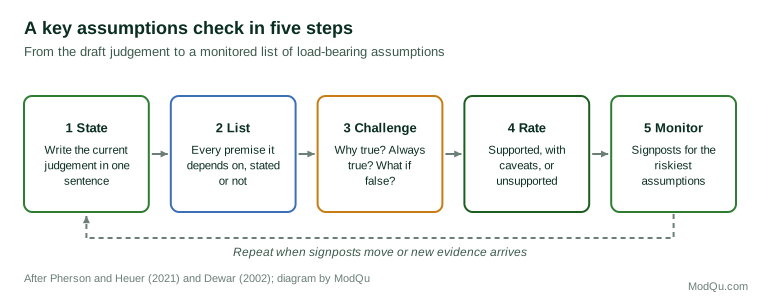
1. State the judgement. Write down the current working conclusion in a single sentence. Without a clear statement it is hard to see which assumptions it rests on.
2. List the assumptions. Ask what must be true for the judgement to hold. Include premises that seem obvious. Useful prompts are: what are we taking for granted about the actors, about conditions, about our sources and about time? Group members should list assumptions individually before discussing them, so that the first speaker does not set the agenda.
3. Challenge each assumption. For each item, ask: why do we believe it is true? Was it true in the past, and is there any reason it might no longer be? Under what circumstances could it be false? What evidence would show that it is failing?
4. Rate and revise. Classify each assumption as supported by evidence, supported with caveats or unsupported. Mark which ones are key, meaning that the judgement would change if they failed. If a key assumption is unsupported, the judgement may need to be reworded, given a lower level of confidence or replaced with alternatives.
5. Monitor. For each vulnerable key assumption, identify signposts: observable developments that would warn that it is breaking down. Assign someone to watch them, and repeat the check when they move.
Useful questions
Several questions help analysts find assumptions they might otherwise miss:
- What would someone with the opposite view need to believe?
- If this judgement turns out to be wrong in a year, what is the most likely reason?
- Which of our sources could be wrong, biased or deceived, and what would follow?
- Are we assuming that the future will resemble the past? Why?
- Are we assuming that the other side sees the situation as we do?
- What are we assuming about time: how fast things will happen, and in what order?
The second question borrows from the premortem technique, in which a team imagines that a plan has already failed and explains why (Klein, 2007). Asking what would make the judgement wrong is often the fastest route to its weakest premise.
What the evidence shows
Research on the key assumptions check itself is limited, as it is for most structured analytic techniques. Coulthart (2017) reviewed the available evidence for twelve core techniques and found that only a few had been tested in controlled conditions, and that the results were mixed. Chang et al. (2018) argued that many techniques were adopted because they seemed sensible rather than because they had been shown to improve accuracy, and called for more systematic testing. Mandel et al. (2018) found that some interventions designed to improve analytic judgement worked less well than expected, while others, such as training in probabilistic reasoning, had clearer benefits.
There is, however, relevant evidence from management research. Schweiger et al. (1986) found that groups using structured methods to challenge assumptions, such as devil's advocacy and dialectical inquiry, produced recommendations and assumptions of higher quality than groups that sought consensus, though members found the process less comfortable. This is consistent with the rationale for the key assumptions check: making premises explicit and inviting challenge improves the quality of reasoning, even if it adds friction.
The strongest case for the method is perhaps the pattern of failures described above. In case after case, investigators found that a single unexamined premise had shaped the outcome. A technique that forces such premises into the open addresses that failure directly, even if its effect on average accuracy has not yet been measured.
Common mistakes
Several errors weaken key assumptions checks in practice:
- Listing only easy assumptions. Teams often list premises they are comfortable with and skip those that would be awkward to question, such as assumptions held by senior leaders.
- Confusing assumptions with evidence. "The supplier has never missed a delivery" is evidence; "the supplier will not miss a delivery this year" is an assumption based on it.
- Doing the check too late. A check carried out after the conclusion has been agreed tends to confirm it. The best time is early, when changing course is cheap, and again before final judgements are issued.
- Stopping at the list. The value lies in rating, revising and monitoring. A list that is filed and forgotten changes nothing.
- Treating the check as a one-off. Assumptions that were sound a year ago may not be sound now. The check should be repeated when circumstances change.
Applying the method in business
Businesses make assumptions constantly: about demand, prices, costs, competitors, regulation and technology. Many planning failures can be traced to an assumption that was never written down. A key assumptions check can be built into ordinary processes with little extra effort.
For an annual budget, the finance team can list the main assumptions behind its revenue and cost forecasts, rate them and identify signposts to review each quarter. For a market entry decision, the strategy team can apply discovery-driven planning (McGrath & MacMillan, 1995), testing the riskiest assumptions with small, inexpensive experiments before committing large sums. For a competitive intelligence report, analysts can add a short section listing the key assumptions behind their judgements, so that readers can see what the conclusions depend on.
Survey research offers a practical way to test many business assumptions. If a plan assumes that customers value a feature, that a price is acceptable or that a brand is well known, a well-designed survey can show whether this is true before money is committed. In this way, the key assumptions check identifies what needs to be known, and research supplies the evidence.
An illustration
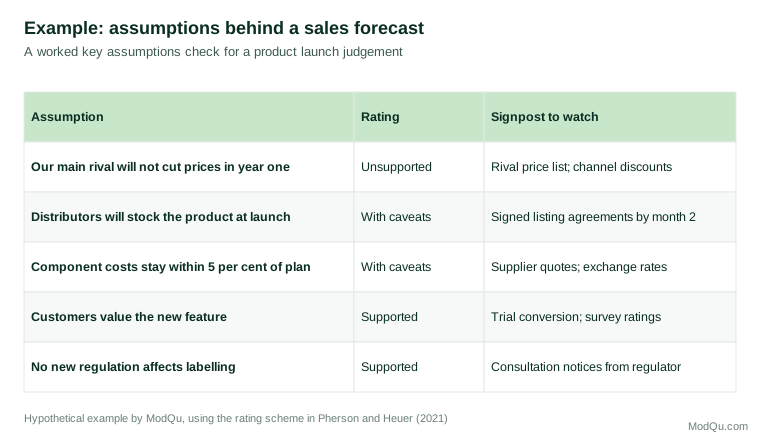
A Canadian food company plans to launch a premium line of frozen meals and forecasts sales of 2 million units in the first year. Before the board meeting, the analysis team runs a key assumptions check. It lists eleven assumptions and rates five as key. Two are well supported: consumer tests showed strong interest, and the regulatory review is complete. Two are supported with caveats: major grocers have shown interest but not yet committed shelf space, and ingredient costs depend on exchange rates. One is unsupported: the forecast assumes that the market leader will not respond with price cuts.
The team does not abandon the forecast. Instead it presents it with a range, explains that the main risk is a competitive price response, and sets three signposts to monitor: changes to the leader's price list, promotional activity in the frozen aisle and any announcement of new products. It also prepares a contingency plan for a price war. Six months after launch, the leader cuts prices in two provinces. Because the company had anticipated this, it responds within a week rather than a quarter.
Conclusion
Assumptions are unavoidable. Analysis would be impossible without them. The danger lies in assumptions that are never stated, never tested and never monitored. The key assumptions check is a short, disciplined way to make them visible, to identify the few that matter most and to watch for signs that they are failing. Its roots lie both in intelligence, where unexamined premises have contributed to major failures, and in planning, where methods such as assumption-based and discovery-driven planning have long been used to manage uncertainty. Evidence on its average effect remains limited, but its logic is sound and its cost is low.
References
Argyris, C. (1977). Double loop learning in organizations. Harvard Business Review, 55(5), 115–125.
Bar-Joseph, U. (2005). The watchman fell asleep: The surprise of Yom Kippur and its sources. State University of New York Press.
Betts, R. K. (2007). Enemies of intelligence: Knowledge and power in American national security. Columbia University Press.
Butler, R. (2004). Review of intelligence on weapons of mass destruction (HC 898). The Stationery Office.
Chang, W., Berdini, E., Mandel, D. R., & Tetlock, P. E. (2018). Restructuring structured analytic techniques in intelligence. Intelligence and National Security, 33(3), 337–356. https://doi.org/10.1080/02684527.2017.1400230
Commission on the Intelligence Capabilities of the United States Regarding Weapons of Mass Destruction. (2005). Report to the President of the United States. U.S. Government Printing Office.
Coulthart, S. J. (2017). An evidence-based evaluation of 12 core structured analytic techniques. International Journal of Intelligence and CounterIntelligence, 30(2), 368–391. https://doi.org/10.1080/08850607.2016.1230706
Davis, J. (2006). Intelligence analysts and policymakers: Benefits and dangers of tensions in the relationship. Intelligence and National Security, 21(6), 999–1021. https://doi.org/10.1080/02684520601046325
Dewar, J. A. (2002). Assumption-based planning: A tool for reducing avoidable surprises. Cambridge University Press.
Dewar, J. A., Builder, C. H., Hix, W. M., & Levin, M. H. (1993). Assumption-based planning: A planning tool for very uncertain times (MR-114-A). RAND Corporation.
Heuer, R. J., Jr. (1999). Psychology of intelligence analysis. Center for the Study of Intelligence, Central Intelligence Agency.
Jervis, R. (2010). Why intelligence fails: Lessons from the Iranian Revolution and the Iraq War. Cornell University Press.
Klein, G. (2007). Performing a project premortem. Harvard Business Review, 85(9), 18–19.
Mandel, D. R., Karvetski, C. W., & Dhami, M. K. (2018). Boosting intelligence analysts' judgment accuracy: What works, what fails? Judgment and Decision Making, 13(6), 607–621.
Mason, R. O., & Mitroff, I. I. (1981). Challenging strategic planning assumptions: Theory, cases, and techniques. Wiley.
Mason, R. O. (1969). A dialectical approach to strategic planning. Management Science, 15(8), B403–B414. https://doi.org/10.1287/mnsc.15.8.B403
McGrath, R. G., & MacMillan, I. C. (1995). Discovery-driven planning. Harvard Business Review, 73(4), 44–54.
National Commission on Terrorist Attacks Upon the United States. (2004). The 9/11 Commission report. W. W. Norton.
Nickerson, R. S. (1998). Confirmation bias: A ubiquitous phenomenon in many guises. Review of General Psychology, 2(2), 175–220. https://doi.org/10.1037/1089-2680.2.2.175
Pherson, R. H., & Heuer, R. J., Jr. (2021). Structured analytic techniques for intelligence analysis (3rd ed.). CQ Press.
Schweiger, D. M., Sandberg, W. R., & Ragan, J. W. (1986). Group approaches for improving strategic decision making: A comparative analysis of dialectical inquiry, devil's advocacy, and consensus. Academy of Management Journal, 29(1), 51–71. https://doi.org/10.5465/255859
Wack, P. (1985a). Scenarios: Uncharted waters ahead. Harvard Business Review, 63(5), 73–89.