
Intelligence · Analysis and tradecraft
Richards Heuer and the Psychology of Intelligence Analysis
Richards Heuer brought the psychology of judgement into intelligence work. This article describes Heuer's career, the main ideas of the influential book, the techniques Heuer developed and how that legacy looks in the light of later research.
Few people have shaped the way intelligence analysts think about their own thinking as much as Richards J. Heuer Jr. A long-serving officer of the Central Intelligence Agency, Heuer spent the later part of a long career translating research on human perception and judgement into practical lessons for analysts. Heuer's book, Psychology of Intelligence Analysis (Heuer, 1999), remains one of the most widely read works in the field, and the methods Heuer developed are taught to analysts in government and business around the world. This article describes Heuer's contribution and how it has stood up over time.
Career and context
Heuer worked for the Central Intelligence Agency for several decades, in both operational and analytical roles, and continued to work with it after retiring. During the 1970s and 1980s Heuer became interested in the new research on judgement and decision-making emerging from cognitive psychology, especially the work of Tversky and Kahneman (1974) on heuristics and biases. Heuer saw that this research explained many of the errors Heuer had observed in intelligence work.
In a paper on strategic deception, Heuer (1981) applied this psychology to the question of why intelligence services are so often deceived. Heuer argued that deception succeeds mainly because it exploits the target's existing beliefs: people readily accept information that fits what they expect and discount information that does not. The same mechanisms that make deception work also cause ordinary analytic errors.
Between the late 1970s and the mid-1980s, Heuer wrote a series of articles for analysts on the psychology of their work. The CIA's Center for the Study of Intelligence collected and published them in 1999 as Psychology of Intelligence Analysis, which it made freely available. Because the book was short, clearly written and free, it spread well beyond the agency, into military, police and business training.
The main ideas
Mindsets
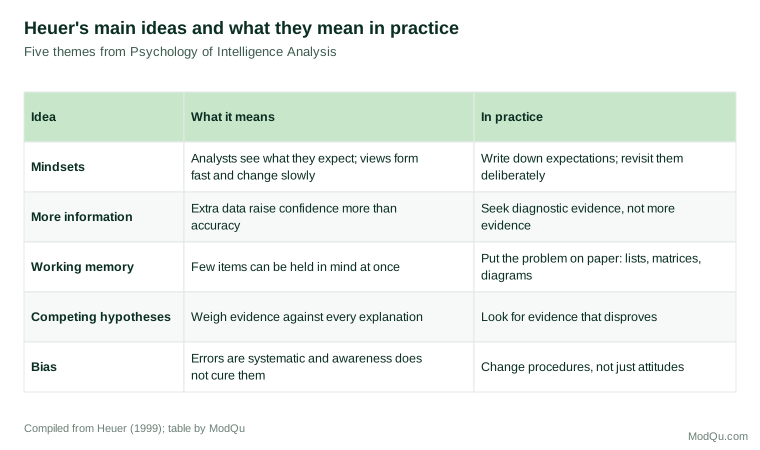
Heuer (1999) argued that analysts, like all people, perceive what they expect to perceive. Expectations, or mindsets, form quickly, on the basis of little evidence, and are slow to change. They are indispensable, because without them no one could make sense of complex information, but they also cause analysts to overlook or misread evidence of change. Nickerson (1998) later reviewed the wider research on confirmation bias that supports this view.
More information is not always better
One of Heuer's best-known arguments is that giving analysts more information does not necessarily make their judgements more accurate, though it makes them more confident. Once an analyst has the key information, additional data tend to be absorbed into the existing view rather than changing it. The practical lesson is to look for diagnostic information, which helps distinguish between explanations, rather than simply more information.
The limits of working memory
People can hold only a few items in mind at once. Complex problems with many variables and hypotheses exceed this capacity, so analysts simplify, often without realising it. Heuer's remedy was to externalise the problem: write it down, break it into parts, and use lists, matrices and diagrams to keep track of evidence and alternatives.
Competing hypotheses
From these ideas came Heuer's best-known technique, analysis of competing hypotheses. Rather than building a case for the most likely explanation, the analyst lists all reasonable hypotheses and judges each item of evidence against all of them, focusing on evidence that is inconsistent with a hypothesis.
Biases cannot be wished away
Heuer stressed that cognitive biases are not the result of poor training or lack of intelligence, and that knowing about them does little to prevent them. Improvement requires changing the way analysis is done: using tools and procedures that make assumptions explicit and force consideration of alternatives.
Influence
Heuer's ideas shaped the structured analytic techniques now taught to analysts. A primer of such techniques produced for the American intelligence community drew directly on Heuer's work (U.S. Government, 2009), and Heuer co-wrote, with Randolph Pherson, a comprehensive handbook of techniques that has gone through several editions (Pherson & Heuer, 2021). Heuer's concepts, such as mindsets, diagnosticity and competing hypotheses, became part of the vocabulary of the profession.
Heuer's influence was partly a response to a real gap. Johnston (2005), in an ethnographic study of American analysts, found that most relied on experience and informal methods, with little formal training in reasoning. Heuer offered a practical, research-based alternative. Later studies of failures, such as Jervis's (2010) analysis of the Iraq weapons assessments, echoed Heuer's warnings about strong prior beliefs and untested assumptions.
Heuer's legacy in the light of later research
Later research has tested some of Heuer's prescriptions more rigorously than was possible in Heuer's day. Experimental studies of analysis of competing hypotheses have found little evidence that the full procedure improves accuracy or reduces confirmation bias (Dhami et al., 2019; Whitesmith, 2020). Coulthart (2017), reviewing evidence for core structured techniques, found it thin and mixed.
These findings qualify, rather than overturn, Heuer's contribution. The diagnosis, that human judgement is systematically biased and that analysts need external aids, is well supported. What remains uncertain is which specific procedures work best. Marrin (2012) argues that progress depends on closer collaboration between researchers who can test methods and practitioners who use them, a collaboration that Heuer did much to begin.
Heuer's ideas in business settings
Although Heuer wrote for government analysts, the ideas apply directly to business. A strategy team convinced that a market is about to grow may read every new report as confirmation, a clear case of a mindset at work. A board that asks for "more data" before a decision may gain confidence without gaining accuracy, as Heuer warned. A product team weighing a single explanation for falling sales, such as a competitor's price cut, may miss others, such as a change in customer needs or a quality problem, unless it deliberately lists alternatives.
Heuer's remedies translate just as easily. Writing down expectations before reviewing results, asking which evidence would distinguish between explanations, and keeping a record of judgements and their basis are habits that cost little and suit any team that must make decisions under uncertainty. Heuer's emphasis on humility, the recognition that intelligent and experienced people are prone to systematic error, is perhaps Heuer's most transferable lesson.
Lessons for analysts today
Heuer's work offers practical lessons that remain valuable, whether in government or business:
- Know your mindset. Write down what you expect before examining new evidence, so you can notice when you are explaining evidence away.
- Seek evidence that discriminates. Ask whether each new item helps tell explanations apart.
- Externalise complex problems. Use paper, lists and diagrams rather than relying on memory.
- Consider several hypotheses. Keep more than one explanation alive until the evidence rules some out.
- Change procedures, not just intentions. Build reviews, challenges and records into routine work.
Conclusion
Richards Heuer gave intelligence analysts a way of understanding their own minds and practical tools for working around their limits. Some of Heuer's specific techniques have not performed as well in experiments as hoped, but the central insight, that analysis is shaped by predictable features of human cognition and must be designed to account for them, has become a foundation of the discipline.
References
Coulthart, S. J. (2017). An evidence-based evaluation of 12 core structured analytic techniques. International Journal of Intelligence and CounterIntelligence, 30(2), 368–391. https://doi.org/10.1080/08850607.2016.1230706
Dhami, M. K., Belton, I. K., & Mandel, D. R. (2019). The "analysis of competing hypotheses" in intelligence analysis. Applied Cognitive Psychology, 33(6), 1080–1090. https://doi.org/10.1002/acp.3550
Heuer, R. J., Jr. (1981). Strategic deception and counterdeception: A cognitive process approach. International Studies Quarterly, 25(2), 294–327.
Heuer, R. J., Jr. (1999). Psychology of intelligence analysis. Center for the Study of Intelligence, Central Intelligence Agency.
Jervis, R. (2010). Why intelligence fails: Lessons from the Iranian Revolution and the Iraq War. Cornell University Press.
Johnston, R. (2005). Analytic culture in the US intelligence community: An ethnographic study. Center for the Study of Intelligence, Central Intelligence Agency.
Marrin, S. (2012). Improving intelligence analysis: Bridging the gap between scholarship and practice. Routledge.
Nickerson, R. S. (1998). Confirmation bias: A ubiquitous phenomenon in many guises. Review of General Psychology, 2(2), 175–220. https://doi.org/10.1037/1089-2680.2.2.175
Pherson, R. H., & Heuer, R. J., Jr. (2021). Structured analytic techniques for intelligence analysis (3rd ed.). CQ Press.
Tversky, A., & Kahneman, D. (1974). Judgment under uncertainty: Heuristics and biases. Science, 185(4157), 1124–1131. https://doi.org/10.1126/science.185.4157.1124
U.S. Government. (2009). A tradecraft primer: Structured analytic techniques for improving intelligence analysis. Center for the Study of Intelligence.
Whitesmith, M. (2020). Cognitive bias in intelligence analysis: Testing the analysis of competing hypotheses method. Edinburgh University Press.