
Intelligence · Analysis and tradecraft
Red Teaming and Devil's Advocacy
Red teaming and devil's advocacy deliberately challenge a group's leading view before it becomes a decision. This article explains the main techniques, what research says about whether they work and how to use them well in business and government.
Every analysis rests on a view that someone could challenge. The danger is that no one does. Teams that agree quickly, that share the same background or that report to a confident leader can settle on a conclusion without testing it. Red teaming and devil's advocacy are structured ways of making sure the test happens. They assign people the job of arguing against the leading view, imagining how an adversary would act or explaining how a plan might fail. This article describes the main techniques, the evidence on their effects and the conditions under which they help.
Why challenge is needed
Janis (1972) showed how cohesive groups of capable people made poor foreign-policy decisions because members suppressed doubts to preserve agreement. Heuer (1999) explained a related problem at the level of the individual analyst: once a mindset forms, new information is interpreted to fit it, and the analyst rarely notices. In both cases the remedy is the same. Someone must be given permission, and preferably an obligation, to argue the other side.
The main techniques
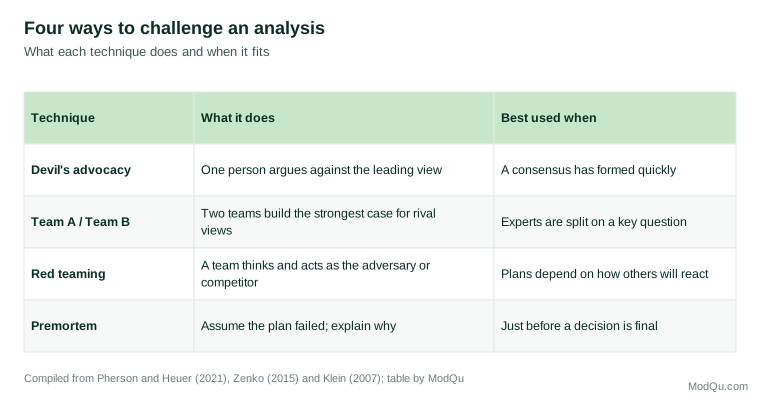
Pherson and Heuer (2021) group several methods under the heading of challenge analysis. Four are widely used.
- Devil's advocacy. One person or a small group builds the strongest possible case against the prevailing judgement. The aim is not to win but to expose weak evidence and untested assumptions.
- Team A / Team B. Two teams each develop the best case for competing views on a disputed question, then present them side by side to decision-makers.
- Red teaming. A team takes the role of an adversary, competitor or other outside party and tries to anticipate or defeat the organisation's plan. Zenko (2015) describes red teams in the military, in security testing and in business, where they probe defences, simulate competitor responses and question strategy.
- The premortem. Before a decision is final, the team imagines that it has been carried out and has failed badly, and each member writes down the reasons (Klein, 2007).
What the research shows
Experimental research on these techniques is encouraging, with caveats. Schweiger et al. (1986) compared groups using devil's advocacy, dialectical inquiry (a formal debate between a plan and a counter-plan) and simple consensus. The groups that used structured conflict produced better assumptions and recommendations, although members were less satisfied with the process. Schwenk (1990), in a meta-analysis, found that both devil's advocacy and dialectical inquiry led to better decisions than approaches that relied on expert recommendation alone.
The premortem draws on a finding by Mitchell et al. (1989): when people imagine that an event has already happened, they generate more reasons to explain it than when they consider whether it might happen. Asking "why did this fail?" therefore surfaces more risks than asking "what could go wrong?".
There is an important qualification. Nemeth et al. (2001) found that authentic dissent, from someone who genuinely holds a different view, stimulated more and better thinking than a devil's advocate playing a role. Group members may discount an assigned critic as merely going through the motions. Role-played challenge is better than none, but organisations should also make it safe for genuine dissenters to speak.
Making red teaming work
Zenko (2015) and the British Ministry of Defence's red teaming handbook (Development, Concepts and Doctrine Centre, 2021) agree on several conditions for success:
- Leadership support. The person who owns the decision must want to hear the challenge and must be willing to act on it. A red team whose findings are ignored wastes its effort and soon loses credibility.
- Independence. Red team members should be far enough outside the planning team to see it critically, yet close enough to understand it. Members who report to the plan's author are unlikely to attack it hard.
- Clear scope. The team needs a defined question: test this assumption, anticipate this competitor's response, find the weak points in this security plan.
- The right people. Effective red teamers combine knowledge of the subject with a willingness to think differently and the tact to deliver uncomfortable findings.
- Timing. Challenge is most useful before commitments are made. A red team convened after a decision is announced tends to become a justification exercise.
Common mistakes
The most frequent failure is ritual. If devil's advocacy becomes a box to tick, the advocate offers mild objections that are easily dismissed and the group leaves more confident than before. Rotating the role, rewarding strong challenges and recording which objections turned out to matter all help. A second mistake is to confuse a red team with a review panel. A review checks quality; a red team argues against the conclusion. A third is using the same red team for every problem, so that its members gradually adopt the organisation's own assumptions.
A business illustration
A Canadian software company plans to enter the Australian market with a lower price than local rivals. Before the board approves the plan, the strategy team runs a short premortem: it is now two years later and the entry has failed. Within half an hour the team lists reasons: a rival matched the price within weeks, local procurement rules favoured established vendors and the support team could not cover Australian business hours. A separate red team, playing the main local competitor, concludes that price matching would be cheap for that rival. The plan is revised to compete on service and integration rather than price alone.
Conclusion
Red teaming and devil's advocacy turn criticism from a personal risk into an assigned task. Research shows that structured challenge improves the quality of assumptions and decisions, especially when it comes before commitments are made and when leaders are willing to listen. The techniques do not replace genuine diversity of views, but they make it far more likely that weak reasoning is found before it becomes costly.
References
Development, Concepts and Doctrine Centre. (2021). Red teaming handbook (3rd ed.). UK Ministry of Defence.
Heuer, R. J., Jr. (1999). Psychology of intelligence analysis. Center for the Study of Intelligence, Central Intelligence Agency.
Janis, I. L. (1972). Victims of groupthink: A psychological study of foreign-policy decisions and fiascoes. Houghton Mifflin.
Klein, G. (2007). Performing a project premortem. Harvard Business Review, 85(9), 18–19.
Mitchell, D. J., Russo, J. E., & Pennington, N. (1989). Back to the future: Temporal perspective in the explanation of events. Journal of Behavioral Decision Making, 2(1), 25–38. https://doi.org/10.1002/bdm.3960020103
Nemeth, C., Brown, K., & Rogers, J. (2001). Devil's advocate versus authentic dissent: Stimulating quantity and quality. European Journal of Social Psychology, 31(6), 707–720. https://doi.org/10.1002/ejsp.58
Pherson, R. H., & Heuer, R. J., Jr. (2021). Structured analytic techniques for intelligence analysis (3rd ed.). CQ Press.
Schweiger, D. M., Sandberg, W. R., & Ragan, J. W. (1986). Group approaches for improving strategic decision making: A comparative analysis of dialectical inquiry, devil's advocacy, and consensus. Academy of Management Journal, 29(1), 51–71. https://doi.org/10.5465/255859
Schwenk, C. R. (1990). Effects of devil's advocacy and dialectical inquiry on decision making: A meta-analysis. Organizational Behavior and Human Decision Processes, 47(1), 161–176. https://doi.org/10.1016/0749-5978(90)90051-A
Zenko, M. (2015). Red team: How to succeed by thinking like the enemy. Basic Books.