
Intelligence · Analysis and tradecraft
"Indicators and Warnings: Detecting Change Early"
Indicators and warnings is the intelligence discipline of spotting, early and reliably, the signs that an important change is under way. This article explains how indicator lists are built and used, why warnings so often fail and how businesses can apply the method.
Most damaging surprises are not completely unforeseeable. In hindsight there were signs: a competitor hiring in a new region, a supplier quietly missing deliveries, troops moving towards a border. The difficulty is to recognise those signs early enough to act. Indicators and warnings is the intelligence discipline devoted to this problem. It defines in advance what an important change would look like, watches systematically for the signs and raises an alarm when enough of them appear. This article explains how the method works, why warning so often fails and how organisations outside government can use it.
Warning is not prediction
Cynthia Grabo, who spent decades as a warning analyst for the American government, stressed that warning is different from forecasting (Grabo, 2002). A forecast states what is most likely to happen. A warning states that something dangerous is possible, or becoming more likely, and that decision-makers should consider acting now. Warning is therefore about changes in probability, not certainty. A good warning may concern an event that ultimately does not happen, because the warning itself prompts action or because the adversary changes course.
Grabo also argued that warning depends on cumulative analysis. Single reports rarely prove anything. It is the accumulation of many small signs, each ambiguous on its own, that builds a case. An analyst who judges each report separately and dismisses it as inconclusive may never see the pattern.
Building an indicator list
An indicator is an observable development that would be expected if a particular change were under way. Pherson and Heuer (2021) describe indicator lists as one of the core structured analytic techniques. The process has four steps.
- Define the change of concern. Be specific: not "the competitor may expand" but "the competitor will begin selling in our national market within 18 months".
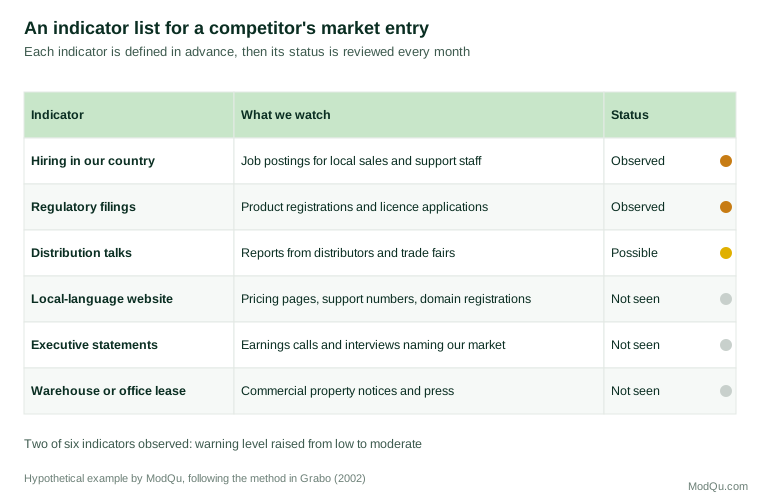
- Work out what must happen first. Any major action requires preparation. A market entry needs staff, regulatory approval, distribution and marketing. A military attack needs mobilisation, logistics and orders. Each preparatory step is a candidate indicator.
- Choose observable indicators. For each step, identify something that could actually be seen with available sources: job postings, filings, trade reports, satellite images, shipping data.
- Set a review routine. Assign responsibility for watching each indicator, review the list on a fixed schedule and record changes in status.
Good indicators are diagnostic: they are more likely to appear if the change is under way than if it is not. Heuer (1999) emphasised that evidence consistent with every hypothesis does nothing to distinguish between them. A competitor's general statement that it is "exploring growth" fits almost any future; a regulatory filing for a specific product in a specific market fits only a few.
Dewar (2002) applies the same idea to plans rather than threats. In assumption-based planning, each vulnerable assumption is paired with signposts, the indicators that would show it is failing. The logic is identical: decide in advance what to look for, then look for it.
Why warnings fail
The history of strategic surprise suggests that the main problem is rarely a complete absence of information. Wohlstetter (1962), in a study of Pearl Harbor, showed that American agencies had many relevant signals before the attack, but they were buried among irrelevant or misleading ones, which Wohlstetter called noise. Knorr (1964) examined the failure to anticipate Soviet missiles in Cuba in 1962 and concluded that analysts had judged the deployment unlikely because it seemed irrational from the American point of view.
Betts (1982), reviewing many surprise attacks, argued that warning was usually available but that political leaders and military commanders did not respond to it in time. Kam (1988) focused on the victim's side and showed how analysts' beliefs, organisational routines and the repeated experience of false alarms led them to discount warnings. The Israeli failure in 1973 illustrates the pattern: indicators of an Egyptian and Syrian attack accumulated for days, but analysts interpreted them through a fixed belief that an attack was unlikely (Bar-Joseph, 2005).
Levite (1987) offered a partial dissent. Levite argued that surprise often results from the lack of specific, conclusive warning rather than from a failure to heed it, and that decision-makers can hardly be blamed for not acting on vague signals. The two views can be reconciled: indicator lists help precisely because they turn vague signals into a structured, cumulative case that is harder to ignore.
Setting warning levels
Many warning systems translate the status of indicators into a small number of graded levels, such as low, moderate, elevated and high. Each level should have a clear threshold and a matching action. At a moderate level, the team might increase collection and brief the responsible manager. At an elevated level, it might prepare contingency plans. At a high level, it might recommend that those plans be put into effect. Linking levels to actions in advance helps overcome the reluctance of decision-makers to respond to ambiguous evidence, which Betts (1982) identified as a central cause of failure. It also provides a record against which the warning system can later be judged.
Indicators in business
Companies face their own surprises: new entrants, technology shifts, changes in customer behaviour and regulation. Day and Schoemaker (2006) argue that most companies have poor peripheral vision: they watch their existing customers and competitors closely but miss signals at the edges of their market. Schoemaker et al. (2013) propose a strategic radar that combines indicator monitoring with scenario planning, so that signals are interpreted against a set of possible futures rather than a single expected one.
Practical sources of indicators for businesses include job postings, patent and trademark filings, regulatory consultations, trade press, supplier and distributor conversations, customer surveys and web search trends. Many cost little to monitor once the list is defined.
Common mistakes
- Too many indicators. A list of fifty items is rarely reviewed. Ten to fifteen well-chosen indicators are usually enough.
- Indicators that cannot be seen. An indicator that no available source could detect is useless, however logical.
- No baseline. Without knowing normal levels of activity, analysts cannot tell whether a change is significant.
- Warning fatigue. Repeated alarms that come to nothing make users discount the next one (Kam, 1988). Graded warning levels, with clear thresholds, help maintain credibility.
- Never retiring the list. Indicators should be revised as the situation changes.
Conclusion
Indicators and warnings turns watchfulness from a vague intention into a routine. By defining in advance what a change would look like, choosing diagnostic and observable signs and reviewing them on a schedule, organisations give themselves the best chance of seeing important developments while there is still time to respond. The method cannot remove surprise entirely, but it makes surprise less frequent and less complete.
References
Bar-Joseph, U. (2005). The watchman fell asleep: The surprise of Yom Kippur and its sources. State University of New York Press.
Betts, R. K. (1982). Surprise attack: Lessons for defense planning. Brookings Institution.
Day, G. S., & Schoemaker, P. J. H. (2006). Peripheral vision: Detecting the weak signals that will make or break your company. Harvard Business School Press.
Dewar, J. A. (2002). Assumption-based planning: A tool for reducing avoidable surprises. Cambridge University Press.
Grabo, C. M. (2002). Anticipating surprise: Analysis for strategic warning. Joint Military Intelligence College.
Heuer, R. J., Jr. (1999). Psychology of intelligence analysis. Center for the Study of Intelligence, Central Intelligence Agency.
Kam, E. (1988). Surprise attack: The victim's perspective. Harvard University Press.
Knorr, K. (1964). Failures in national intelligence estimates: The case of the Cuban missiles. World Politics, 16(3), 455–467. https://doi.org/10.2307/2009582
Levite, A. (1987). Intelligence and strategic surprises. Columbia University Press.
Pherson, R. H., & Heuer, R. J., Jr. (2021). Structured analytic techniques for intelligence analysis (3rd ed.). CQ Press.
Schoemaker, P. J. H., Day, G. S., & Snyder, S. A. (2013). Integrating organizational networks, weak signals, strategic radars and scenario planning. Technological Forecasting and Social Change, 80(4), 815–824. https://doi.org/10.1016/j.techfore.2012.10.020
Wohlstetter, R. (1962). Pearl Harbor: Warning and decision. Stanford University Press.