
Intelligence · Analysis and tradecraft
Weak Signals and Horizon Scanning
Weak signals are early, fragmentary hints of changes that may later become important. This article explains the idea, how horizon scanning finds and interprets such signals, and how organisations can make it part of their routine.
Major changes rarely arrive without warning. Before a new technology disrupts an industry or a social trend reshapes a market, there are usually early hints: a research paper, a small start-up, an unusual pattern in customer complaints. These hints are weak signals. They are easy to miss and hard to interpret, but organisations that notice them early gain time to prepare. Horizon scanning is the systematic search for such signals.
Ansoff's idea
The concept of weak signals was introduced by Igor Ansoff, a pioneer of strategic management. Ansoff (1975) argued that companies were often surprised by changes that, in hindsight, had been foreshadowed. Ansoff suggested that firms should not wait until information was complete and precise before responding. Instead they should respond in graduated steps as signals strengthened: first by raising awareness, then by improving flexibility, and only later by committing to specific actions.
Holopainen and Toivonen (2012) revisited Ansoff's work and noted that the term has since been used loosely. They suggest that a weak signal has two defining features: it is an early sign of a possible future change, and its meaning is still uncertain or disputed.
What makes a signal weak
Hiltunen (2008) proposed that a "future sign" has three dimensions: the signal itself (how visible or frequent it is), the issue it points to (the underlying change) and the interpretation given to it by the observer. A signal may be weak because it is rare, because the issue is still small, or because few people yet understand what it means. The same signal can be weak for one organisation and strong for another, depending on their knowledge and attention.
Rossel (2012) reviewed the field and observed that weak signals sit within a wider family of concepts, including early warnings, emerging issues and "seeds of change". What they share is the challenge of acting on incomplete information about the future.
How horizon scanning works
Amanatidou et al. (2012), drawing on a European policy project, describe horizon scanning as a structured process. It typically involves the following steps.
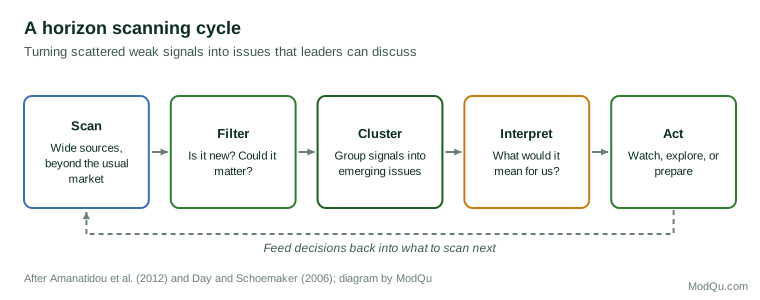
- Scan a wide range of sources, deliberately including those outside the organisation's usual field: scientific journals, patent filings, niche media, start-up funding announcements, conference programmes and conversations with unusual customers.
- Filter for signals that are new and could matter.
- Cluster related signals into emerging issues.
- Interpret each issue: what would it mean for the organisation if it grew?
- Act in proportion to the signal, as Ansoff (1975) recommended: watch, explore further or begin preparing.
Using many scanners with different backgrounds improves coverage, since each person notices different things. Amanatidou et al. (2012) stress that involving experts and stakeholders in interpretation is as important as the search itself.
Peripheral vision
Day and Schoemaker (2006) argue that most companies have poor peripheral vision. They focus on their core customers and known rivals and filter out signals from the edges. The authors recommend asking questions about the past (what blind spots surprised us before?), the present (what are mavericks and outsiders doing?) and the future (what scenarios could hurt or help us?). Schoemaker et al. (2013) suggest building a strategic radar that links scanning with scenario planning and with networks of people inside and outside the organisation.
An illustration
A Canadian insurer's scanning team notices three unrelated items over a few months: a university study on sensors that detect water leaks in homes, a start-up offering such sensors at low cost, and a trade article about a European insurer giving discounts to customers who install them. None is significant alone. Clustered together, they point to an emerging issue: home insurance priced on real-time data rather than on historical averages. The team does not recommend a product launch. It recommends a small pilot and a survey of policyholders' willingness to share sensor data, so that the company can move quickly if the trend strengthens. This is the graduated response that Ansoff (1975) described: modest action early, larger commitments only as the signal grows clearer.
Common mistakes
- Scanning only familiar sources, which finds only familiar signals.
- Dismissing a signal because it is small, rather than asking what it could become.
- Collecting signals without a routine for discussing them with decision-makers.
- Treating every signal as urgent, which exhausts attention.
Conclusion
Weak signals are the earliest evidence of change. Horizon scanning gives organisations a disciplined way to find them, make sense of them and respond in proportion. The method does not predict the future, but it widens the field of view and buys time to prepare.
References
Amanatidou, E., Butter, M., Carabias, V., Könnölä, T., Leis, M., Saritas, O., Schaper-Rinkel, P., & van Rij, V. (2012). On concepts and methods in horizon scanning: Lessons from initiating policy dialogues on emerging issues. Science and Public Policy, 39(2), 208–221. https://doi.org/10.1093/scipol/scs017
Ansoff, H. I. (1975). Managing strategic surprise by response to weak signals. California Management Review, 18(2), 21–33. https://doi.org/10.2307/41164635
Day, G. S., & Schoemaker, P. J. H. (2006). Peripheral vision: Detecting the weak signals that will make or break your company. Harvard Business School Press.
Hiltunen, E. (2008). The future sign and its three dimensions. Futures, 40(3), 247–260. https://doi.org/10.1016/j.futures.2007.08.021
Holopainen, M., & Toivonen, M. (2012). Weak signals: Ansoff today. Futures, 44(3), 198–205. https://doi.org/10.1016/j.futures.2011.10.002
Rossel, P. (2012). Early detection, warnings, weak signals and seeds of change: A turbulent domain of futures studies. Futures, 44(3), 229–239. https://doi.org/10.1016/j.futures.2011.10.005
Schoemaker, P. J. H., Day, G. S., & Snyder, S. A. (2013). Integrating organizational networks, weak signals, strategic radars and scenario planning. Technological Forecasting and Social Change, 80(4), 815–824. https://doi.org/10.1016/j.techfore.2012.10.020