
Insights · Generating insight
Generational Insights: Evidence Versus Stereotype
What research says about generational differences, why age, period and cohort effects are hard to separate, and how to use generational labels without falling into stereotype.
Labels such as Baby Boomers, Generation X, Millennials and Generation Z are used widely in marketing, media and management. They promise a simple way to understand groups of customers: each generation is said to share values, habits and preferences shaped by the times in which it grew up. The research evidence is much less clear-cut than the popular picture suggests.
The idea of generations
Mannheim (1952), in an essay first published in 1928, argued that people who experience major historical events at a formative age can develop a shared outlook. This idea, that a birth cohort may carry the imprint of its youth throughout life, underlies generational thinking. It is a plausible idea, and some historical events, such as wars and economic depressions, do appear to leave lasting marks on those who lived through them young.
Three effects that are hard to separate
A difference between younger and older people at a single point in time can arise in three ways.
Age effects arise because people change as they grow older: their incomes, family responsibilities, health and priorities shift over the life course.
Period effects arise because events and conditions at a particular time affect everyone, whatever their age, such as a recession or the spread of smartphones.
Cohort effects arise because people born at a particular time share formative experiences that stay with them. These are the effects generational labels claim to describe.
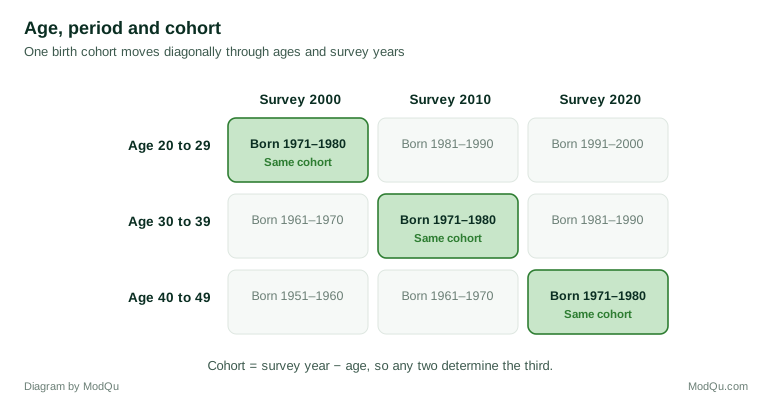
The difficulty is that the three are linked: a person's birth year equals the survey year minus their age. Glenn (2005) explained that, as a result, the separate effects of age, period and cohort cannot be identified from data alone without additional assumptions. Yang and Land (2013) described statistical methods that attempt the separation under explicit assumptions, but no method removes the problem entirely. A survey taken in one year that finds younger people more interested in a product cannot tell whether the difference reflects their age, which will change, or their generation, which will not.
What the evidence shows
Research that has tried to measure generational differences carefully has generally found them to be small. Costanza et al. (2012) conducted a meta-analysis of studies of work-related attitudes, such as job satisfaction and commitment, and found that differences between generations were small and in many cases negligible. Twenge et al. (2010) used repeated surveys of high school seniors over several decades, a design that compares people of the same age at different times, and found some changes in work values, such as greater value placed on leisure in later cohorts, although even these shifts were moderate in size.
Reviews have become more critical. A committee of the US National Academies of Sciences, Engineering, and Medicine (2020) concluded that generational categories are not a sound basis for workforce decisions, because the evidence for meaningful differences between them is weak and the boundaries between generations are arbitrary. Rudolph et al. (2021) argued that generational labels often function as stereotypes, and that differences attributed to generations are better explained by age, life stage and period.
Consumer examples show why this matters. Younger adults are often described as a generation that prefers renting to owning, or experiences to possessions. Some of this pattern reflects age and circumstance: younger people have always had lower incomes, fewer assets and more frequent moves, all of which favour renting. Some reflects period: housing costs and the spread of digital services affect everyone. Only the remaining part, if any, reflects a lasting generational difference, and it can be estimated only by following cohorts over time.
Using generational insight well
For insight teams, the evidence suggests several practices. Compare people of the same age at different times, using repeated surveys, rather than comparing different ages at one time. Consider life stage, income and household circumstances before attributing a difference to generation. Report the size of differences, not only their direction, and note how much people within each generation vary. And treat generational labels as convenient shorthand for age bands, not as evidence of shared values.
Key takeaways
Generational labels are popular but rest on weak evidence. Age, period and cohort effects are tightly linked and hard to separate, and careful studies generally find generational differences to be small. Life stage and historical events often explain more than generation. Insight is stronger when it uses repeated data, reports effect sizes and avoids attributing to generations what is better explained by age or circumstance.
References
Costanza, D. P., Badger, J. M., Fraser, R. L., Severt, J. B., & Gade, P. A. (2012). Generational differences in work-related attitudes: A meta-analysis. Journal of Business and Psychology, 27(4), 375–394. https://doi.org/10.1007/s10869-012-9259-4
Glenn, N. D. (2005). Cohort analysis (2nd ed.). SAGE.
Mannheim, K. (1952). The problem of generations. In P. Kecskemeti (Ed.), Essays on the sociology of knowledge (pp. 276–322). Routledge & Kegan Paul. (Original work published 1928)
National Academies of Sciences, Engineering, and Medicine. (2020). Are generational categories meaningful distinctions for workforce management? The National Academies Press. https://doi.org/10.17226/25796
Rudolph, C. W., Rauvola, R. S., Costanza, D. P., & Zacher, H. (2021). Generations and generational differences: Debunking myths in organizational science and practice and paving new paths forward. Journal of Business and Psychology, 36(6), 945–967. https://doi.org/10.1007/s10869-020-09715-2
Twenge, J. M., Campbell, S. M., Hoffman, B. J., & Lance, C. E. (2010). Generational differences in work values: Leisure and extrinsic values increasing, social and intrinsic values decreasing. Journal of Management, 36(5), 1117–1142. https://doi.org/10.1177/0149206309352246
Yang, Y., & Land, K. C. (2013). Age-period-cohort analysis: New models, methods, and empirical applications. CRC Press.