
Insights · Generating insight
Cultural Insight and Semiotics
How cultural analysis and semiotics reveal the shared meanings that shape what products, brands and images signify to consumers, the main concepts and methods involved, and how insight teams can use them alongside conventional research.
Most customer research studies individuals: what each person thinks, feels and does. But individuals do not make sense of products on their own. They draw on shared cultural meanings, learned from families, media, advertising and everyday life, that tell them what a colour, a shape, a word or a style signifies. A green label suggests something natural; a heavy bottle suggests quality; a handwritten font suggests a small producer. Cultural insight studies these shared meanings directly, and semiotics, the study of signs, provides many of its tools.
Why culture matters for insight
Levy (1959) argued that people buy products not only for what they do but also for what they mean, and that consumers are highly sensitive to the symbolic meanings of goods. Douglas and Isherwood (1979) proposed that goods function as a system of communication through which people make visible and stable the categories of their culture. Belk (1988) argued that possessions become part of a person's extended self, so that what people own expresses and shapes who they are.
These ideas became a substantial body of research. Arnould and Thompson (2005) described consumer culture theory as a family of perspectives that study the cultural meanings of consumption, consumers' identity projects, the cultural and social structures that shape consumption, and the ways consumers interpret media and marketing. Geertz (1973) described the anthropologist's task as interpreting culture as a web of meanings that people themselves have spun, an approach known as "thick description". Cultural insight work applies a similar interpretive stance to markets.
How meaning moves to products
McCracken (1986) proposed a model of how cultural meaning moves into consumer goods and then into consumers' lives. Meaning originates in the culturally constituted world, the shared categories and principles through which a society understands itself. Advertising and the fashion system transfer meaning from this world into goods, by placing products alongside images, people and settings that already carry meaning. Consumers then transfer meaning from goods into their own lives through rituals such as exchanging gifts, caring for possessions, preparing to go out and disposing of things.
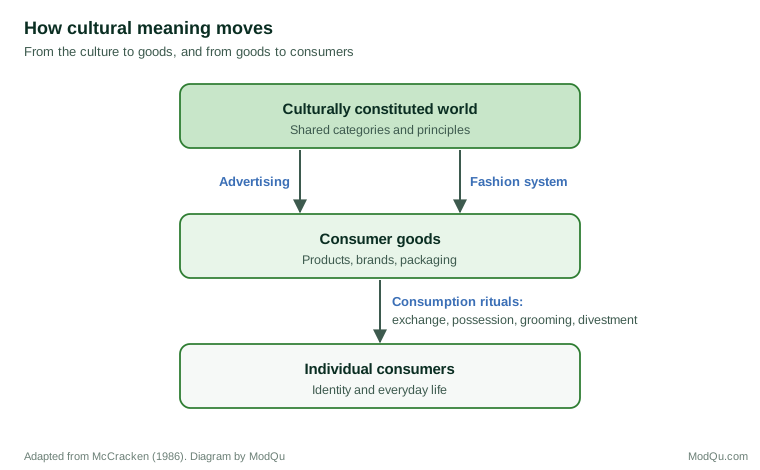
The model shows why brands cannot simply assign meanings to their products. They borrow meanings that already exist in the culture, and those meanings change over time. Holt (2004) studied brands that became cultural icons and argued that they succeeded by offering stories that addressed tensions in society at a particular moment, and that they lost relevance when the culture moved on.
Semiotics: the study of signs
Semiotics provides concepts for analysing how meaning is carried by signs. Saussure (1959), in lectures first published in 1916, described the sign as a combination of a signifier, the form, such as a word or image, and a signified, the concept it evokes. Saussure emphasised that the relationship between them is conventional, learned within a culture rather than natural, and that signs gain meaning from their differences from other signs in a system.
Barthes (1972) extended these ideas to everyday culture, including advertising, food and entertainment. Barthes distinguished denotation, the literal meaning of a sign, from connotation, the further associations it carries, and described how cultural "myths" make particular meanings seem natural. In an analysis of an advertisement for pasta, Barthes (1977) showed how an image of fresh vegetables, a string bag and the colours of the Italian flag together connoted "Italianicity" and freshness, without stating either.
Mick (1986) introduced semiotics to consumer research and argued that it offered tools for studying the meanings of products, brands, advertising and consumption practices that other approaches overlooked. Scott (1994) argued that images in advertising should be understood as a form of visual rhetoric, constructed from culturally learned conventions, rather than as simple copies of reality. McQuarrie and Mick (1996) developed a framework for classifying the rhetorical figures used in advertising language, such as rhyme, pun and metaphor, and their effects on consumers.
Cultural codes and change
Commercial semiotics often analyses the codes, the recurring patterns of signs, that a category uses to communicate meaning. Codes can be described in relation to cultural change. Williams (1977) distinguished between dominant elements of culture, those that are currently mainstream; residual elements, formed in the past but still active; and emergent elements, new meanings and practices that are beginning to appear. Applied to a product category, this distinction helps identify which codes feel current, which feel dated, and which point to where the category is moving.
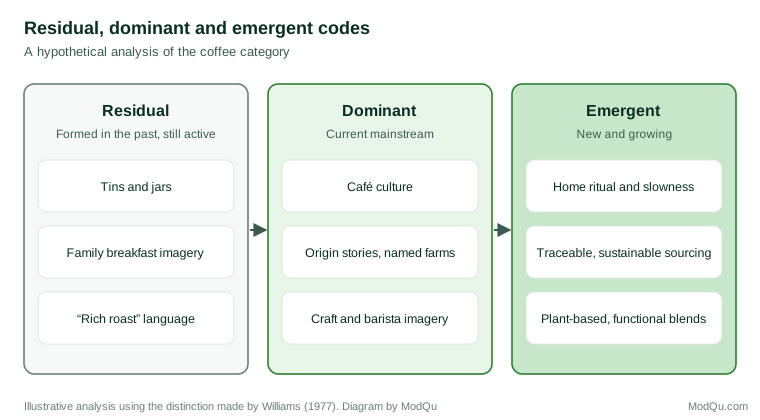
Oswald (2012) described how semiotic analysis of this kind can inform brand strategy, packaging, advertising and retail design, by showing which codes a brand currently uses, how they compare with competitors and with wider culture, and which codes could be adopted to signal a change of position.
Culture across markets
Cultural meanings also differ within a single market. Different age groups, regions and communities can read the same sign in different ways: a style that signals authenticity to one group may signal nostalgia or exclusion to another. Cultural analysis therefore needs to ask not only what a sign means, but to whom.
Cultural meanings differ across countries and communities. Hofstede (2001) described national cultures in terms of dimensions such as individualism and power distance, and showed how these differences relate to behaviour in organisations and markets. Aaker et al. (2001) studied brand personality in Japan, Spain and the United States and found that some dimensions were shared across cultures while others were specific to one culture, suggesting that brands carry culturally specific meanings. A colour, gesture or image that signals one thing in one market may signal something different, or nothing, in another. Cultural analysis is therefore especially valuable when brands cross borders.
Methods for cultural insight
Cultural insight draws on several methods.
Semiotic analysis examines a large sample of materials, such as packaging, advertising, retail environments, social media and media coverage, to identify the codes in use and how they create meaning.
Ethnography studies people in their everyday settings, observing how products are used and talked about and what they mean in practice.
Discourse and media analysis examines how a topic is discussed in news, entertainment and online conversation, revealing the frames and assumptions that shape public understanding. Hall (1997) described how meaning is produced through representation in language and images, and how the same object can be represented in very different ways.
Expert and trend interviews draw on people who observe culture closely, such as designers, journalists and curators.
These methods are interpretive. Their quality depends on the breadth of materials examined, the skill of the analyst and the transparency of the reasoning. Good cultural analysis shows its evidence, such as the examples on which a code is based, so that others can judge the interpretation.
An example
Consider a hypothetical maker of packaged soups whose sales are declining among younger shoppers, although taste tests show that they like the product. A semiotic analysis of the category, covering packaging, advertising, recipe sites, social media and supermarket displays, finds that the brand's packaging relies on residual codes: a farmhouse illustration, a serif typeface and the language of "hearty goodness" that once signified comfort and tradition. The dominant codes in the wider food culture now signify freshness and transparency through photography of ingredients, simple typography and short ingredient lists. Emergent codes connect food with global flavours and with sustainability.
The analysis suggests that the brand's packaging tells younger shoppers that the product belongs to an earlier generation's kitchen, a meaning that a taste test cannot detect. It also suggests options: moving towards the dominant codes to signal that the product belongs in a contemporary kitchen, or drawing on emergent codes to signal a distinctive future direction. Each option can then be turned into designs and tested quantitatively with shoppers, to check that they read the new codes as intended and that the change does not alienate existing customers who value the residual meanings.
The example illustrates the typical contribution of cultural insight: it explains a gap between what consumers say about a product and how they respond to it in the market, and it provides a vocabulary of meanings from which new options can be built.
Cautions
Cultural and semiotic analysis has limits that insight teams should recognise. Because it is interpretive, two analysts can read the same materials differently, and an attractive interpretation can be presented with more confidence than the evidence supports. The meanings an analyst identifies may not be the meanings consumers actually take, particularly across different social groups and markets. And culture changes, so an analysis can become dated quickly.
These limits can be managed. Analysts should examine a broad and systematic sample of materials rather than a few striking examples, document the evidence for each code, check interpretations with people from the relevant culture, and test key conclusions with consumers. Treating semiotic findings as well-grounded hypotheses rather than settled facts keeps their value while reducing the risk of error.
Using cultural insight alongside other research
Cultural insight complements rather than replaces conventional research. Surveys and interviews show what individual consumers think and do; cultural analysis shows the shared meanings within which they think and act. The two can be combined. Semiotic analysis can generate hypotheses about which codes communicate a desired meaning, and quantitative testing can check whether consumers actually read those codes as intended. Conversely, a puzzling survey finding, such as a product that consumers rate highly but do not buy, may be explained by cultural meanings that the survey did not capture, such as an association with an outdated or unappealing identity.
Key takeaways
Products, brands and images carry shared cultural meanings that shape how consumers understand and choose them. Meaning moves from the wider culture into goods through advertising and design, and from goods into consumers' lives through use and ritual. Semiotics offers concepts, such as signifier and signified, denotation and connotation, and cultural codes, for analysing how this meaning is carried. Distinguishing residual, dominant and emergent codes helps show where a category is moving. Cultural insight is interpretive and should be evidenced transparently, and it is most powerful when combined with research on individual consumers.
References
Aaker, J. L., Benet-Martínez, V., & Garolera, J. (2001). Consumption symbols as carriers of culture: A study of Japanese and Spanish brand personality constructs. Journal of Personality and Social Psychology, 81(3), 492–508. https://doi.org/10.1037/0022-3514.81.3.492
Arnould, E. J., & Thompson, C. J. (2005). Consumer culture theory (CCT): Twenty years of research. Journal of Consumer Research, 31(4), 868–882. https://doi.org/10.1086/426626
Barthes, R. (1972). Mythologies (A. Lavers, Trans.). Hill and Wang. (Original work published 1957)
Barthes, R. (1977). Rhetoric of the image. In Image, music, text (S. Heath, Trans., pp. 32–51). Hill and Wang. (Original work published 1964)
Belk, R. W. (1988). Possessions and the extended self. Journal of Consumer Research, 15(2), 139–168. https://doi.org/10.1086/209154
Douglas, M., & Isherwood, B. (1979). The world of goods: Towards an anthropology of consumption. Basic Books.
Geertz, C. (1973). The interpretation of cultures. Basic Books.
Hall, S. (Ed.). (1997). Representation: Cultural representations and signifying practices. SAGE.
Hofstede, G. (2001). Culture's consequences: Comparing values, behaviors, institutions, and organizations across nations (2nd ed.). SAGE.
Holt, D. B. (2004). How brands become icons: The principles of cultural branding. Harvard Business School Press.
Levy, S. J. (1959). Symbols for sale. Harvard Business Review, 37(4), 117–124.
McCracken, G. (1986). Culture and consumption: A theoretical account of the structure and movement of the cultural meaning of consumer goods. Journal of Consumer Research, 13(1), 71–84. https://doi.org/10.1086/209048
McQuarrie, E. F., & Mick, D. G. (1996). Figures of rhetoric in advertising language. Journal of Consumer Research, 22(4), 424–438. https://doi.org/10.1086/209459
Mick, D. G. (1986). Consumer research and semiotics: Exploring the morphology of signs, symbols, and significance. Journal of Consumer Research, 13(2), 196–213. https://doi.org/10.1086/209060
Oswald, L. R. (2012). Marketing semiotics: Signs, strategies, and brand value. Oxford University Press.
Saussure, F. de. (1959). Course in general linguistics (C. Bally & A. Sechehaye, Eds.; W. Baskin, Trans.). Philosophical Library. (Original work published 1916)
Scott, L. M. (1994). Images in advertising: The need for a theory of visual rhetoric. Journal of Consumer Research, 21(2), 252–273. https://doi.org/10.1086/209396
Williams, R. (1977). Marxism and literature. Oxford University Press.