
Insights · Generating insight
Verbatim Analysis: Letting Respondents Speak
How to use customers' own words in insight work, including how to select quotations that are representative rather than merely striking, what the language customers use can reveal, and the ethical care that verbatim reporting requires.
A well-chosen quotation can do what a chart cannot. When a customer says "I spent forty minutes on hold just to be told to send an email", decision makers understand the problem immediately and remember it. Verbatims, customers' own words taken from interviews, open survey questions, reviews or service transcripts, bring evidence to life. They also carry risks: a vivid quote can make a rare complaint seem common, and a carelessly reported quote can identify the person who said it. Verbatim analysis is the disciplined use of customers' words as evidence.
Why customers' words matter
Customers' own language shows how they think about a product or problem, which is often different from how the organisation thinks about it. A company may talk about "fulfilment latency" while customers talk about "waiting in for a parcel that never came". Zaltman (2003) argued that much of what shapes customer behaviour lies in the images, metaphors and associations customers use, which structured questions rarely capture. Using customers' words helps organisations see problems from the outside and communicate in language customers recognise.
Quotations also make findings persuasive. Concrete examples are more memorable and convincing than abstract summaries, which is one reason why stories and specific cases travel further within organisations than statistics (Heath & Heath, 2007).
Selecting quotations well
The persuasive power of quotes is also their main danger. Nickerson (1998) reviewed evidence of confirmation bias, the tendency to select and interpret evidence in ways that support existing beliefs. An analyst who has formed a view can easily choose quotes that illustrate it and pass over those that do not.
Qualitative researchers have discussed this problem at length. Sandelowski (1994) cautioned against using quotations as a substitute for analysis, and argued that quotes should be chosen to illustrate the analyst's interpretation of a pattern, with care that they represent the data. Corden and Sainsbury (2006) interviewed social researchers about their use of verbatim quotations and found that researchers used quotes for several purposes, including providing evidence, explaining meaning and giving participants a voice, but were aware of the risk that a striking quote could mislead readers about how widely a view was held. Lincoln and Guba (1985) argued that the credibility of qualitative findings depends partly on showing readers enough of the data to judge the interpretation for themselves.
Several practices follow:
- Code first, quote second. Identify themes systematically across all responses, then choose quotes to illustrate them. Braun and Clarke (2006) described thematic analysis as a process in which extracts are selected after themes have been developed and reviewed.
- Choose typical quotes for typical themes. A quote used to illustrate a common view should express that view in a typical way, not in its most extreme form.
- Label unusual quotes as unusual. A rare but important comment can be reported, but its rarity should be stated.
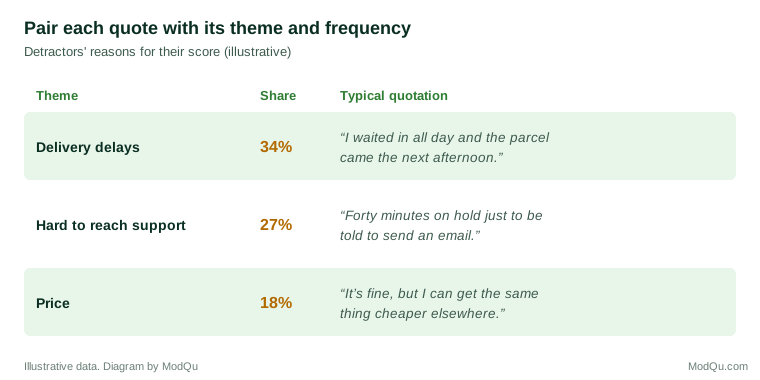
- Show the frequency. Pair each theme with the share of respondents who mentioned it, so that readers can weigh the quote against the numbers.
- Include contrary voices. Where a minority holds a different view, a quote from that minority makes the picture more honest.
What language reveals
Beyond illustration, the words customers use can be analysed in their own right. The choice of words can indicate emotion, certainty, involvement and attention. Tausczik and Pennebaker (2010) reviewed research using a word-counting method that classifies words into psychological categories, and described how measures such as the use of emotion words, first-person pronouns and words indicating certainty or tentativeness relate to people's states and situations. Humphreys and Wang (2018) described how automated text analysis can be used in consumer research to measure concepts such as sentiment, attention and identity, and set out steps for doing so validly. Berger et al. (2020) reviewed the growing use of text in marketing research and the insights it can provide.
Simple displays of word frequency, such as word clouds, are popular but limited. Viégas et al. (2009) studied the widespread use of one word cloud tool and noted that, although people found such displays engaging, they are poor at conveying precise information, since size and placement are hard to compare and words are shown without context. A word cloud can prompt questions but should not be treated as analysis.
Sources of verbatims
Verbatims come from several sources, each with its own character. Interview transcripts provide the richest material, with context and follow-up, but come from few people. Open survey responses come from many people but are usually brief and written with little reflection. Online reviews and social media posts are unsolicited and often vivid, but they come disproportionately from customers with strong feelings and may be written for an audience. Contact centre transcripts and chat logs capture customers at the moment of a problem, in their most natural language. Knowing the source helps interpret a quote: a furious review and a measured interview answer about the same issue tell different parts of the story, and both may be needed.
Combining sources also strengthens analysis. A theme that appears in survey responses, reviews and service transcripts, expressed in similar words, is more credible than one that appears in only one source.
Ethical care
Verbatims come from people who have trusted the researcher with their words. Professional codes require that research participants are not identified without their consent and that their data are used only for the purposes they agreed to (ICC/ESOMAR, 2016). Removing names is not always enough. Saunders et al. (2015) described the practical difficulty of anonymising interview data, since details such as a job title, a location or an unusual event can identify a person to those who know them. Before quotes are shared, especially beyond the research team, details that could identify the speaker should be removed or altered, while preserving the meaning. Recordings and full transcripts need particular care.
Using verbatims in reporting
In reports and presentations, verbatims work best when they serve the analysis. Each quote should be attached to a clearly stated theme, accompanied by its frequency, and chosen to represent that theme fairly. Kvale and Brinkmann (2009) recommended that quotations in interview reports be relatively brief, related to the general text, and edited only lightly for readability without changing their meaning. A small number of well-chosen quotes is more effective than many, which can blur together and overwhelm the reader.
Key takeaways
Customers' own words reveal how they think and make findings memorable and persuasive. Because vivid quotes can mislead, they should be chosen after systematic coding, represent their themes fairly, be paired with frequencies, and include contrary views where relevant. The language customers use can also be analysed for emotion and other qualities, but simple displays such as word clouds are not analysis. Verbatims must be anonymised with care so that participants cannot be identified.
References
Berger, J., Humphreys, A., Ludwig, S., Moe, W. W., Netzer, O., & Schweidel, D. A. (2020). Uniting the tribes: Using text for marketing insight. Journal of Marketing, 84(1), 1–25. https://doi.org/10.1177/0022242919873106
Braun, V., & Clarke, V. (2006). Using thematic analysis in psychology. Qualitative Research in Psychology, 3(2), 77–101. https://doi.org/10.1191/1478088706qp063oa
Corden, A., & Sainsbury, R. (2006). Using verbatim quotations in reporting qualitative social research: Researchers' views. Social Policy Research Unit, University of York.
Heath, C., & Heath, D. (2007). Made to stick: Why some ideas survive and others die. Random House.
Humphreys, A., & Wang, R. J.-H. (2018). Automated text analysis for consumer research. Journal of Consumer Research, 44(6), 1274–1306. https://doi.org/10.1093/jcr/ucx104
ICC/ESOMAR. (2016). ICC/ESOMAR international code on market, opinion and social research and data analytics. ESOMAR.
Kvale, S., & Brinkmann, S. (2009). InterViews: Learning the craft of qualitative research interviewing (2nd ed.). SAGE.
Lincoln, Y. S., & Guba, E. G. (1985). Naturalistic inquiry. SAGE.
Nickerson, R. S. (1998). Confirmation bias: A ubiquitous phenomenon in many guises. Review of General Psychology, 2(2), 175–220. https://doi.org/10.1037/1089-2680.2.2.175
Sandelowski, M. (1994). The use of quotes in qualitative research. Research in Nursing & Health, 17(6), 479–482. https://doi.org/10.1002/nur.4770170611
Saunders, B., Kitzinger, J., & Kitzinger, C. (2015). Anonymising interview data: Challenges and compromise in practice. Qualitative Research, 15(5), 616–632. https://doi.org/10.1177/1468794114550439
Tausczik, Y. R., & Pennebaker, J. W. (2010). The psychological meaning of words: LIWC and computerized text analysis methods. Journal of Language and Social Psychology, 29(1), 24–54. https://doi.org/10.1177/0261927X09351676
Viégas, F. B., Wattenberg, M., & Feinberg, J. (2009). Participatory visualization with Wordle. IEEE Transactions on Visualization and Computer Graphics, 15(6), 1137–1144. https://doi.org/10.1109/TVCG.2009.171
Zaltman, G. (2003). How customers think: Essential insights into the mind of the market. Harvard Business School Press.