
Insights · Generating insight
Neuromarketing: Physiological Data as a Source of Consumer Knowledge
What neuroimaging and physiological measures such as fMRI, EEG, eye tracking and skin conductance can and cannot tell us about consumers, what the evidence shows about their predictive value, and the methodological and ethical cautions that apply.
Neuromarketing, or consumer neuroscience, uses measures of brain activity and other bodily responses to study how consumers react to products, brands and advertising. Its appeal is easy to understand. If consumers cannot always report their reactions accurately, measuring responses directly in the brain or body might reveal what surveys miss. The field has produced some genuinely interesting findings. It has also attracted exaggerated claims. This article explains the main methods, reviews what the evidence shows and sets out the cautions that apply.
The main methods
Ariely and Berns (2010) reviewed the use of neuroimaging in business and described both its promise and the hype surrounding it. The methods in use vary greatly in what they measure, how precise they are and how much they cost.
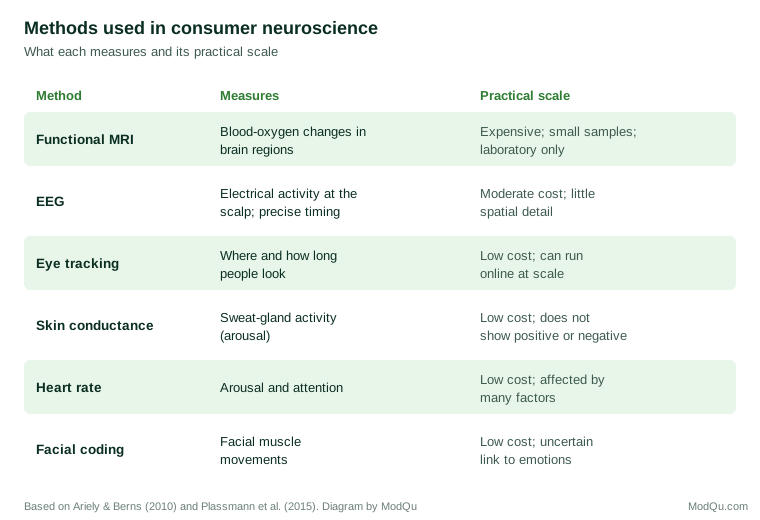
Functional magnetic resonance imaging (fMRI) measures changes in blood oxygen in brain regions, an indirect indicator of neural activity. It shows where in the brain activity changes, but it is expensive, requires participants to lie still in a scanner, and is usually used with small samples.
Electroencephalography (EEG) records electrical activity at the scalp. It tracks the timing of responses very precisely, which makes it suitable for studying reactions to moment-by-moment content such as advertisements, but it gives little information about where in the brain the activity arises.
Eye tracking records where people look and for how long. Wedel and Pieters (2008) reviewed eye-tracking research in marketing and described its value for studying attention to advertising, packaging and shelves. It measures attention, not liking. Because attention is a precondition for most other effects, eye tracking is often the most practical physiological measure for everyday insight work, and webcam-based versions allow it to be used with larger online samples, though with less precision than laboratory equipment.
Skin conductance and heart rate measure physiological arousal. Boucsein (2012) described electrodermal activity, changes in the skin's electrical conductance caused by sweat-gland activity, as a sensitive indicator of arousal. Such measures show that something provoked a reaction but not whether the reaction was positive or negative.
Facial coding analyses facial muscle movements. As discussed elsewhere in this series, the link between facial movements and specific emotions is much weaker than often assumed (Barrett et al., 2019).
What the evidence shows
Several well-known studies show that brand and marketing information affects neural responses. McClure et al. (2004) studied preferences for Coca-Cola and Pepsi and found that when participants did not know which drink they were tasting, their preferences were related to activity in one brain region, but when they knew the brand, brand knowledge influenced both their stated preferences and activity in other regions associated with memory. Plassmann et al. (2008) found that telling participants a wine was more expensive increased both their reported enjoyment and activity in a brain region associated with experienced pleasantness, even though the wine was the same.
Other studies have asked whether neural measures can predict behaviour beyond what people say. Knutson et al. (2007) found that activity in brain regions associated with anticipated reward and with responses to prices could predict whether participants would buy products in the experiment. Berns and Moore (2012) found that the brain responses of a small group of adolescents to unfamiliar songs were related to the songs' later sales, while the participants' own ratings of the songs were not. Falk et al. (2012) found that brain responses to anti-smoking advertisements predicted which campaign produced the most calls to a quit-smoking helpline across a population, better than participants' own judgements of the advertisements.
The most systematic test in a marketing setting was conducted by Venkatraman et al. (2015), who compared several methods, including traditional self-report measures, eye tracking, skin conductance, EEG and fMRI, for predicting the market response to television advertisements. They found that fMRI measures explained additional variation in advertising effectiveness beyond traditional measures, while the other physiological measures added little.
Taken together, the evidence suggests that neural measures can sometimes add predictive information, particularly about how a population will respond, but that the added value is modest, method-specific and demonstrated in a limited number of studies.
Why might a small group's brain responses predict population behaviour better than their own ratings? One explanation offered by researchers is that self-reports are influenced by what people think they should say, or by reasoning about why they like something, while early neural responses capture more immediate reactions that are shared across people. Another is that neural measures average out some of the idiosyncratic factors that shape individual ratings. These explanations are plausible but not yet firmly established, and the number of studies remains small.
Cautions
Reverse inference. Many neuromarketing claims take the form "region X was active, so the consumer felt Y". Poldrack (2006) explained why such reverse inferences are weak: most brain regions are involved in many processes, so activity in a region does not reliably indicate any one mental state. Claims that a brain scan reveals "desire" or "trust" should be treated with caution.
Small samples. Button et al. (2013) showed that many neuroscience studies have small samples and low statistical power, which makes their findings less likely to be true and their effect sizes likely to be exaggerated. Commercial studies often have the same problem.
Arousal is not preference. Physiological measures mainly capture arousal and attention. An advertisement can be arousing because it is annoying.
Validation. Plassmann et al. (2015) reviewed applications of consumer neuroscience and argued that its most promising contributions lie in improving understanding of the processes behind consumer decisions and in combining neural data with other data to predict behaviour, but that the field needs larger samples, replication and validation against real market outcomes.
Ethics. Measuring brain and bodily responses raises questions of consent, privacy and manipulation. Murphy et al. (2008) argued that neuromarketing research should protect participants, particularly vulnerable groups such as children, and that its claims should be accurately represented to clients and the public.
Using neuromarketing in insight work
For most organisations, the practical lessons are modest. Low-cost methods such as eye tracking are useful for specific questions about attention to packaging, websites and advertisements. Neural and physiological measures can complement self-report when testing advertising, particularly where people may not be able to articulate their reactions. Claims that a method reveals hidden buying intentions should be met with requests for evidence of validation against actual behaviour. And neuromarketing results should be combined with conventional research and market data rather than treated as a substitute for them.
An example
Consider a hypothetical company choosing between three versions of a television advertisement. A conventional pre-test asks viewers to rate each version and to report their purchase intention; the three versions score similarly. The company adds eye tracking, which shows that in one version most viewers miss the brand name because it appears while attention is on a moving character. It also adds a small EEG study, which suggests that engagement drops sharply in the final seconds of another version.
These results do not replace the ratings, but they point to specific, fixable problems: moving the brand name to a moment of lower visual competition and shortening the ending. The revised versions can then be tested again, and their effect measured in market through a controlled regional rollout. The neural and physiological data are useful here because they answer narrow questions about attention and timing, not because they reveal hidden desires.
Key takeaways
Consumer neuroscience measures brain and bodily responses to marketing. Studies show that brand and price information affect neural responses, and some find that neural measures add modest predictive value beyond self-report, especially for population-level responses to advertising. But activity in a brain region does not reliably indicate a specific mental state, many studies are small, and physiological measures mainly capture arousal and attention. The methods are best used as a complement to conventional research, with claims validated against real behaviour and with care for participants' rights.
References
Ariely, D., & Berns, G. S. (2010). Neuromarketing: The hope and hype of neuroimaging in business. Nature Reviews Neuroscience, 11(4), 284–292. https://doi.org/10.1038/nrn2795
Barrett, L. F., Adolphs, R., Marsella, S., Martinez, A. M., & Pollak, S. D. (2019). Emotional expressions reconsidered: Challenges to inferring emotion from human facial movements. Psychological Science in the Public Interest, 20(1), 1–68. https://doi.org/10.1177/1529100619832930
Berns, G. S., & Moore, S. E. (2012). A neural predictor of cultural popularity. Journal of Consumer Psychology, 22(1), 154–160. https://doi.org/10.1016/j.jcps.2011.05.001
Boucsein, W. (2012). Electrodermal activity (2nd ed.). Springer. https://doi.org/10.1007/978-1-4614-1126-0
Button, K. S., Ioannidis, J. P. A., Mokrysz, C., Nosek, B. A., Flint, J., Robinson, E. S. J., & Munafò, M. R. (2013). Power failure: Why small sample size undermines the reliability of neuroscience. Nature Reviews Neuroscience, 14(5), 365–376. https://doi.org/10.1038/nrn3475
Falk, E. B., Berkman, E. T., & Lieberman, M. D. (2012). From neural responses to population behavior: Neural focus group predicts population-level media effects. Psychological Science, 23(5), 439–445. https://doi.org/10.1177/0956797611434964
Knutson, B., Rick, S., Wimmer, G. E., Prelec, D., & Loewenstein, G. (2007). Neural predictors of purchases. Neuron, 53(1), 147–156. https://doi.org/10.1016/j.neuron.2006.11.010
McClure, S. M., Li, J., Tomlin, D., Cypert, K. S., Montague, L. M., & Montague, P. R. (2004). Neural correlates of behavioral preference for culturally familiar drinks. Neuron, 44(2), 379–387. https://doi.org/10.1016/j.neuron.2004.09.019
Murphy, E. R., Illes, J., & Reiner, P. B. (2008). Neuroethics of neuromarketing. Journal of Consumer Behaviour, 7(4–5), 293–302. https://doi.org/10.1002/cb.252
Plassmann, H., O'Doherty, J., Shiv, B., & Rangel, A. (2008). Marketing actions can modulate neural representations of experienced pleasantness. Proceedings of the National Academy of Sciences, 105(3), 1050–1054. https://doi.org/10.1073/pnas.0706929105
Plassmann, H., Venkatraman, V., Huettel, S., & Yoon, C. (2015). Consumer neuroscience: Applications, challenges, and possible solutions. Journal of Marketing Research, 52(4), 427–435. https://doi.org/10.1509/jmr.14.0048
Poldrack, R. A. (2006). Can cognitive processes be inferred from neuroimaging data? Trends in Cognitive Sciences, 10(2), 59–63. https://doi.org/10.1016/j.tics.2005.12.004
Venkatraman, V., Dimoka, A., Pavlou, P. A., Vo, K., Hampton, W., Bollinger, B., Hershfield, H. E., Ishihara, M., & Winer, R. S. (2015). Predicting advertising success beyond traditional measures: New insights from neurophysiological methods and market response modeling. Journal of Marketing Research, 52(4), 436–452. https://doi.org/10.1509/jmr.13.0593
Wedel, M., & Pieters, R. (2008). A review of eye-tracking research in marketing. Review of Marketing Research, 4, 123–147. https://doi.org/10.1108/S1548-6435(2008)0000004009