
Insights · Generating insight
Cross-Pollination of Insights: Generating Knowledge Across Industry Silos
How ideas and insights travel between industries and between parts of an organisation, what research on brokerage, analogy and knowledge transfer shows about why it works and why it often fails, and practical ways to borrow insight from outside your own field.
Many useful ideas are not new. They are ideas that already work somewhere else, brought into a setting where no one had thought to apply them. Surgical teams have borrowed checklists from aviation. Hospital handover procedures have been redesigned by studying motor-racing pit crews. Retailers have learned from logistics companies, and banks from games designers. In each case, insight came not from deeper study of one's own industry but from looking across the boundary into another.
Organisations are also divided internally. Marketing, operations, finance and product teams collect different data, use different language and solve similar problems separately. Knowledge that would help one team often sits unused in another. Cross-pollination, the deliberate movement of insight across industries and across internal silos, is one of the most reliable ways to generate new knowledge. This article reviews what research shows about how it works, why it is harder than it sounds, and how to do it well.
Why ideas from elsewhere are valuable
Research on innovation has long found that new ideas often arise from new combinations of existing knowledge. Fleming (2001) studied patents and found that inventions combining components that had rarely been combined before were more uncertain in their outcomes, but were also more likely to produce occasional breakthroughs. Uzzi et al. (2013) analysed millions of scientific papers and found that the papers most likely to be highly cited combined mostly conventional sources of knowledge with a small proportion of unusual combinations. Novelty, in other words, frequently comes from importing something unfamiliar into a familiar base.
March (1991) distinguished between exploitation, the refinement of what an organisation already knows, and exploration, the search for new possibilities. March argued that organisations tend to favour exploitation because its returns are quicker and more certain, and that this can trap them in competence at things that are becoming less valuable. Looking across industry boundaries is a form of exploration that does not require starting from nothing, because the borrowed idea has already been tested elsewhere.
Brokers and the gaps between groups
People and organisations that sit between otherwise separate groups are well placed to move ideas between them. Granovetter (1973) showed that "weak ties", connections to acquaintances rather than close friends, are especially valuable for passing on new information, because acquaintances move in different circles and know things one's close contacts do not. Burt (2004) studied managers in a large electronics company and found that those whose networks spanned "structural holes", gaps between groups that were not otherwise connected, were more likely to have their ideas judged valuable by senior managers. Burt argued that such people see more alternatives and can recognise when an idea that is ordinary in one group is new in another.
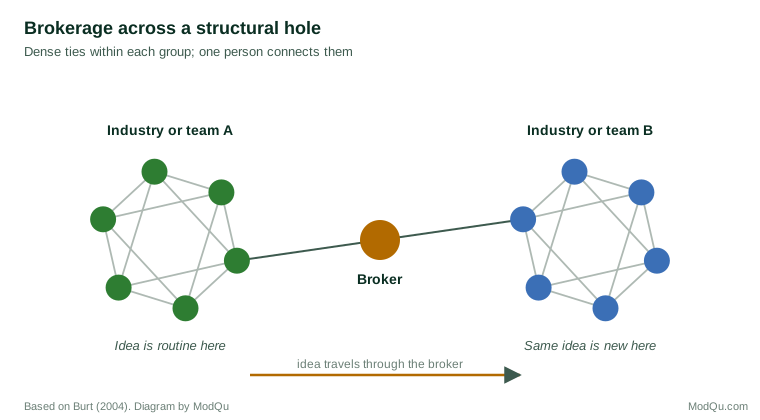
Hargadon and Sutton (1997) studied a product design consultancy that worked for clients in dozens of industries. They found that the firm innovated by "technology brokering": its designers learned about technologies and solutions in one industry and recognised how they could solve problems in another. The firm built practices to support this, including collections of objects and materials from past projects and brainstorming sessions that drew on people with different experience. Hargadon (2002) later developed this into a broader account of knowledge brokering as a process of access to different domains, learning about them, linking past solutions to current problems, and implementing the result.
Within organisations, similar roles exist. Tushman (1977) studied research and development laboratories and described "boundary spanners", individuals who linked their units to other parts of the organisation and to the outside world. Allen (1977) found that in engineering organisations a small number of "gatekeepers" read widely, maintained outside contacts and passed what they learned to colleagues. Insight teams often play this role, because they gather information from customers, markets and many internal functions.
Analogy: the mental mechanism
At the level of individual thinking, cross-pollination depends on analogy: recognising that a problem in one domain has the same structure as a problem in another. Gentner (1983) proposed that analogy works by mapping relationships rather than surface features. A hospital ward and a pit lane look nothing alike, but both involve a team that must transfer a complex situation quickly and safely under time pressure. It is this shared structure, not any surface resemblance, that makes the analogy useful.
People often fail to notice useful analogies on their own. Gick and Holyoak (1980) gave participants a story about an army that captured a fortress by dividing into small groups and converging from several directions, then asked them to solve a medical problem with the same structure: destroying a tumour with rays that would damage healthy tissue at full strength. Few participants used the analogy spontaneously, but many did once they were told that the story might help. The lesson for practice is that useful analogies are more likely to be found when people are prompted to look for them deliberately.
Analogies can also improve the quality of new ideas. Dahl and Moreau (2002) found in experiments that participants who drew on analogies from more distant domains when designing new products produced more original designs. Gavetti et al. (2005) argued that analogy is central to strategy making in novel situations, where managers reason from similar cases they know, and that the quality of the resulting strategy depends on whether they identify the deep similarities rather than the superficial ones.
Evidence from looking outside
Some studies have measured directly what happens when organisations seek ideas from outside their own field. Jeppesen and Lakhani (2010) studied an online platform where companies posted scientific problems that their own researchers had failed to solve. They found that solvers whose expertise lay furthest from the field of the problem were more likely to succeed, because they brought approaches that specialists in the field did not consider. Franke et al. (2014) asked people from different markets to suggest solutions to problems in a target market, and found that solutions from analogous markets were more novel than those from the target market, although the more distant solutions were also judged less immediately useful. Enkel and Gassmann (2010) examined cases of cross-industry innovation and found that the transfer was most successful when firms recognised structural similarities between their problem and the source industry's solution and adapted it rather than copying it directly.
Two well-known examples show the process. Haynes et al. (2009) tested a surgical safety checklist, modelled on the checklists used in aviation, in eight hospitals around the world, and found that rates of death and complications after surgery fell after it was introduced. Catchpole et al. (2007) worked with a Formula 1 racing team and aviation specialists to redesign the handover of children from surgery to intensive care at a London hospital, and found that the number of technical errors and information omissions in handovers fell after the new procedure was introduced. In both cases, the borrowed idea was adapted to the new setting rather than imported unchanged.
Why insight does not travel easily
If borrowing ideas is so valuable, why is it not more common? Research identifies several obstacles.
Absorptive capacity. Cohen and Levinthal (1990) argued that an organisation's ability to recognise, absorb and apply outside knowledge depends on what it already knows. Knowledge that is too far from existing expertise may not be recognised as relevant at all. This creates a paradox: the most valuable distant ideas are also the hardest to absorb.
Stickiness. Szulanski (1996) studied the transfer of best practices within firms and found that the main barriers were not lack of motivation but lack of absorptive capacity in the receiving unit, ambiguity about why the practice worked, and difficult relationships between the source and recipient. Knowledge that is easy to describe in a report often depends on tacit skills and local conditions that do not travel with it.
Search and transfer. Hansen (1999) found that weak ties between business units helped project teams find useful knowledge in other units, but that weak ties made it harder to transfer complex knowledge, which needed closer relationships. Reagans and McEvily (2003) found that cohesive networks and networks spanning diverse knowledge areas both made knowledge transfer easier.
Boundaries of meaning. Carlile (2004) distinguished three kinds of knowledge boundary. At a syntactic boundary, groups simply need a shared vocabulary. At a semantic boundary, the same words mean different things, and translation is required. At a pragmatic boundary, groups have different interests, and knowledge must be transformed and negotiated before it can be used. Many insight transfers fail because they are treated as simple handovers when they actually cross semantic or pragmatic boundaries.
Not invented here. Katz and Allen (1982) studied research teams and found that groups that had worked together for a long time communicated less with outsiders and performed less well, a pattern associated with the "not invented here" syndrome, the tendency to reject ideas from outside the group.
Making cross-pollination work
Several practices follow from this research.
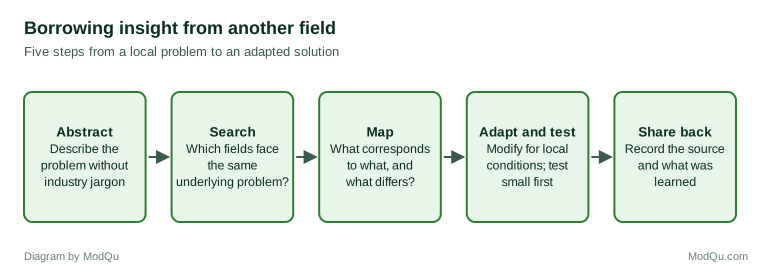
Abstract the problem. Describe the problem in general terms, free of the jargon of one's own industry. "Reduce errors when a patient's care passes from one team to another" invites comparison with any field that hands over complex work under time pressure. "Improve the post-operative transfer protocol" does not.
Search deliberately in analogous fields. Ask which other industries face the same underlying problem, and look at how they solve it. Gick and Holyoak's (1980) findings suggest that prompting people to look for analogies makes them far more likely to find them.
Map the structure, including the differences. Identify what corresponds to what between the source and the target, and what does not. A pit crew practises one task repeatedly with the same team; a hospital handover involves changing staff and patients with very different conditions. The differences determine what must be adapted.
Adapt and test. Borrowed solutions should be modified for local conditions and tested on a small scale before being rolled out, as both the surgical checklist and the handover examples were.
Use boundary objects. Star and Griesemer (1989) described "boundary objects", such as shared maps, models or forms, that are understood by different groups in their own ways while still allowing them to work together. In insight work, a customer journey map, a shared dashboard or a common segmentation can serve this purpose, giving teams from different functions something concrete to discuss.
Build connections across silos. Rotating staff between functions, running joint projects, and holding regular sessions in which teams present findings to each other create the weak ties through which ideas travel. Insight teams can deliberately act as brokers, routinely asking whether a finding from one part of the business is relevant to another.
Record and share what was borrowed. Documenting the source of an idea, how it was adapted and what happened makes the knowledge available for the next team and builds the organisation's absorptive capacity over time.
An example
Consider a hypothetical insurance company whose claims process is slow and generates many complaints. Its own analysis has focused on staffing levels and processing times. An insight analyst reframes the problem in general terms: "how can an organisation keep anxious customers informed during a process that takes days and involves several handovers?"
The team looks at how other industries handle similar situations. Parcel delivery companies give customers real-time tracking with clear stages. Airlines send proactive messages when flights are delayed, often before customers ask. Hospitals with good discharge processes give patients a named contact and a written plan. The team maps these practices onto the claims process, noting the differences: unlike a parcel, a claim may change direction when new information arrives, and the customer may be distressed.
The company adapts the ideas, introducing a simple claim tracker showing the current stage, proactive updates when a claim stalls, and a named handler for complex claims. It tests the changes with one region first. Complaints about not knowing what is happening fall sharply, even though processing times change little. The insight came not from studying claims more closely but from recognising that the customer's real problem was uncertainty, a problem other industries had already solved.
Key takeaways
Cross-pollination generates new knowledge by moving insights between industries and between parts of an organisation. Research shows that novel combinations of existing knowledge are a frequent source of breakthroughs, that people who bridge separate groups are well placed to spot valuable ideas, and that outsiders often solve problems specialists cannot. Analogies work by mapping deep structure, and people find them more often when prompted to look. But transfer is hard: organisations struggle to absorb distant knowledge, practices are sticky, and different groups attach different meanings to the same words. Abstracting problems, searching deliberately in analogous fields, adapting rather than copying, using shared boundary objects and building connections across silos all make cross-pollination more likely to succeed.
References
Allen, T. J. (1977). Managing the flow of technology: Technology transfer and the dissemination of technological information within the R&D organization. MIT Press.
Burt, R. S. (2004). Structural holes and good ideas. American Journal of Sociology, 110(2), 349–399. https://doi.org/10.1086/421787
Carlile, P. R. (2004). Transferring, translating, and transforming: An integrative framework for managing knowledge across boundaries. Organization Science, 15(5), 555–568. https://doi.org/10.1287/orsc.1040.0094
Catchpole, K. R., de Leval, M. R., McEwan, A., Pigott, N., Elliott, M. J., McQuillan, A., MacDonald, C., & Goldman, A. J. (2007). Patient handover from surgery to intensive care: Using Formula 1 pit-stop and aviation models to improve safety and quality. Paediatric Anaesthesia, 17(5), 470–478. https://doi.org/10.1111/j.1460-9592.2006.02239.x
Cohen, W. M., & Levinthal, D. A. (1990). Absorptive capacity: A new perspective on learning and innovation. Administrative Science Quarterly, 35(1), 128–152. https://doi.org/10.2307/2393553
Dahl, D. W., & Moreau, P. (2002). The influence and value of analogical thinking during new product ideation. Journal of Marketing Research, 39(1), 47–60. https://doi.org/10.1509/jmkr.39.1.47.18930
Enkel, E., & Gassmann, O. (2010). Creative imitation: Exploring the case of cross-industry innovation. R&D Management, 40(3), 256–270. https://doi.org/10.1111/j.1467-9310.2010.00591.x
Fleming, L. (2001). Recombinant uncertainty in technological search. Management Science, 47(1), 117–132. https://doi.org/10.1287/mnsc.47.1.117.10671
Franke, N., Poetz, M. K., & Schreier, M. (2014). Integrating problem solvers from analogous markets in new product ideation. Management Science, 60(4), 1063–1081. https://doi.org/10.1287/mnsc.2013.1805
Gavetti, G., Levinthal, D. A., & Rivkin, J. W. (2005). Strategy making in novel and complex worlds: The power of analogy. Strategic Management Journal, 26(8), 691–712. https://doi.org/10.1002/smj.475
Gentner, D. (1983). Structure-mapping: A theoretical framework for analogy. Cognitive Science, 7(2), 155–170. https://doi.org/10.1207/s15516709cog0702_3
Gick, M. L., & Holyoak, K. J. (1980). Analogical problem solving. Cognitive Psychology, 12(3), 306–355. https://doi.org/10.1016/0010-0285(80)90013-4
Granovetter, M. S. (1973). The strength of weak ties. American Journal of Sociology, 78(6), 1360–1380. https://doi.org/10.1086/225469
Hansen, M. T. (1999). The search-transfer problem: The role of weak ties in sharing knowledge across organization subunits. Administrative Science Quarterly, 44(1), 82–111. https://doi.org/10.2307/2667032
Hargadon, A. B. (2002). Brokering knowledge: Linking learning and innovation. Research in Organizational Behavior, 24, 41–85. https://doi.org/10.1016/S0191-3085(02)24003-4
Hargadon, A., & Sutton, R. I. (1997). Technology brokering and innovation in a product development firm. Administrative Science Quarterly, 42(4), 716–749. https://doi.org/10.2307/2393655
Haynes, A. B., Weiser, T. G., Berry, W. R., Lipsitz, S. R., Breizat, A.-H. S., Dellinger, E. P., Herbosa, T., Joseph, S., Kibatala, P. L., Lapitan, M. C. M., Merry, A. F., Moorthy, K., Reznick, R. K., Taylor, B., & Gawande, A. A. (2009). A surgical safety checklist to reduce morbidity and mortality in a global population. New England Journal of Medicine, 360(5), 491–499. https://doi.org/10.1056/NEJMsa0810119
Jeppesen, L. B., & Lakhani, K. R. (2010). Marginality and problem-solving effectiveness in broadcast search. Organization Science, 21(5), 1016–1033. https://doi.org/10.1287/orsc.1090.0491
Katz, R., & Allen, T. J. (1982). Investigating the Not Invented Here (NIH) syndrome: A look at the performance, tenure, and communication patterns of 50 R&D project groups. R&D Management, 12(1), 7–20. https://doi.org/10.1111/j.1467-9310.1982.tb00478.x
March, J. G. (1991). Exploration and exploitation in organizational learning. Organization Science, 2(1), 71–87. https://doi.org/10.1287/orsc.2.1.71
Reagans, R., & McEvily, B. (2003). Network structure and knowledge transfer: The effects of cohesion and range. Administrative Science Quarterly, 48(2), 240–267. https://doi.org/10.2307/3556658
Star, S. L., & Griesemer, J. R. (1989). Institutional ecology, "translations" and boundary objects: Amateurs and professionals in Berkeley's Museum of Vertebrate Zoology, 1907–39. Social Studies of Science, 19(3), 387–420. https://doi.org/10.1177/030631289019003001
Szulanski, G. (1996). Exploring internal stickiness: Impediments to the transfer of best practice within the firm. Strategic Management Journal, 17(S2), 27–43. https://doi.org/10.1002/smj.4250171105
Tushman, M. L. (1977). Special boundary roles in the innovation process. Administrative Science Quarterly, 22(4), 587–605. https://doi.org/10.2307/2392402
Uzzi, B., Mukherjee, S., Stringer, M., & Jones, B. (2013). Atypical combinations and scientific impact. Science, 342(6157), 468–472. https://doi.org/10.1126/science.1240474