
Share your experience of workplace training
Tell us whether your employer paid for training this year, which skills would help your career and whether you have earned a certificate online. Your answers are combined with other people's and reported only as totals.
Start the workplace training and skills surveyAbout 5 minutes. No account needed. You can stop at any time.
What workplace training covers
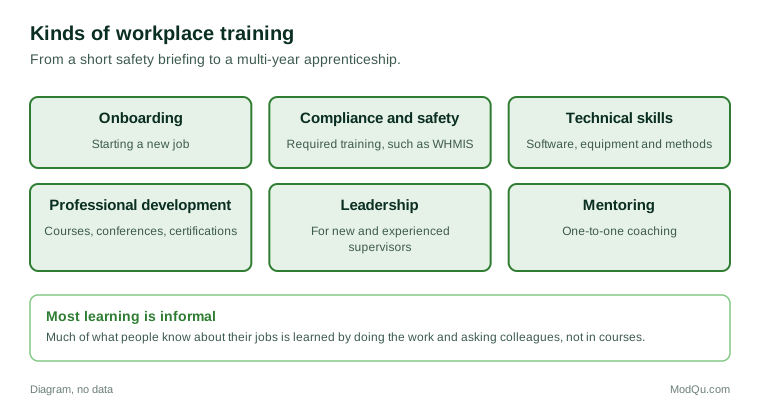
Workplace training is any organized learning connected to a job. It ranges from a one-hour safety briefing to a multi-year apprenticeship. Common kinds include:
- Onboarding: training for new hires on the organization, its systems and the basics of the job.
- Compliance and safety training: required training on workplace safety, privacy, harassment, food handling, financial rules or similar. Some is required by law, such as WHMIS training on hazardous products in Canadian workplaces.
- Technical and job skills: training on software, equipment, methods or products.
- Professional development: courses, conferences and certifications that build a career.
- Leadership and management training for new and experienced supervisors.
- Soft skills: communication, teamwork, customer service and problem solving.
- Mentoring and coaching, one to one.
Training can be delivered in a classroom, online, on the job, through self-paced e-learning, or in a mix of these, often called blended learning.
Learning on the job
Much workplace learning is informal. People learn by doing the work, asking colleagues, watching experienced staff, trying new tasks and solving problems. A widely cited rule of thumb in training circles, the 70-20-10 model, suggests that most learning comes from experience on the job, some from other people, and a smaller share from formal courses. The exact numbers are not based on firm evidence, but the idea that most learning happens outside formal training is widely accepted.
Informal learning is flexible and directly tied to the job, but it can be uneven. New staff may pick up bad habits, and knowledge may be lost when experienced workers leave.
Example
A new receiving clerk at a warehouse gets two days of formal training on the inventory system and safety rules. Most of what they learn about the job, such as which suppliers often send incorrect orders and how to sort out problems, comes from working beside a senior clerk for the first month. When that clerk retires, the employer realizes much of this knowledge was never written down.
Who pays for training
Training is paid for in several ways:
- Employers pay for training they require, and many pay for some or all of other courses that support the job, sometimes in exchange for staying with the employer for a set time.
- Workers pay for their own courses and certifications, especially when changing careers.
- Governments fund training through programs for unemployed workers, apprenticeships, and grants to employers. In Canada, the federal Canada Training Credit allows eligible workers to claim part of their training costs, and provinces offer their own programs and grants.
- Unions and industry groups run training funds and programs in some sectors.
Access to training is uneven. Workers in large organizations, full-time permanent employees and people in higher-paid jobs often receive more employer-paid training than part-time, temporary, gig and lower-paid workers, who may need it just as much.
Example (hypothetical figures)
An employer offers to pay for a project management certification costing $1,800, on the condition that the employee stays for at least one year afterwards or repays part of the cost: 100% if they leave within six months, 50% within twelve months. The employee leaves after nine months for a new job and repays $900.
Certifications and micro-credentials
Credentials show employers what someone knows or can do. Common kinds include:
- Degrees and diplomas from colleges and universities;
- Trade certifications, such as the Red Seal endorsement in Canada, which lets qualified tradespeople work across provinces and territories;
- Professional designations in fields such as accounting, human resources, engineering and project management, usually requiring exams and experience;
- Vendor and technology certifications on particular software or systems;
- Micro-credentials, short, focused programs that certify specific skills, offered by colleges, universities, professional bodies and online platforms;
- Digital badges, online records of completed training that can be shared.
Online certificates have become common, and opinions differ on what they are worth. Some employers value them as proof of initiative and specific skills; others give more weight to degrees, experience or established designations.
Skills gaps and in-demand skills
A skills gap is a mismatch between the skills employers need and the skills available among workers. Employers and governments in Canada and elsewhere regularly report shortages of skilled trades, health care workers and some technical roles, while also noting changes in the skills needed across many jobs.
Skills that employers and workers often mention include:
- digital skills, from basic computer use to data analysis and programming;
- working with new technology tools and automated systems;
- communication, in writing and in person;
- problem solving and critical thinking;
- management and leadership;
- trade and technical skills;
- languages, including English and French in Canada.
Upskilling means building on existing skills to keep up in a current job. Reskilling means learning new skills to move into a different job.
Apprenticeships and work-integrated learning
Apprenticeships combine paid work under a qualified tradesperson with periods of classroom training. In Canada, provinces and territories run apprenticeship systems for trades such as electrician, plumber, carpenter, welder and automotive technician, and many trades lead to the Red Seal.
Work-integrated learning is a broader term for programs that combine study and work, such as co-op programs, internships and practicums in colleges and universities. Employers use them to recruit, and students use them to gain experience.
What makes training worthwhile
People's views of training vary widely. Training that workers rate highly tends to:
- be relevant to the job they do now or want next;
- be given at the time it is needed;
- let them practise what they learn;
- be supported by their manager, with time to use the new skills;
- lead to recognition, a credential or a raise.
Training that people rate poorly is often generic, too long, poorly timed, or done only to tick a box. Mandatory online modules that everyone clicks through are a common complaint.
Example
An office team is required to complete a two-hour online course on a new data system. Most staff click through it in an hour and still struggle with the system. The manager then sets up short weekly sessions where a colleague who knows the system shows real tasks. Within a month, the team is using the system well, and staff say the sessions were more useful than the course.
What people disagree about
There is debate about who should bear the cost of training, especially when workers change employers more often. Some employers worry that if they train staff, competitors will hire them away. Others argue that offering training helps them keep staff. People also disagree about whether short online credentials can replace longer programs, whether governments should fund more training directly to workers or through employers, and how quickly workers will need to retrain as technology changes.
Key terms
- OnboardingTraining and support for new employees as they start a job.
- UpskillingBuilding on existing skills to keep up in a current job.
- ReskillingLearning new skills to move into a different job.
- Micro-credentialA short program that certifies a specific skill.
- ApprenticeshipPaid work under a qualified tradesperson combined with classroom training.
- Red SealA Canadian endorsement that lets qualified tradespeople work across provinces and territories.
- Blended learningTraining that mixes online and in-person methods.
- Skills gapA mismatch between the skills employers need and those workers have.
Full glossary: training development terms on EditingTests.com.
Workplace training and skills vocabulary test
How well do you know the language of this topic? Try 8 quick questions. Your score is shown straight away and is not saved.
What the workplace training and skills survey asks
This survey is part of ModQu's Work and Careers survey. The workplace training and skills part takes about five minutes and covers:
- Whether your employer provided or paid for training this year, and what kind.
- How useful your most recent training was.
- Which skills would most help your career.
- Whether you have earned a certificate or micro-credential, online or in person.
- Who paid for your training, and whether cost has stopped you.
- How you prefer to learn: online, in person, on the job or a mix.
After that you can choose to continue with other short parts of the Work and Careers survey, such as job satisfaction or remote and hybrid work, or stop.
Ready to take part?
Your answers help show what people really think and do. Results are only ever reported as totals; no one can see your individual answers.
Start the surveyQuestions about this survey
Who can take part?
Employed adults.
Do I have to give my name?
No. You may be asked for your age group, region and similar details so results can be broken down, but not your name. ModQu never asks for passwords, card numbers or account numbers.
How are the results used?
Answers are combined into totals and percentages and published in ModQu reports. Individual answers are never shown.
Is the vocabulary test part of the survey?
No. It is optional and separate, and your score is not stored.
I am self-employed. Can I take part?
Yes. The survey asks about training you arrange and pay for yourself, as well as employer training.