
Share how safe you feel at work
Tell us whether you have been injured at work, what safety training you received and how safe you feel. Your answers are combined with other people's and reported only as totals.
Start the workplace safety surveyAbout 5 minutes. No account needed. You can stop at any time.
What workplace safety covers
Workplace safety, often called occupational safety and health, is about preventing injury and illness caused by work. It covers sudden events such as falls and machine accidents, and long-term harm such as hearing loss, back problems, breathing problems from dust or chemicals, and stress.
The International Labour Organization, a United Nations agency, treats a safe and healthy working environment as a fundamental principle and right at work. Most countries have laws that set out duties for employers and workers, and public agencies that inspect workplaces and investigate serious incidents. The details of the laws, and how strongly they are enforced, vary a great deal between countries and between formal and informal work.
The main kinds of hazards
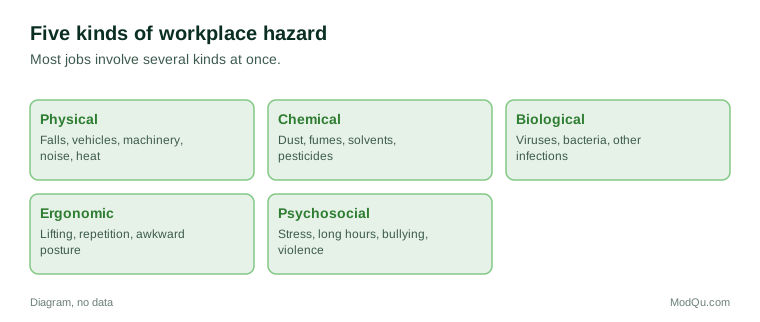
A hazard is anything that could cause harm. Hazards at work are often grouped into several types, shown in the figure below:
- Physical: falls from height, slips and trips, moving vehicles, machinery, noise, vibration, heat and cold, radiation.
- Chemical: dust, fumes, solvents, pesticides, cleaning products and other substances.
- Biological: viruses, bacteria and other infections, for example in health care, farming and waste work.
- Ergonomic: lifting, repetitive movements, awkward postures and poorly set up workstations.
- Psychosocial: stress, long hours, bullying, harassment, violence and aggression from customers or the public.
Some jobs carry well-known high risks, such as construction, mining, farming, fishing, forestry, transport and manufacturing. But injuries also happen in offices, shops, schools, hospitals and homes where people work. Slips, trips, lifting injuries and stress are common in almost every sector.
Who is responsible for safety
In most legal systems, employers have the main duty to keep workplaces safe. That usually includes:
- identifying hazards and assessing risks;
- removing hazards where possible, and controlling the rest;
- providing safety equipment, training and supervision;
- consulting workers on safety;
- recording and reporting serious injuries.
Workers usually have duties too: following safe procedures, using the equipment provided and reporting hazards. In many countries workers have a right to refuse work they believe is seriously dangerous, and a right not to be punished for raising safety concerns.
Many workplaces have safety representatives or joint health and safety committees with members from both management and staff.
Controlling risks
A widely used approach to reducing risk, often called the hierarchy of controls, ranks ways of dealing with hazards from most to least effective:
- Elimination: removing the hazard altogether, such as doing a task at ground level instead of on a ladder.
- Substitution: replacing a hazard with something safer, such as a less harmful cleaning product.
- Engineering controls: physical changes such as guards on machines, ventilation and barriers.
- Administrative controls: rules, procedures, training, rotation of tasks and warning signs.
- Personal protective equipment (PPE): hard hats, gloves, safety glasses, hearing protection, masks and safety boots.
PPE is important, but it is treated as the last line of defence because it only works if worn correctly every time.
Safety training
Safety training ranges from a short induction on the first day to specialist courses and licences. Common topics include:
- emergency procedures and fire evacuation;
- safe lifting and handling;
- use of specific machinery or vehicles;
- working at height and in confined spaces;
- handling chemicals and reading safety labels;
- first aid;
- preventing workplace violence and harassment;
- reporting hazards and incidents.
The quality of training varies. Some workers receive thorough, practical training; others receive a short video or a form to sign. Temporary, agency, gig and informal workers often receive less training than permanent staff.
Example
A young person starts a summer job in a busy restaurant kitchen. They are shown where the fire exit is and told to be careful with knives, but receive no training on the deep fryer. In the second week they suffer a burn while emptying hot oil. Afterwards the manager writes a step-by-step procedure for the fryer and has a senior cook train every new worker on it.
Reporting injuries and near misses
When something goes wrong at work, it is usually meant to be recorded. Many systems distinguish between:
- Injuries and illnesses, from minor cuts to serious harm.
- Near misses, where no one was hurt but could have been, such as a box falling from a shelf beside a worker.
- Dangerous occurrences, serious events defined in law that must be reported to the authorities.
Near misses are valuable because they show where an injury may happen next. But many go unreported. Workers may not want to cause trouble, may fear blame or losing shifts, or may think reporting makes no difference.
Example (hypothetical figures)
A warehouse with 80 staff records 3 injuries and 4 near misses in a year. After a campaign encouraging staff to report near misses without blame, the next year shows 2 injuries and 26 near misses. The manager notes that the number of near misses did not really rise sixfold; staff are now reporting more of what was already happening, which lets the warehouse fix problems before someone is hurt.
How safe workers feel
Feeling safe at work depends on more than the physical setting. Workers say they feel safer when:
- managers take safety seriously and act on reports;
- equipment is maintained and there are enough staff to do tasks safely;
- they can raise concerns without fear;
- they are not pressured to rush or cut corners;
- violence and harassment are taken seriously.
They feel less safe when targets are high, staffing is low, they work alone or at night, or they deal with aggressive members of the public. Health care, social care, retail and transport workers often report concerns about violence and abuse.
Example
A home care worker visits clients alone in the evenings. After an incident in which a client's relative was aggressive, their employer introduces a check-in system: workers send a short message on arrival and departure, and a supervisor calls if a message is late. The worker says they still find some visits stressful, but they feel less alone.
Trends in workplace safety
Changes in work bring new concerns. Remote and hybrid work raise questions about home workstations and isolation. Gig and platform work raise questions about who is responsible for the safety of delivery riders and drivers. Heat waves have increased attention on working in high temperatures. Mental health and stress are now widely treated as safety issues, not only personal ones.
What people disagree about
- How much regulation is right? Some see safety rules as essential; others see some as costly paperwork.
- Who protects gig workers? Views differ on whether platforms should have the same duties as employers.
- Is stress a safety issue? Many now say yes; some still see it as outside the scope of safety law.
Questions that public bodies, insurers and employers want answered here include how many workers have been injured, what training they received and how safe they feel.
Key terms
- HazardAnything that could cause harm.
- RiskThe chance that a hazard will cause harm, and how serious that harm could be.
- Risk assessmentA careful look at what could cause harm and what to do about it.
- Near missAn event in which no one was hurt but could have been.
- PPEPersonal protective equipment, such as gloves, helmets and safety glasses.
- Hierarchy of controlsA ranking of ways to reduce risk, from removing the hazard to using PPE.
- ErgonomicsDesigning tasks and workplaces to fit the human body.
- Safety representativeA worker chosen to represent colleagues on safety matters.
Full glossary: safety training services terms on EditingTests.com.
Workplace safety vocabulary test
How well do you know the language of this topic? Try 8 quick questions. Your score is shown straight away and is not saved.
What the workplace safety survey asks
This survey is part of ModQu's Safety and Emergencies survey. The workplace safety part takes about five minutes and covers:
- Whether you have been injured or made ill by your work, and how.
- What safety training you received, and how useful it was.
- Whether you have seen or reported a near miss.
- Which hazards concern you most in your job.
- How safe you feel at work, and why.
- Whether you feel able to raise safety concerns without fear.
After that you can choose to continue with other short parts of the Safety and Emergencies survey, such as emergency preparedness or fire safety at home, or stop.
Ready to take part?
Your answers help show what people really think and do. Results are only ever reported as totals; no one can see your individual answers.
Start the surveyQuestions about this survey
Who can take part?
Employees.
Do I have to give my name?
No. You may be asked for your age group, region and similar details so results can be broken down, but not your name. ModQu never asks for passwords, card numbers or account numbers.
How are the results used?
Answers are combined into totals and percentages and published in ModQu reports. Individual answers are never shown.
Is the vocabulary test part of the survey?
No. It is optional and separate, and your score is not stored.