
Share how you decide what to trust
Tell us how often you see information you think is false, how you check it and whom you trust. Your answers are combined with other people's and reported only as totals.
Start the trust in information surveyAbout 5 minutes. No account needed. You can stop at any time.
Misinformation, disinformation and malinformation
False and misleading information is often grouped into three kinds:
- Misinformation is false or misleading information shared without intent to deceive, for example a person passing on a rumour they believe is true.
- Disinformation is false information created or shared deliberately to deceive, for example to influence an election or to make money.
- Malinformation is true information shared to cause harm, such as private details posted to harass someone, or facts taken out of context.
The same claim can move between categories: a story invented to deceive (disinformation) can be shared by people who believe it (misinformation). The Canadian Centre for Cyber Security and other public bodies use these terms in their public guidance.
How false information spreads
False information spreads in many ways: on social media, in messaging apps and group chats, by word of mouth, on websites made to look like news sites, in videos and memes, and sometimes in mainstream media when errors are made. Things that make false claims spread faster include:
- Emotion: content that causes anger, fear or surprise is shared more.
- Speed: people share before they read, sometimes after seeing only a headline.
- Trust in the sharer: a claim passed on by a friend or relative feels more believable.
- Repetition: hearing a claim many times makes it feel more familiar and so more true.
- Fake accounts and automation, which can make a claim look more popular than it is.
- Manipulated media, including edited images, misleading captions and deepfakes made with artificial intelligence tools.
Example
A family group chat receives a forwarded message saying a common household product causes a serious illness. Several relatives forward it to other groups within an hour. One cousin searches for the claim and finds a public health agency page explaining that the message has circulated for years and is false. She posts the link in the chat; two relatives thank her, and one says they will keep using the product anyway "to be safe".
How people check information
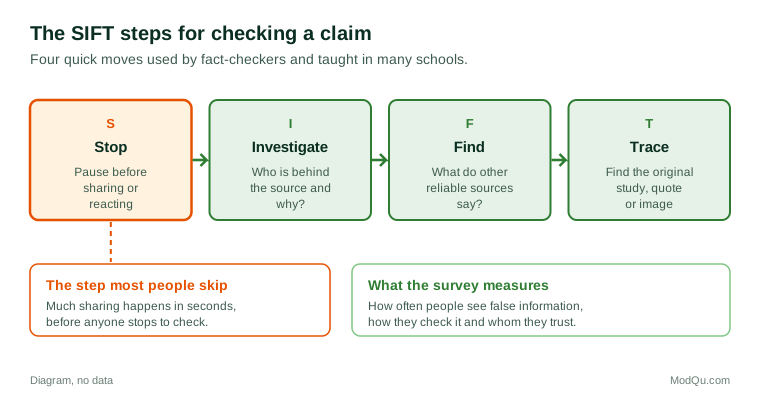
People use many ways to judge whether something is true. Professional fact-checkers often use a method called lateral reading: instead of studying the page in front of them, they open new tabs to see what other sources say about the claim and about the source itself. A widely taught version is the SIFT method:
- Stop: pause before sharing or reacting.
- Investigate the source: who is behind it and what is their purpose?
- Find better coverage: what do other reliable sources say?
- Trace claims to their origin: find the original study, quote or image.
Other common checks include looking at the date, checking whether a photo has appeared before by doing a reverse image search, looking for the same story on established news sites, and asking whether the claim seems designed to make readers angry. Fact-checking organizations publish verdicts on viral claims, and some platforms add labels or context notes.
Example
Before sharing a striking photo said to show a recent flood in their city, a high-school student does a reverse image search. They find the same photo published years earlier from another country. They post a reply with the original source instead of sharing the photo.
Whom people trust
Trust in sources of information varies widely between people and between countries. Sources people turn to include family and friends, doctors and pharmacists, scientists and universities, government agencies, news organizations, teachers, religious leaders, online creators and search results. Many people trust some sources for some topics and not for others: a doctor for health, a mechanic for cars, a local news site for road closures.
What makes people trust a source? Common factors include past accuracy, openness about mistakes, perceived honesty and independence, shared values, expertise, and whether the source is seen as taking sides. Trust can fall quickly after a well-publicized error, and it is slow to rebuild.
Example
A man who distrusts national news outlets relies on a local radio host and a few online channels for news. When his town has a boil-water advisory, he follows the instructions from the municipality's website, because he says the town has always been straight with residents about water.
Trust in experts and institutions
Surveys in Canada and other countries track trust in scientists, doctors, governments, the media and other institutions. Trust levels often change after major events, such as a pandemic or an election. Trust in experts tends to be higher than trust in governments or the media in many surveys, but it varies by topic, age, region, education and political views.
Low trust is not always the same as believing false information. Some people are sceptical of all sources and check everything; others trust a narrow set of sources completely. Researchers distinguish healthy scepticism, which asks for evidence, from cynicism, which rejects evidence whatever its source.
Information in emergencies
Trust in information matters most when people need to act quickly, such as during wildfires, floods, storms and public health emergencies. Official alerts in Canada are sent through the national public alerting system to TV, radio and compatible phones. At the same time, rumours about evacuations, road closures and causes of an emergency can spread fast on social media.
Emergency agencies try to post updates often, correct false claims quickly and use plain language. Many people check several sources at once, such as an official alert, a local news site and a neighbourhood group, and give more weight to sources that have been reliable before. Surveys after emergencies often ask which sources people used and which they trusted.
What people disagree about
Debates include who should decide what counts as misinformation, how much social media platforms should remove or label content, whether governments should regulate online information, how to protect free expression while limiting harm, how schools should teach media literacy, and how artificial intelligence tools will affect what people can believe. Questions that governments, media and community organizations want answered include how often people see false information, whether they check before sharing, and which sources they trust for which topics.
Key terms
- MisinformationFalse or misleading information shared without intent to deceive.
- DisinformationFalse information created or shared deliberately to deceive.
- MalinformationTrue information shared to cause harm.
- Lateral readingChecking a claim by seeing what other sources say about it and its source.
- Reverse image searchSearching with an image to find where else it has appeared.
- DeepfakeVideo, audio or images altered or made with artificial intelligence to look real.
- Fact-checkA published review of whether a claim is accurate.
- Media literacyThe skills to find, judge and use information from media.
Full glossary: news production terms on EditingTests.com.
Trust in information vocabulary test
How well do you know the language of this topic? Try 8 quick questions. Your score is shown straight away and is not saved.
What the trust in information survey asks
This survey is part of ModQu's Communities and Society survey. The trust in information part takes about five minutes and covers:
- How often you see information you think is false or misleading, and where.
- Whether you check facts before sharing, and how.
- Whom you trust most for information on health, news and local matters.
- Whether your trust in scientists, governments and media has changed, and why.
- Whether you have shared something that later turned out to be false.
- What you think should be done about false information online.
After that you can choose to continue with other short parts of the Communities and Society survey, such as neighbourhoods and community life or loneliness and social connection, or stop.
Ready to take part?
Your answers help show what people really think and do. Results are only ever reported as totals; no one can see your individual answers.
Start the surveyQuestions about this survey
Who can take part?
Adults.
Do I have to give my name?
No. You may be asked for your age group, region and similar details so results can be broken down, but not your name. ModQu never asks for passwords, card numbers or account numbers.
How are the results used?
Answers are combined into totals and percentages and published in ModQu reports. Individual answers are never shown.
Is the vocabulary test part of the survey?
No. It is optional and separate, and your score is not stored.