
Share your spiritual practices
Tell us whether you see yourself as spiritual, which practices you follow and where you learn about them. Your answers are combined with other people's and reported only as totals.
Start the spirituality and prayer surveyAbout 5 minutes. No account needed. You can stop at any time.
What people mean by spirituality
Spirituality is a broad word, and people use it in different ways. For some it means a personal relationship with God. For others it means a sense of connection to something larger than oneself, such as nature, humanity or the universe. Some use it to describe a search for meaning, peace or purpose, without any belief in the supernatural.
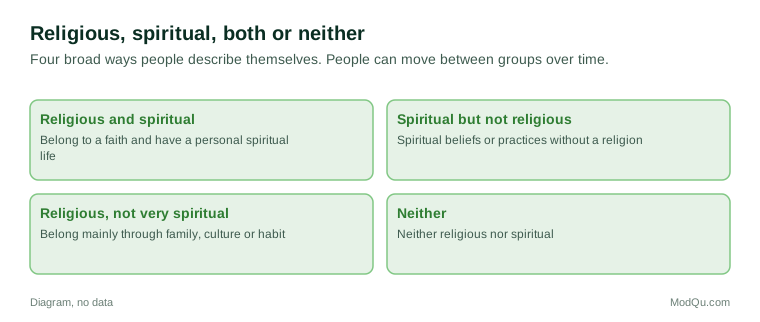
Researchers often find that people fall into four rough groups:
- Religious and spiritual: they belong to a faith and also have a personal spiritual life.
- Spiritual but not religious: they have spiritual beliefs or practices but do not identify with a religion.
- Religious but not very spiritual: they belong to a faith mainly through family, culture or habit.
- Neither: they describe themselves as neither religious nor spiritual.
People can move between these groups over a lifetime.
Prayer
Prayer is one of the most widespread spiritual practices. It takes many forms:
- Set prayers recited at fixed times or in fixed words.
- Personal prayer in a person's own words, asking for help, giving thanks or speaking about worries.
- Prayer for others, such as sick relatives or people affected by disaster.
- Chanting and repetition of sacred words, sometimes counted on beads.
- Silent or contemplative prayer, sitting quietly with attention on God or the sacred.
Some people pray several times a day; others only in times of crisis. Some people who do not belong to a religion still say they pray.
Example
A taxi driver does not attend any religious services but says a short prayer for safety each morning before starting work, as his grandmother taught him. He describes himself as "spiritual, not religious" and says the habit helps him feel calm on busy days.
Meditation and mindfulness
Meditation comes from several religious traditions, including Buddhist, Hindu, Christian, Jewish, Muslim and Sikh practices. It is now also taught in secular settings such as schools, hospitals and workplaces, often under the name mindfulness. Common forms include focusing on the breath, repeating a word or phrase, walking slowly with full attention and body scans.
People meditate for different reasons: some as part of their faith, some to manage stress, some to improve concentration and some out of curiosity. Health organizations describe meditation as a practice that some people find helpful for stress, but it is not a replacement for medical care.
Other personal practices
Spiritual practices outside formal religion include:
- spending time in nature, such as walking in forests or by the sea;
- journaling, gratitude lists or reflection at the end of the day;
- yoga, tai chi or other movement practices with spiritual roots;
- lighting candles, keeping a home altar or remembering ancestors;
- reading spiritual books or poetry;
- music, singing or chanting;
- retreats, silent days or time away from devices.
Some people also follow practices such as astrology, tarot or crystals. Others see these as entertainment or reject them. Surveys usually ask about these separately because people see them in very different ways.
Example
A teacher who was raised without religion starts a short morning meditation using a free recording from a local library. After a year, she adds a weekly walk alone in a park, which she describes as "the closest thing I have to church".
Where people learn about spiritual practices
People learn about spirituality from many sources:
- family and childhood religious teaching;
- places of worship, religious teachers and study groups;
- books, podcasts, videos and apps;
- classes at community centres, gyms and yoga studios;
- friends and colleagues;
- retreats and workshops.
The quality of these sources varies. Some teachers are trained within long traditions; others have little training. People often say they find it hard to tell which sources are trustworthy.
Example (hypothetical figures)
A person tries three meditation apps over a year. The first is free with advertisements; the second costs 8 a month and the third 60 a year. They keep the yearly plan, which works out at 5 a month, and cancel the others. They also join a free weekly group at a local community centre.
Spirituality, health and wellbeing
Many people say that prayer or meditation helps them cope with stress, grief or illness. Hospitals in many countries have chaplains or spiritual care staff of several faiths, and some include questions about spiritual needs in patient care. Researchers study links between spiritual practice and wellbeing, but results are mixed and depend on how practice and wellbeing are measured. Spiritual practice can support, but should not replace, professional medical or mental health care.
What people disagree about
- Whether spirituality without religion is a full spiritual life or something thinner.
- Whether secular mindfulness respects or strips away the religious roots of meditation.
- How much money should be made from spiritual products and courses.
- Whether schools and workplaces should offer meditation or prayer spaces.
- How to tell sincere teachers from people who exploit followers.
Why surveys ask about spirituality
Questions that organizations want answered include how many people see themselves as spiritual, which practices they follow, how often, where they learn about them and what they would like to learn more about. Every question can be skipped, and answers are reported in groups.
Spiritual practice at different ages
Spiritual practice often looks different at different ages. Children may learn short prayers or songs from parents and grandparents. Teenagers and young adults often question what they were taught and try new practices, sometimes through friends or online sources. Adults in busy working years may have little time for practice and fit it into commutes or the start and end of the day. Older adults often report more time for prayer and reflection, and some say spiritual practice becomes more important as they face illness or the loss of friends.
These differences are one reason surveys ask about age as well as practice, so results can show how habits change across generations.
Key terms
- SpiritualityA sense of connection to something beyond oneself, with or without religion.
- Contemplative prayerSilent prayer focused on God or the sacred rather than on words.
- MeditationA practice of training attention, often by focusing on breath, a word or an image.
- MindfulnessPaying full attention to the present moment without judgment; often taught in secular settings.
- MantraA word or phrase repeated in meditation or prayer.
- RetreatA period away from daily life for prayer, meditation or reflection.
- ChaplainA spiritual care worker in a hospital, prison, university or the armed forces.
- Spiritual but not religiousDescribing someone with spiritual beliefs or practices who does not identify with a religion.
Full glossary: wellness terms on EditingTests.com.
Spirituality and prayer vocabulary test
How well do you know the language of this topic? Try 8 quick questions. Your score is shown straight away and is not saved.
What the spirituality and prayer survey asks
This survey is part of ModQu's Religion and Spirituality survey. The spirituality and prayer part takes about five minutes and covers:
- Whether you consider yourself religious, spiritual, both or neither.
- Which practices you follow, such as prayer, meditation or time in nature.
- How often you practise, and at what times of day.
- Where you learn about spiritual practices.
- Whether you pay for books, apps, classes or retreats.
- How your spiritual life has changed in recent years.
After that you can choose to continue with other short parts of the Religion and Spirituality survey, such as religion in daily life or places of worship, or stop.
Ready to take part?
Your answers help show what people really think and do. Results are only ever reported as totals; no one can see your individual answers.
Start the surveyQuestions about this survey
Who can take part?
Adults.
Do I have to give my name?
No. You may be asked for your age group, region and similar details so results can be broken down, but not your name. ModQu never asks for passwords, card numbers or account numbers.
How are the results used?
Answers are combined into totals and percentages and published in ModQu reports. Individual answers are never shown.
Is the vocabulary test part of the survey?
No. It is optional and separate, and your score is not stored.
Can I take the survey if I am not religious?
Yes. Many questions are about personal practices such as meditation or time in nature, and every question can be skipped.
Does the survey judge any belief or practice?
No. It records what people do and think, and treats every answer the same way.