
Share how you celebrate
Tell us which holidays you mark, how you celebrate, what you spend and whether you get time off. Your answers are combined with other people's and reported only as totals.
Start the religious holidays and festivals surveyAbout 5 minutes. No account needed. You can stop at any time.
What counts as a religious holiday or festival
A religious holiday is a day or period set aside in a faith's calendar to remember an event, honour a figure, mark a season or observe a fast. Festivals can last a single day or several weeks. Examples from different faiths include Christmas and Easter, Eid al-Fitr and Eid al-Adha, Diwali and Holi, Passover and Yom Kippur, Vesak, Vaisakhi, Lunar New Year customs with religious roots, and many local saints' days and temple festivals.
Religious holidays follow different calendars. Some follow the solar calendar and fall on the same date each year. Others follow a lunar or lunisolar calendar, so their date moves from year to year. A holiday that falls in winter in one decade can fall in summer some years later, which changes how people celebrate, travel and work.
Kinds of holidays
Holidays can be grouped by what they ask of people:
- Feasts and celebrations: shared meals, gifts, music, lights and decorations.
- Fasts and solemn days: going without food or drink for set hours, quiet reflection and extra prayer.
- Remembrance days: honouring the dead, visiting graves or lighting candles.
- Pilgrimage festivals: travelling to holy sites, often in very large numbers.
- Harvest and seasonal festivals: marking planting, harvest or the new year.
Many holidays combine several of these. A month of fasting may end with a large festival and family visits.
How people celebrate
Celebration usually mixes religious and family traditions. Common activities include:
- attending special services or prayers;
- cooking traditional dishes and sharing meals with family and neighbours;
- giving gifts, money in envelopes or charity to the poor;
- wearing new or traditional clothes;
- decorating homes with lights, lamps, flowers or images;
- visiting relatives, sometimes travelling long distances;
- public parades, fireworks or community events.
Some people celebrate a holiday mainly as a family or cultural event, without strong religious belief. Others keep the religious side strictly and avoid what they see as commercial excess.
Example
A family that lives abroad cannot travel home for a major festival this year. They join their parents' celebration by video call, cook the same dishes at the same time, and visit a local temple that holds an evening event for people from their home region.
What people spend
Religious holidays are among the biggest spending periods of the year in many countries. Spending often goes on:
- food and drink for meals and guests;
- gifts and new clothing;
- travel to see family;
- decorations, candles and lamps;
- donations and charity;
- special services such as catering or hall rental for large gatherings.
Retailers, airlines and food producers plan months ahead for these periods, and prices for travel often rise. For some households, holidays bring financial strain, with credit card debt or loans taken to meet family expectations.
Example (hypothetical figures)
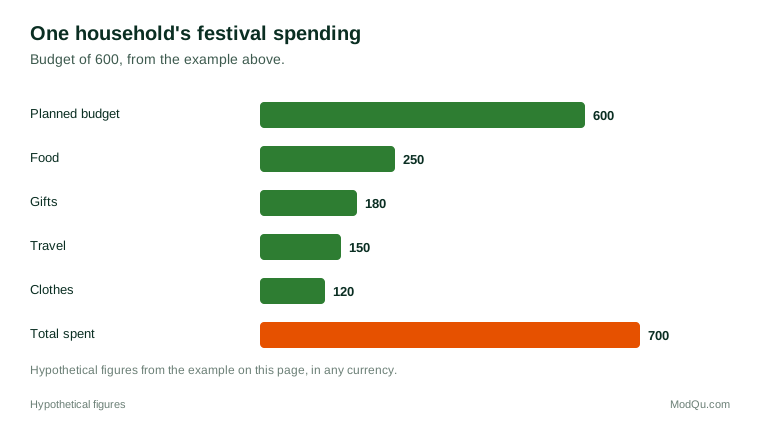
A household sets a budget of 600 for a festival. They spend 250 on food, 180 on gifts, 120 on new clothes for the children and 150 on train tickets to visit grandparents. The total is 700, which is 100 over budget. They decide to agree a gift limit with relatives next year.
Time off work and school
Whether people get time off for religious holidays depends on where they live and which faith they follow. In many countries the main holidays of the majority religion are public holidays, so most people have the day off. People of minority faiths often have to use annual leave, swap shifts or ask for unpaid time.
Common arrangements include:
- public holidays set by law;
- floating holidays that employees choose for their own faith;
- shift swaps and flexible hours, especially during fasting periods;
- school rules that excuse pupils for religious days without penalty.
Example
A warehouse worker asks to finish early each day during a month of fasting so that they can break the fast at home with family. Their manager agrees to an earlier shift pattern, and a colleague who celebrates a different festival later in the year agrees to cover for them in return.
Holidays in diverse societies
In countries with many faiths, holiday calendars become more complex. Schools may avoid setting exams on major holy days of several faiths, cities may hold public events for several festivals, and shops may stock goods for each one. Some people welcome the chance to learn about neighbours' holidays; others feel that their own traditions get less attention than they once did.
What people disagree about
Common debates include:
- whether holidays have become too commercial;
- which religious holidays should be public holidays in a diverse country;
- whether greetings and public decorations should be general or specific to one faith;
- the environmental cost of fireworks, travel and waste;
- how to balance religious observance with the needs of employers.
Why surveys ask about holidays
Questions that organizations want answered include which holidays people celebrate, how they celebrate, how much they spend and on what, how they travel, and whether they can get time off. Answers are grouped, and questions about religion can be skipped.
Holidays for people who live away from home
Students, migrant workers and people who have moved abroad often spend religious holidays far from family. Some travel home at great cost during the busiest weeks of the year. Others join celebrations organized by local faith communities, student societies or people from the same home region, or mark the day with family by video call. Food shops that sell ingredients from many countries are often busiest in the days before major festivals.
For people working in health care, transport, hospitality and other jobs that run every day of the year, holidays can mean working while others celebrate. Many such workers trade shifts with colleagues of other faiths so that each can be with family on their own most important days.
Key terms
- Liturgical calendarThe yearly cycle of holy days and seasons in a religious tradition.
- Lunar calendarA calendar based on the phases of the moon, so dates move against the solar year.
- Feast dayA day of celebration in a religious calendar.
- FastGoing without some or all food and drink for a set time, for religious reasons.
- Public holidayA day off set by law for most workers and schools.
- Floating holidayA day off an employee may choose, often for their own religious holiday.
- AlmsgivingGiving money or goods to people in need as a religious duty.
- VigilA period of staying awake for prayer, often the night before a holy day.
Full glossary: faith based organizations terms on EditingTests.com.
Religious holidays and festivals vocabulary test
How well do you know the language of this topic? Try 8 quick questions. Your score is shown straight away and is not saved.
What the religious holidays and festivals survey asks
This survey is part of ModQu's Religion and Spirituality survey. The religious holidays and festivals part takes about five minutes and covers:
- Which religious holidays and festivals you celebrate.
- How you celebrate: services, meals, gifts, travel or events.
- How much you spend and on what.
- Whether you get time off work or school for them.
- Whether you travel to see family, and how you arrange it.
- How your celebrations have changed in recent years.
After that you can choose to continue with other short parts of the Religion and Spirituality survey, such as religion in daily life or places of worship, or stop.
Ready to take part?
Your answers help show what people really think and do. Results are only ever reported as totals; no one can see your individual answers.
Start the surveyQuestions about this survey
Who can take part?
Adults.
Do I have to give my name?
No. You may be asked for your age group, region and similar details so results can be broken down, but not your name. ModQu never asks for passwords, card numbers or account numbers.
How are the results used?
Answers are combined into totals and percentages and published in ModQu reports. Individual answers are never shown.
Is the vocabulary test part of the survey?
No. It is optional and separate, and your score is not stored.
Can I take part if I celebrate holidays only as family or cultural events?
Yes. The survey covers religious, cultural and family celebrations, whatever your beliefs.
Do I need to give exact spending figures?
No. Spending questions use ranges, and you can skip any you prefer not to answer.