
Share your views on religious education
Tell us whether your child receives religious education, where, and how important it is to you. Your answers are combined with other people's and reported only as totals.
Start the religious education surveyAbout 5 minutes. No account needed. You can stop at any time.
Two meanings of religious education
Religious education is used in two different senses:
- Learning a faith from within: teaching children and adults the beliefs, scriptures, prayers, rituals and values of their own religion, usually by members of that faith. This is sometimes called religious instruction or faith formation.
- Learning about religions: studying several religions and non-religious worldviews from the outside, often in public schools, to understand their history, beliefs and practices.
Some systems combine the two. Survey questions usually make clear which kind they mean, because parents often feel differently about them.
Where religious education happens
Religious education takes place in many settings:
- Faith schools: full-time schools run by or linked to a religious body, teaching the standard curriculum alongside religious teaching.
- Public school lessons: required or optional classes in religion or ethics, depending on the country.
- Supplementary classes: weekend, evening or after-school classes at a place of worship, such as scripture study or language classes for reading sacred texts.
- Preparation for rites of passage: courses before a first communion, bar or bat mitzvah, confirmation or similar ceremony.
- Home teaching: parents and grandparents teaching prayers, stories and customs.
- Online classes: live or recorded lessons with teachers who may be in another country.
- Higher education: theology and religious studies degrees, seminaries and religious colleges.
How it differs by country
Countries take very different approaches. In some, religion is a compulsory school subject, sometimes taught according to the faith of the majority, with exemptions for others. In some, public schools teach about several religions in a neutral way. In others, public schools do not teach religion at all and leave it to families and faith communities. Funding of faith schools also varies: some states fund them fully, some partly, and some not at all. Parents' rights to withdraw children from religious lessons also differ.
How families choose
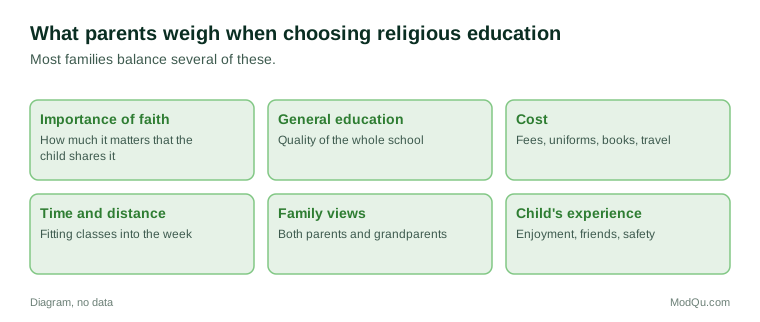
The figure below shows the main factors that parents weigh when choosing religious education for a child.
Parents often weigh:
- how important it is to them that the child shares their faith;
- the quality of the general education at a faith school;
- cost, including fees, uniforms and travel;
- distance and timing of classes alongside school and activities;
- the views of the other parent and of grandparents;
- whether the child enjoys the classes and has friends there;
- whether the teaching matches their own beliefs and values.
Example
Parents in a mixed-faith family agree that their daughter will attend a public school, learn about several religions there, and join a weekend class at each parent's place of worship once a month. They say the arrangement is busy but lets their daughter understand both families' traditions.
Costs
Costs range from nothing to a large share of household income. Supplementary classes may be free, supported by donations or charged a modest fee. Faith schools may be free where state-funded, or charge fees where private. Additional costs include books, special clothing, travel and gifts at rites of passage.
Example (hypothetical figures)
A family pays 40 a month for weekend scripture classes for each of two children, for ten months of the year. That is 800 a year. Books and a uniform for the classes add 120, so the total is 920 a year.
What children learn
Content varies by faith and by setting, but often includes:
- stories and history of the faith;
- prayers and how to take part in worship;
- reading or reciting sacred texts, sometimes in a language other than the child's first language;
- ethics and how to treat others;
- festivals and their meanings;
- for learning about religions: comparison of beliefs, visits to places of worship and discussion of different worldviews.
Example
A teenager who attended weekend classes for eight years says the language lessons were hard but now lets them read their grandparents' prayers. They also say the classes gave them a group of friends who share their background, which mattered when they were the only member of their faith in their school year.
Child safety and standards
Parents expect religious classes to be safe and well run. Many faith bodies and governments now require background checks for teachers and volunteers, child protection policies and clear ways to report concerns. Standards for supplementary classes vary, and some countries have introduced registration or inspection. Parents are often advised to ask about safeguarding policies when choosing a class.
What people disagree about
- Whether public money should fund faith schools.
- Whether public schools should teach religion, ethics or neither.
- Whether parents should be able to withdraw children from lessons about religion.
- How faith schools should admit pupils of other faiths or none.
- How to balance passing on a faith with a child's own freedom to choose.
Why surveys ask about religious education
Questions that faith organizations, schools, publishers and public bodies want answered include how many children receive religious education, where, at what cost, how satisfied parents are and how important it is to them. Questions about religion can be skipped and answers are grouped.
Religious education for adults
Religious education does not end in childhood. Adults join study circles, scripture classes, language courses for reading sacred texts, preparation courses before marriage or before joining a faith, and evening talks at places of worship. Many universities offer theology or religious studies courses to the public, and online courses let adults study with teachers in other countries. Adults give reasons such as wanting to understand their faith better, preparing to teach their own children, returning to a faith after time away or learning about a partner's religion. Some adults also take courses on world religions out of general interest or for work in fields such as health care, social work and teaching.
Key terms
- Faith schoolA school run by or linked to a religious body.
- Religious instructionTeaching the beliefs and practices of a faith to its members.
- Religious studiesLearning about several religions from a neutral, academic point of view.
- Supplementary schoolClasses held outside normal school hours, often at weekends.
- SeminaryA college that trains clergy or religious teachers.
- CatechismA summary of a faith's teaching, often in questions and answers, used to teach it.
- Opt-outA parent's right to withdraw a child from certain lessons.
- SafeguardingPolicies and practices that protect children from harm.
Full glossary: faith based organizations terms on EditingTests.com.
Religious education vocabulary test
How well do you know the language of this topic? Try 8 quick questions. Your score is shown straight away and is not saved.
What the religious education survey asks
This survey is part of ModQu's Religion and Spirituality survey. The religious education part takes about five minutes and covers:
- Whether your child receives religious education, and of which kind.
- Where it takes place: faith school, public school, weekend class, home or online.
- How much it costs your household.
- How important it is to you that your child learns your faith, or about many faiths.
- How satisfied you are with the teaching and safety.
- Your views on religion in public schools.
After that you can choose to continue with other short parts of the Religion and Spirituality survey, such as religion in daily life or places of worship, or stop.
Ready to take part?
Your answers help show what people really think and do. Results are only ever reported as totals; no one can see your individual answers.
Start the surveyQuestions about this survey
Who can take part?
Parents and adults.
Do I have to give my name?
No. You may be asked for your age group, region and similar details so results can be broken down, but not your name. ModQu never asks for passwords, card numbers or account numbers.
How are the results used?
Answers are combined into totals and percentages and published in ModQu reports. Individual answers are never shown.
Is the vocabulary test part of the survey?
No. It is optional and separate, and your score is not stored.
Can I take the survey if I do not have children?
Yes. Adults are asked about their own religious education and their views, and parents are asked about their children.
Will the survey ask which school my child attends?
No. It asks about the kind of school or class, never its name.