
Share your experience of running a business
Tell us your biggest challenge this year, whether you plan to hire and which tools you rely on. Your answers are combined with other people's and reported only as totals.
Start the small business owners surveyAbout 5 minutes. No account needed. You can stop at any time.
Who small business owners are
A small business is usually defined by its number of employees. In Canada, Innovation, Science and Economic Development Canada commonly counts businesses with 1 to 99 employees as small, and those with fewer than 5 as micro-businesses; this survey looks at owners of businesses with fewer than 50 staff. Small businesses account for the great majority of employer businesses in Canada, and many more people are self-employed with no employees at all.
Small business owners run every kind of firm:
- Local services, such as restaurants, salons, trades, repair shops and cleaning companies.
- Retail, from corner stores to specialty shops and online sellers.
- Professional services, such as accounting, law, design, consulting and IT.
- Construction and trades, including contractors, electricians and plumbers.
- Manufacturing and food production, often in small workshops or shared kitchens.
- Farms, fishing and forestry businesses, many of them family-owned.
- Health and wellness practices, such as clinics, physiotherapists and dentists.
Owners also vary: first-time founders, people who bought an existing business, second- and third-generation family owners, newcomers to Canada, and people who started a side business that grew.
The challenges owners report
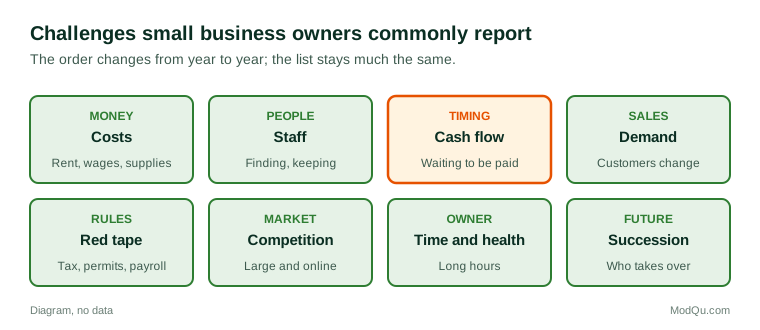
Small business surveys in Canada and elsewhere tend to find a similar set of concerns, though their order changes from year to year:
- Costs: rent, wages, supplies, insurance, energy and interest.
- Finding and keeping staff, especially skilled workers.
- Cash flow: paying bills while waiting for customers to pay.
- Demand: sales slowing, or customers changing how they buy.
- Red tape: taxes, permits, payroll rules and reporting.
- Competition, including from large firms and online sellers.
- Owner time and health, since many owners work long hours with no cover.
Example
The owner of a small bakery with six staff lists her top three problems for the year: higher costs for flour and butter, a commercial rent increase at lease renewal, and difficulty finding a trained baker for early shifts. She raises prices twice, cuts one product line and trains a kitchen helper to take on more baking tasks.
Growth plans and hiring
Not every owner wants to grow. Some want a stable business that supports their family; others plan to expand to new locations, products or markets. Common growth steps include hiring staff, moving to larger premises, buying equipment, starting to sell online, exporting, or buying a competitor.
Hiring is often the hardest step. The first employee brings payroll, source deductions, workplace safety coverage and employment standards that the owner may not have dealt with before. Many owners use part-time staff, contractors or family members before hiring full-time employees.
Financing a small business
Owners use several sources of money to start and run a business:
- Personal savings, the most common starting source for many owners.
- Family and friends, as gifts, loans or investments.
- Bank loans and lines of credit, often secured by business or personal assets.
- Credit cards, used for short-term needs.
- Government-backed loans and programs, such as the federal Canada Small Business Financing Program, and lending from the Business Development Bank of Canada, a Crown corporation.
- Grants, usually for specific purposes such as hiring, training or exporting.
- Investors, for a smaller number of high-growth firms.
- Equipment leasing and supplier credit.
This page describes financing options in general and is not financial advice.
Example (hypothetical figures)
A landscaping company needs a $60,000 truck and trailer. The owner has $15,000 in savings and borrows the remaining $45,000 over five years. At a payment of about $890 a month, the 60 payments total about $53,400, so borrowing costs about $8,400 in interest over the term. The owner expects the extra crew to bring in enough work to cover the payment in the busy season.
Technology and the tools owners rely on
Small businesses rely on a growing set of tools:
- accounting and bookkeeping software;
- point-of-sale systems and card terminals;
- payroll and scheduling apps;
- websites, online stores and booking systems;
- social media and email marketing;
- customer relationship management (CRM) tools;
- cloud storage, email and video calls;
- industry-specific software, such as tools for trades, clinics or restaurants.
Owners often choose software by price, ease of use and whether it works with tools they already have. Many say they struggle to keep up with technology, and some depend on a family member or one employee who understands it.
Example
A two-person plumbing business used paper invoices and a spreadsheet. After waiting months for some customers to pay, the owners switch to an app that creates quotes and invoices on a phone and accepts card payments on site. They say they now get paid faster, but they had to spend several evenings learning the system.
Where owners get help
Owners turn to accountants, bookkeepers, lawyers, banks, industry associations, chambers of commerce, business support centres funded by governments, mentors, peer groups and online forums. Government websites list programs and rules for each province and territory. Owners often say that the hardest part is knowing which help exists and which rules apply to them.
Succession and the future of the business
Many small business owners are approaching retirement age, which raises questions about who will take over. Options include passing the business to family, selling to employees or managers, selling to an outside buyer, or closing it. Planning a succession can take years, and many owners have no written plan.
Example
The owner of a hardware store, aged 66, wants to retire in three years. Neither of his children wants to run the store. He talks to his accountant about a sale and to his longest-serving manager about buying the business over several years. They agree on a plan in which the manager buys a share each year.
Trends and debates
Recent years have brought online selling, card and mobile payments in place of cash, remote work for office-based firms, and higher costs and interest rates. Owners and governments debate the level of taxes and regulation, minimum wages, support programs, and how to help small firms compete with large ones. Questions businesses want answered include owners' biggest challenges, plans to hire, sources of financing, and the software they rely on most.
Key terms
- Small businessIn Canada, usually a business with 1 to 99 employees.
- Sole proprietorshipA business owned by one person who is personally responsible for its debts.
- IncorporationRegistering a business as a separate legal entity from its owners.
- Cash flowThe timing of money coming into and going out of a business.
- Line of creditBorrowing up to a set limit, repaid and borrowed again as needed.
- Source deductionsIncome tax, CPP and EI amounts employers withhold from pay.
- Point of saleThe system and place where a customer pays.
- Succession planA plan for who will own or run a business when the owner leaves.
Full glossary: commercial lending terms on EditingTests.com.
Small business owners vocabulary test
How well do you know the language of this topic? Try 8 quick questions. Your score is shown straight away and is not saved.
What the small business owners survey asks
This survey is part of ModQu's Business and Professional Services survey. The small business owners part takes about five minutes and covers:
- What your business does, how long it has operated and how many people it employs.
- Your biggest challenges this year.
- Whether you plan to hire, expand or change the business in the next year.
- How the business is financed, and whether you have applied for credit recently.
- Which software and tools the business relies on most.
- Where you go for advice and support.
After that you can choose to continue with other short parts of the Business and Professional Services survey, such as accounting and bookkeeping or marketing and advertising, or stop.
Ready to take part?
Your answers help show what people really think and do. Results are only ever reported as totals; no one can see your individual answers.
Start the surveyQuestions about this survey
Who can take part?
Owners of businesses with fewer than 50 staff.
Do I have to give my name?
No. You may be asked for your age group, region and similar details so results can be broken down, but not your name. ModQu never asks for passwords, card numbers or account numbers.
How are the results used?
Answers are combined into totals and percentages and published in ModQu reports. Individual answers are never shown.
Is the vocabulary test part of the survey?
No. It is optional and separate, and your score is not stored.