
Share how safe you feel in public
Tell us how safe you feel walking alone at night, on transport and in public places, and what you do to feel safer. Your answers are combined with other people's and reported only as totals.
Start the personal safety in public surveyAbout 5 minutes. No account needed. You can stop at any time.
What personal safety in public means
Personal safety in public is about the risk of harm, and the fear of harm, when people are outside their homes: on streets, in parks, on public transport, in car parks, at stations, in shops and at events. It covers crimes such as theft, robbery, assault and harassment, as well as non-criminal risks such as poorly lit paths, crowds and traffic.
Researchers separate two things that do not always match:
- Actual risk: how likely a person is to be harmed in a given place and time.
- Perceived safety: how safe the person feels.
A person may feel very unsafe in a place where crime is rare, or feel safe in a place with real risks. Both matter. Fear affects behaviour even when actual risk is low, and feeling safe can lead people to take fewer precautions.
How safe people feel and where
A common survey question asks how safe people feel walking alone in their area after dark. National and international surveys have used versions of this question for many years, which allows comparisons across countries and over time.
Feelings of safety vary with:
- Time of day: most people feel less safe at night.
- Place: busy streets usually feel safer than empty ones; parks, underpasses, car parks and stations can feel risky after dark.
- Transport: waiting at a stop, walking to and from a station, and being on a near-empty vehicle can feel less safe than being on a busy one.
- Familiarity: people often feel safer in their own neighbourhood than in unfamiliar areas.
- Past experience: people who have been victims of crime, or know someone who has, often feel less safe.
Who feels less safe
Feelings of safety differ between groups. In many countries surveys have found that:
- women are more likely than men to say they feel unsafe walking alone at night, and more likely to report sexual harassment in public;
- older people may feel less safe, though younger people are often more likely to be victims of some crimes;
- people from minority groups, including ethnic and religious minorities and lesbian, gay, bisexual and transgender people, may face harassment or hate incidents;
- people with disabilities may feel more vulnerable, especially when transport or streets are hard to use;
- people who work late shifts, and rely on transport at night, face particular risks.
Example
A hospital cleaner finishes work at 11 p.m. and takes two buses home. The second stop is on a dark road with no shelter. They used to wait there but now walk an extra ten minutes to a busier stop outside a petrol station that stays open late, even though it means a longer trip.
What affects feelings of safety
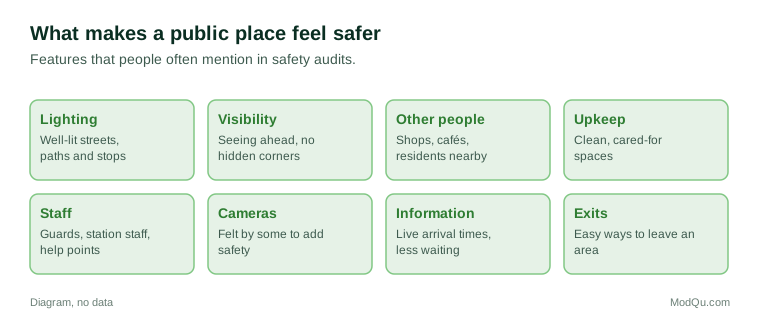
Many features of a place shape how safe it feels. The figure below groups the main ones:
- Lighting: well-lit streets, paths and stops.
- Visibility: being able to see ahead and be seen by others, with no hidden corners.
- Other people: activity from shops, cafés, residents and passers-by, sometimes called "eyes on the street".
- Upkeep: litter, graffiti, broken windows and empty buildings can make a place feel neglected and less safe.
- Staff and help: station staff, security guards, help points and emergency phones.
- Cameras: some people feel safer with surveillance cameras; others doubt they prevent harm.
- Information: real-time arrival times reduce waiting in empty places.
- Exits and routes: being able to leave an area easily.
What people do to feel safer
Many people change their behaviour to feel safer, often without thinking much about it. Common steps include:
- changing routes to avoid certain streets, parks or underpasses;
- avoiding going out at night or to certain places;
- travelling with others or arranging to be met;
- sharing their location with a friend or family member through a phone;
- phoning someone while walking;
- taking taxis or rides instead of walking or using public transport, which adds cost;
- carrying a personal alarm, a whistle or a torch;
- keeping valuables out of sight;
- choosing seats near the driver or in busier carriages.
The laws on carrying self-defence items differ widely between countries; items legal in one place, such as some sprays, are illegal in others.
Example (hypothetical figures)
A university student lists what they spend to feel safer getting home from evening classes. Instead of the 20-minute walk, they take a taxi twice a week at $12 each way, or $24 a week. Over a 30-week academic year that is $720. They also bought a personal alarm for $15. They say they would walk if the path through the park were better lit.
Questions that public bodies and businesses want answered here include how safe people feel at different times and places, how often they change their behaviour and what would make the biggest difference.
Harassment in public
Harassment in public includes unwanted comments, staring, following, touching, and sharing images without consent. It is often not reported, because people think it will not be taken seriously, find it hard to prove or want to move on. Some countries and cities have introduced laws, reporting apps and campaigns on public transport to encourage reporting and bystander action.
Bystander intervention is the idea that people who witness harassment can help, for example by distracting the harasser, checking on the person targeted, reporting to staff or recording an incident when safe to do so.
Example
On a crowded train, a passenger notices a man standing too close to a young woman, who looks uncomfortable. The passenger moves next to her and starts a conversation as though they know each other, asking which stop she is going to. The man moves away. At the next station, the passenger tells a member of staff what happened.
What cities and transport services do
Public bodies use several approaches to make public spaces safer:
- better street and park lighting;
- designing streets and stations to improve visibility and reduce hidden spots, sometimes called crime prevention through environmental design;
- more staff on transport at night;
- request-stop schemes on night buses that let passengers get off closer to home;
- help points, cameras and emergency buttons;
- safety audits that ask local people, especially women, older people and people with disabilities, which places feel unsafe.
What people disagree about
- Cameras and privacy: some welcome more surveillance; others see it as an invasion of privacy with little effect on safety.
- Policing: views differ on whether more police presence makes people feel safer or, for some groups, less safe.
- Who should change? Some advice focuses on what individuals should do to stay safe; others say the burden should fall on offenders and on the design of public places.
Key terms
- Perceived safetyHow safe a person feels in a place, which may differ from the actual risk.
- Fear of crimeWorry about becoming a victim, which can change behaviour.
- Personal alarmA small device that makes a loud noise to draw attention.
- Location sharingLetting a trusted person see where you are through a phone.
- HarassmentUnwanted behaviour that makes a person feel intimidated, degraded or offended.
- Bystander interventionAction by a witness to help someone being harassed or harmed.
- Natural surveillanceBeing seen by others in a place, such as from windows and shops.
- Request stopA bus stop where passengers can ask to get off at night closer to their destination.
Full glossary: public safety terms on EditingTests.com.
Personal safety in public vocabulary test
How well do you know the language of this topic? Try 8 quick questions. Your score is shown straight away and is not saved.
What the personal safety in public survey asks
This survey is part of ModQu's Safety and Emergencies survey. The personal safety in public part takes about five minutes and covers:
- How safe you feel walking alone in your area after dark.
- How safe you feel on public transport and at stops and stations.
- Whether you have changed your route or habits to feel safer.
- Whether you carry a personal alarm or use location sharing.
- Whether you have experienced or witnessed harassment in public.
- What would make you feel safer in public places.
After that you can choose to continue with other short parts of the Safety and Emergencies survey, such as emergency preparedness or fire safety at home, or stop.
Ready to take part?
Your answers help show what people really think and do. Results are only ever reported as totals; no one can see your individual answers.
Start the surveyQuestions about this survey
Who can take part?
Adults.
Do I have to give my name?
No. You may be asked for your age group, region and similar details so results can be broken down, but not your name. ModQu never asks for passwords, card numbers or account numbers.
How are the results used?
Answers are combined into totals and percentages and published in ModQu reports. Individual answers are never shown.
Is the vocabulary test part of the survey?
No. It is optional and separate, and your score is not stored.