
Share your views on online privacy
Tell us what you know about your rights over your data, whether you have asked a company what it holds and what you click on cookie banners. Your answers are combined with other people's and reported only as totals.
Start the online privacy rights surveyAbout 5 minutes. No account needed. You can stop at any time.
What online privacy rights cover
Online privacy rights are the legal protections people have over personal information that businesses, governments and other organizations collect about them online. Personal information is any information about an identifiable person: a name, email address, phone number, location, purchase history, device identifiers, photos, health information and much more.
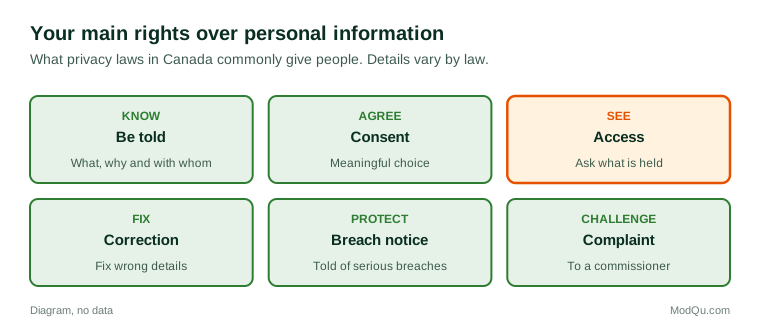
These rights usually cover:
- Being told what is collected, why and who it is shared with.
- Consent to collection and use, in many situations.
- Access: asking an organization what personal information it holds about you.
- Correction of inaccurate information.
- Limits on how long information is kept and what it is used for.
- Security, and notice when information is breached.
- Complaints to an independent privacy regulator.
Privacy laws in Canada and elsewhere
In Canada, privacy law has several layers:
- The Personal Information Protection and Electronic Documents Act (PIPEDA) applies to private-sector organizations in the course of commercial activity in most provinces, and to federally regulated businesses such as banks, airlines and telecom companies.
- Alberta, British Columbia and Quebec have their own private-sector privacy laws that apply instead of PIPEDA for many organizations in those provinces. Quebec's law was significantly strengthened by reforms known as Law 25.
- The federal Privacy Act and provincial public-sector laws cover government institutions.
- Health privacy laws in several provinces cover health information.
The Office of the Privacy Commissioner of Canada oversees the federal laws, and provinces have their own commissioners. Proposals to replace PIPEDA with new federal legislation have been debated in Parliament.
Elsewhere, the European Union's General Data Protection Regulation (GDPR) gives strong rights, including a right to erasure and data portability, and applies to many organizations outside Europe that serve people in the EU. In the United States there is no single federal privacy law for the private sector; several states, led by California, have passed their own consumer privacy laws.
Consent online
Under Canadian law, organizations generally need meaningful consent to collect, use and disclose personal information, and people should be able to understand what they are agreeing to. Consent can be express (for example ticking a box) or, for less sensitive uses that people would reasonably expect, implied. Sensitive information, such as health or financial details, generally calls for express consent.
In practice, many people agree to long privacy policies without reading them. Regulators have issued guidance asking organizations to explain key points clearly and up front rather than burying them in long documents.
Example
A person downloads a free flashlight app. During setup it asks for access to their location, contacts and photos. They wonder why a flashlight needs this, deny the requests and the app still works. Later they check their phone's settings and find several other apps with location access they do not use.
Cookies and cookie banners
Cookies are small files a website stores on a browser. Some are needed for a site to work, such as keeping items in a shopping cart. Others track visitors across sites to build profiles for advertising. Related tracking methods include pixels, device fingerprinting and identifiers in apps.
Cookie banners ask visitors to accept or manage cookies. They are most common on sites that serve European visitors, because EU rules require consent for non-essential cookies, but they now appear widely. People respond in different ways:
- clicking "Accept all" to get to the content quickly;
- clicking "Reject all" where it is offered;
- opening the settings to choose categories;
- closing the banner without choosing;
- using browser settings or extensions that block tracking.
Critics argue that some banners use design tricks, sometimes called dark patterns, such as a large bright "Accept" button and a hidden or multi-step "Reject" option. Regulators in Europe and elsewhere have taken action against some of these designs.
Asking a company what data it holds
Under PIPEDA and provincial laws, people can make an access request: a written request asking an organization for the personal information it holds about them, how it has been used and to whom it has been disclosed. Organizations generally must respond within set time limits (30 days under PIPEDA, with possible extensions) and at minimal or no cost, with some exceptions, such as information protected by legal privilege or that would reveal information about another person.
Example
After receiving targeted ads that mention a recent medical purchase, a person writes to the pharmacy chain's privacy officer asking what personal information it holds and who it has shared it with. The reply, received within 30 days, lists their loyalty program purchases and says the data was used for in-house offers but not sold. They opt out of marketing.
People can also ask for corrections to inaccurate information, and in some places, such as Quebec and under GDPR, ask for information to be deleted or moved to another service in certain situations.
Data breaches
A data breach occurs when personal information is lost, stolen or accessed without authorization. Under PIPEDA, organizations must report breaches that create a real risk of significant harm to the Privacy Commissioner, notify affected people and keep records of all breaches. Notices usually explain what happened, what information was involved and steps people can take, such as changing passwords, watching bank statements or placing a fraud alert with credit bureaus.
Example (hypothetical figures)
An online store notifies 48,000 customers that a breach exposed names, email addresses and the last four digits of payment cards. Of those customers, 6,000 had also reused their store password elsewhere, according to a later survey of a sample of them; that is 12.5% of those notified. The store forces a password reset for all 48,000 accounts.
Complaints and enforcement
If an organization does not respond properly to a privacy concern, people can complain first to the organization's privacy officer and then to the federal or provincial privacy commissioner. Commissioners investigate, publish findings and make recommendations. Their power to impose penalties differs between laws: Quebec's reformed law allows significant fines, while the federal commissioner's powers under PIPEDA are more limited, which has been part of the debate over reform.
Trends and debates
Trends include more data collected by connected devices, cars and smart homes; use of personal data to train artificial intelligence; facial recognition; the growth of data brokers; and stronger privacy settings built into browsers and phones. Debates include whether consent can be meaningful online, how far regulators' powers should go, whether targeted advertising should be limited, and how children's data should be protected. Questions businesses and public bodies want answered include how aware people are of their rights, how many have asked a company what it holds and how people respond to cookie banners.
Key terms
- Personal informationInformation about an identifiable individual.
- PIPEDACanada's federal private-sector privacy law.
- ConsentAgreement to the collection, use or sharing of personal information.
- CookieA small file a website stores on a browser.
- Access requestA request to see the personal information an organization holds about you.
- Data breachLoss of, or unauthorized access to, personal information.
- Privacy commissionerAn independent official who oversees privacy law and handles complaints.
- Dark patternA design that nudges users toward choices they might not otherwise make.
Full glossary: data privacy law terms on EditingTests.com.
Online privacy rights vocabulary test
How well do you know the language of this topic? Try 8 quick questions. Your score is shown straight away and is not saved.
What the online privacy rights survey asks
This survey is part of ModQu's Law and Rights survey. The online privacy rights part takes about five minutes and covers:
- What you know about your rights over your personal data.
- Whether you have asked a company what data it holds about you, and what happened.
- What you usually click on cookie banners, and why.
- Whether you have changed app permissions or privacy settings recently.
- Whether you have received a data breach notice, and what you did.
- How much you trust companies to protect your data.
After that you can choose to continue with other short parts of the Law and Rights survey, such as using a lawyer or consumer rights and complaints, or stop.
Ready to take part?
Your answers help show what people really think and do. Results are only ever reported as totals; no one can see your individual answers.
Start the surveyQuestions about this survey
Who can take part?
Internet users.
Do I have to give my name?
No. You may be asked for your age group, region and similar details so results can be broken down, but not your name. ModQu never asks for passwords, card numbers or account numbers.
How are the results used?
Answers are combined into totals and percentages and published in ModQu reports. Individual answers are never shown.
Is the vocabulary test part of the survey?
No. It is optional and separate, and your score is not stored.