
Share your views on news and bias
Tell us whether you think the news is biased, which sources you trust most and whether you read sources with different views. Your answers are combined with other people's and reported only as totals.
Start the media bias surveyAbout 5 minutes. No account needed. You can stop at any time.
What media bias means
Media bias is a tendency in news coverage to favour one side, view or group over others. It can be deliberate or unintended. It can come from individual journalists, editors, owners, advertisers or the way news is selected and presented. Bias is different from openly stated opinion: an opinion column is expected to take a side, while a news report is usually expected to be fair and balanced.
Forms of bias
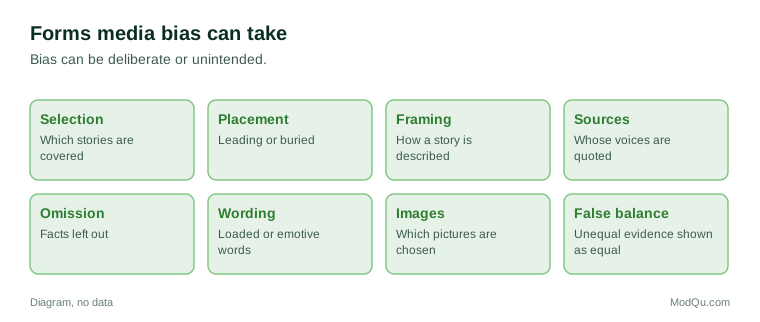
Bias can show up in several ways:
- Selection: which stories are covered and which are ignored.
- Placement: whether a story leads the news or is buried.
- Framing: how a story is described, such as calling a policy a "reform" or a "cut".
- Sources: which experts and voices are quoted, and how often.
- Omission: leaving out facts that would change how readers understand the story.
- Tone and wording: emotive or loaded words.
- Images: which photos or video clips are chosen.
- False balance: giving equal time to views that have very different levels of evidence.
The figure below sets these out.
Example
Two news sites report the same unemployment figures. One headline says "Unemployment falls for third month". The other says "Thousands still out of work despite small fall". Both are accurate, but they frame the same number differently.
Why people see bias differently
Research has found that people with strong views on an issue often see neutral coverage as biased against their own side. This is sometimes called the hostile media effect. People also tend to remember coverage that annoyed them more than coverage they agreed with. As a result, people on opposite sides of a debate may both say the same outlet is biased against them.
Perceptions of bias also depend on:
- a person's political and social views;
- the issue being covered;
- trust in institutions more generally;
- how often they use a particular source.
Ownership, funding and pressure
Concerns about bias often focus on who owns and funds the media:
- Private owners may have political or business interests.
- Advertisers may influence coverage, directly or indirectly.
- Public broadcasters, funded by taxes or licence fees, are often expected to be impartial, and some have legal duties to be so; critics may still accuse them of bias.
- State-controlled media in some countries follow government lines.
- Digital platforms use algorithms that decide what people see.
Rules on media ownership, impartiality and political advertising differ widely between countries.
Choosing trusted sources
People decide which sources to trust based on:
- long habit and family use;
- a sense that the source shares their values;
- reputation for accuracy and corrections;
- transparency about ownership and funding;
- how clearly it separates news from opinion;
- recommendations from friends or people they follow online.
Example
A shop manager trusts a local radio station more than national news because its reporters live in the area and often admit when they get things wrong. She checks national stories on two sites with different editorial lines before making up her mind.
Reading different views
Some people make a point of reading or watching sources with views different from their own. Others prefer sources that match their views, or avoid political news entirely. Online, recommendation systems and the choice of who to follow can lead some people to see mostly one kind of view. Researchers debate how strong this effect is, and studies find that many people see a wider mix of views than is often assumed.
Example (hypothetical figures)
A survey of 600 adults asks how often they use a news source with views different from their own. 18 percent say often, 37 percent sometimes, 29 percent rarely and 16 percent never. Together, 55 percent say often or sometimes.
Bias, misinformation and errors
Bias is different from misinformation and from honest error. A biased report may be accurate but one-sided; misinformation is false; an error is a mistake that a responsible outlet corrects. Many news organizations publish corrections and have editorial standards, ombudspeople or complaints processes. Press councils and regulators in some countries handle complaints about accuracy and fairness.
Media literacy
Media literacy means the skills to find, judge and understand news and information. It includes checking who produced a story, comparing sources, telling news from opinion and advertising, and recognizing emotive framing. Many schools and libraries teach these skills.
What people disagree about
- Which outlets are biased and in which direction.
- Whether public broadcasters are impartial.
- Whether platforms should rank or label news sources.
- Whether balance means equal time for all views.
- How much media ownership should be regulated.
Why surveys ask about media bias
Questions that media organizations, policy groups, universities and public bodies want answered include whether people think the news is biased, which sources they trust and whether they read sources with different views. Answers are grouped, and the survey does not ask you to name your political views unless you choose to.
Bias in the age of social media
Social media has changed how people meet and judge news. Stories are often seen as headlines or short clips, without the full report, and are shared with comments that add a point of view. People may judge bias based on who shared a story rather than on the story itself. Partisan pages and commentators who are not journalists also share news with a strong slant. Some platforms label state-controlled media or add context to disputed claims. Researchers study whether these labels change how much people trust a story, with mixed results.
Key terms
- Media biasA tendency in news coverage to favour one side, view or group.
- FramingHow a story is presented, which shapes how readers understand it.
- ImpartialityFair treatment of different views without taking sides.
- Hostile media effectThe tendency of people with strong views to see neutral coverage as biased against them.
- False balancePresenting views with very different evidence as if they were equally supported.
- Editorial lineThe general viewpoint or approach of a news outlet.
- CorrectionA published notice that fixes an error in an earlier report.
- Media literacyThe skills to find, judge and understand news and information.
Full glossary: journalism terms on EditingTests.com.
Media bias vocabulary test
How well do you know the language of this topic? Try 8 quick questions. Your score is shown straight away and is not saved.
What the media bias survey asks
This survey is part of ModQu's Politics and Current Affairs survey. The media bias part takes about five minutes and covers:
- Whether you think the news is biased, and in what way.
- Which kinds of news sources you trust most and least.
- Whether you read or watch sources with views different from your own.
- How you decide whether a news story is fair.
- Whether you have complained about or stopped using a source because of bias.
- What would make news more trustworthy for you.
After that you can choose to continue with other short parts of the Politics and Current Affairs survey, such as political engagement or trust in political parties, or stop.
Ready to take part?
Your answers help show what people really think and do. Results are only ever reported as totals; no one can see your individual answers.
Start the surveyQuestions about this survey
Who can take part?
Adults.
Do I have to give my name?
No. You may be asked for your age group, region and similar details so results can be broken down, but not your name. ModQu never asks for passwords, card numbers or account numbers.
How are the results used?
Answers are combined into totals and percentages and published in ModQu reports. Individual answers are never shown.
Is the vocabulary test part of the survey?
No. It is optional and separate, and your score is not stored.
Will I be asked to name news outlets?
Questions mostly ask about kinds of source. You can choose whether to name any.
Does the survey assume the news is biased?
No. "The news is mostly fair" is one of the answers, and every view is treated the same way.