
Share your experience of immigration help
Tell us whether you used a lawyer or consultant for your application, how you found them and whether it was worth the cost. Your answers are combined with other people's and reported only as totals.
Start the immigration legal help surveyAbout 5 minutes. No account needed. You can stop at any time.
What this topic covers
This topic is about the help people use when they apply to visit, study, work, live or become a citizen in another country, with a focus on Canada. It covers the kinds of people who can give immigration advice, what they do, how applicants find and pay them, how satisfied applicants are and how to avoid fraud. It also covers free help from settlement agencies and official sources.
In Canada, immigration is managed by Immigration, Refugees and Citizenship Canada (IRCC), with border matters handled by the Canada Border Services Agency (CBSA) and appeals and refugee claims heard by the Immigration and Refugee Board (IRB). Quebec selects many of its own economic immigrants through a separate system.
Who can give immigration advice for a fee
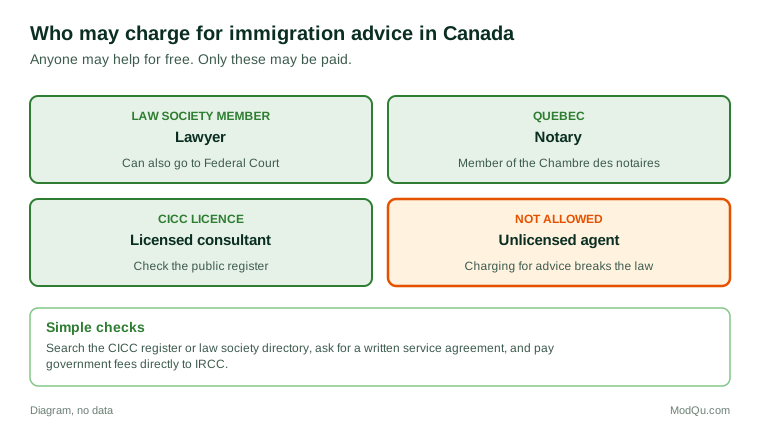
Under Canadian law, only certain people may give immigration or citizenship advice or represent applicants for a fee or other payment:
- Lawyers who are members of a Canadian provincial or territorial law society.
- Notaries who are members of the Chambre des notaires du Québec.
- Licensed immigration and citizenship consultants, who must be licensed by the College of Immigration and Citizenship Consultants (CICC), the national regulator established in 2021.
- Students-at-law acting under the supervision of a lawyer.
Paralegals licensed by the Law Society of Ontario may also represent clients in some immigration matters. Anyone may help for free, such as a family member or a settlement worker, but unlicensed people who charge for immigration advice are breaking the law. IRCC can refuse to deal with unauthorized paid representatives.
What representatives do
Depending on the case, a representative may:
- assess which programs an applicant may be eligible for;
- explain requirements, documents and deadlines;
- prepare and review application forms;
- submit applications and communicate with IRCC on the applicant's behalf;
- respond to requests for more information or procedural fairness letters;
- prepare for interviews;
- represent applicants at the Immigration and Refugee Board or in court (lawyers for Federal Court);
- advise on refusals, reconsideration and appeals.
Applicants can also apply on their own. Many do, using IRCC's online portals, guides and checklists. Using a representative does not make IRCC process an application faster or improve the chance of approval on its own.
How applicants find help
Common sources include:
- recommendations from family, friends and community members;
- people from their home country who went through the same process;
- online searches and social media;
- advertising, including in community newspapers and on video sites;
- employers who sponsor workers and use their own lawyers;
- universities and colleges, for international students;
- settlement agencies funded by IRCC, which offer free information and referrals once people are in Canada.
Example
An international student wants to apply for a post-graduation work permit. Her college's international student office runs a free workshop explaining the requirements and the online application. She applies on her own. Two years later, when applying for permanent residence with a more complicated work history, she hires a licensed consultant recommended by a classmate.
Costs
Representatives set their own fees, which are separate from the government fees paid to IRCC. Fees vary with the type of application, its complexity and the representative. Arrangements include fixed fees for each application, hourly rates for complex cases and appeals, and fees paid in stages. Licensed representatives are generally required to have a written service agreement that sets out the work and fees.
Example (hypothetical figures)
A family of three applies for permanent residence. Their consultant charges a fixed fee of $4,500, paid in three equal stages of $1,500. Government processing and right of permanent residence fees for the family total $2,800, and medical exams, police certificates and translations cost another $1,150. The family's total cost is $4,500 plus $2,800 plus $1,150, which is $8,450.
Checking a representative and avoiding fraud
Immigration fraud is a serious problem, and newcomers and people abroad are frequent targets. IRCC and the CICC publish warnings about common scams:
- promises of guaranteed approval, a job or a faster process;
- claims of special contacts inside IRCC;
- people who are not licensed charging for advice, sometimes calling themselves "agents" or "visa experts";
- requests to pay government fees into a personal account;
- fake job offers that require payment;
- fake websites and phone calls pretending to be IRCC;
- advice to include false information or documents in an application.
Common checks include searching the CICC's public register for consultants or the relevant law society's directory for lawyers, asking for a written service agreement, paying government fees directly to IRCC, and keeping copies of everything submitted. Applicants remain responsible for the truth of their applications even when a representative prepares them; misrepresentation can lead to a refusal and a ban on applying for a period.
Example
A man in another country is offered a job in Canada through a social media message, with a work permit "guaranteed" for a $6,000 fee. He searches for the company and the "agent" and finds no licence on the CICC register. A relative in Canada shows him the IRCC page on fraud, and he does not pay.
Satisfaction and complaints
Applicants who used representatives often judge them on communication, honesty about their chances, accuracy of the application, responsiveness to requests and whether the outcome justified the cost. Complaints about licensed consultants can be made to the CICC, and complaints about lawyers to the provincial law society. Fraud can be reported to IRCC, the Canadian Anti-Fraud Centre and police.
Trends and debates
Trends include more online applications, changes to program rules and caps on some permits, longer or shorter processing times as volumes change, and stronger oversight of consultants since the CICC was created. Debates include whether consultants should be regulated separately from lawyers, how to stop unlicensed agents abroad, how much applicants should rely on paid help, and how clearly government guides explain the rules. Questions businesses and public bodies want answered include how many applicants use paid help, how they find it, what they pay and whether they felt it was worth the cost.
Key terms
- IRCCImmigration, Refugees and Citizenship Canada, the federal immigration department.
- Licensed consultantAn immigration consultant licensed by the College of Immigration and Citizenship Consultants.
- Authorized representativeA person legally allowed to give immigration advice for a fee.
- Settlement agencyAn organization that offers newcomers free information and support.
- MisrepresentationGiving false or misleading information in an application.
- Service agreementA written contract setting out a representative's work and fees.
- Permanent residenceStatus allowing a person to live and work in Canada indefinitely without being a citizen.
- Procedural fairness letterA letter from IRCC raising concerns and giving the applicant a chance to respond.
Full glossary: immigration law terms on EditingTests.com.
Immigration legal help vocabulary test
How well do you know the language of this topic? Try 8 quick questions. Your score is shown straight away and is not saved.
What the immigration legal help survey asks
This survey is part of ModQu's Law and Rights survey. The immigration legal help part takes about five minutes and covers:
- Which immigration or citizenship application you made, and when.
- Whether you used a lawyer, licensed consultant, other helper or applied on your own.
- How you found your representative, and whether you checked their licence.
- What you paid in representative fees and government fees.
- Whether the service was worth the cost, and why.
- Whether you have met an immigration scam or unlicensed agent.
After that you can choose to continue with other short parts of the Law and Rights survey, such as using a lawyer or consumer rights and complaints, or stop.
Ready to take part?
Your answers help show what people really think and do. Results are only ever reported as totals; no one can see your individual answers.
Start the surveyQuestions about this survey
Who can take part?
Newcomers and people applying for visas.
Do I have to give my name?
No. You may be asked for your age group, region and similar details so results can be broken down, but not your name. ModQu never asks for passwords, card numbers or account numbers.
How are the results used?
Answers are combined into totals and percentages and published in ModQu reports. Individual answers are never shown.
Is the vocabulary test part of the survey?
No. It is optional and separate, and your score is not stored.