
Share your experience of immigration
Tell us where you were born, which settlement services you used and what would help newcomers most. Your answers are combined with other people's and reported only as totals.
Start the immigration and newcomers surveyAbout 5 minutes. No account needed. You can stop at any time.
This page describes immigration in general terms. It is not legal or immigration advice. For advice about your own case, use official government sources or a licensed immigration professional or lawyer.
Who counts as a newcomer
"Newcomer" usually means a person who has recently moved to a country to live, often within the last five years or so. In Canada, newcomers include several groups with different rights:
- Permanent residents, who have the right to live and work in Canada and can later apply for citizenship.
- Refugees and protected persons, including resettled refugees selected abroad and people who make a refugee claim in Canada.
- Temporary residents, such as international students, temporary foreign workers and people on work permits, who may or may not stay permanently.
- New citizens, who have gone through the citizenship process.
Immigration, Refugees and Citizenship Canada (IRCC) is the federal department responsible for immigration. Quebec selects many of its own economic immigrants under an agreement with the federal government, and other provinces nominate some immigrants through provincial nominee programs.
The main pathways to permanent residence
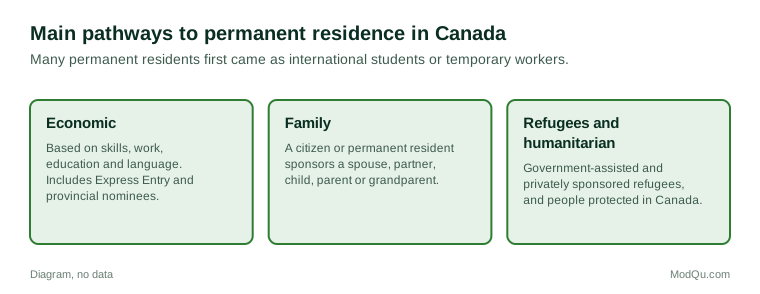
People become permanent residents of Canada through several main streams:
- Economic immigration, based on skills, work experience, education and language ability, including programs managed through the Express Entry system, provincial nominee programs and programs for business people and caregivers.
- Family sponsorship, where a citizen or permanent resident sponsors a spouse, partner, child, parent or grandparent.
- Refugees and humanitarian cases, including government-assisted refugees, privately sponsored refugees and people granted protection in Canada.
Many permanent residents first came to Canada as international students or temporary workers. The federal government publishes an immigration levels plan each year that sets targets for the number of new permanent residents, and in recent years has also set limits on some temporary resident programs.
The first months after arrival
Newcomers often describe the first months as a long list of tasks:
- getting a Social Insurance Number, opening a bank account and getting a phone plan;
- finding housing, often without a Canadian credit history or references;
- applying for a provincial health card, with a waiting period in some provinces;
- enrolling children in school;
- finding work, sometimes while taking language classes;
- learning how things work, from transit and winter clothing to taxes and benefits.
Example
A family arrives in a mid-sized city as permanent residents. Before they land, they register online with a pre-arrival service that connects them to a local settlement agency. In their first week, a settlement worker helps them apply for health cards and a Social Insurance Number, explains how to rent an apartment and books an assessment for English classes. The parents say having one person to ask made the first month far less confusing.
Settlement services
Canada funds a wide network of settlement services, mostly delivered by non-profit organizations. They include:
- Information and orientation about life in Canada.
- Language classes, such as Language Instruction for Newcomers to Canada (LINC) and, in Quebec, French classes for immigrants.
- Employment services, including job search help, mentoring, bridging programs and work placements.
- Help with forms and connecting people to other services.
- Community connections, such as conversation circles and mentoring programs.
- Support for refugees, including help with housing, income support for an initial period and trauma-informed care.
Many newcomers also rely heavily on family, friends, faith communities and cultural associations, sometimes more than on formal services.
Work, credentials and income
Finding work that matches one's skills is one of the biggest challenges newcomers describe. Common barriers include:
- Foreign credential recognition: getting education and professional qualifications from another country recognized, especially in regulated professions such as medicine, nursing, engineering, law and teaching.
- Canadian experience: employers asking for experience in Canada that newcomers cannot yet have.
- Language, including workplace and professional language.
- Networks: many jobs are found through contacts.
- Discrimination in hiring.
As a result, many newcomers work for some years in jobs below their skill level, a pattern often called underemployment or "brain waste".
Example
An engineer with ten years of experience abroad arrives in Canada and learns they cannot use the title "engineer" until they are licensed by the provincial engineering regulator. While working in a warehouse, they have their degree assessed, take a professional practice exam and join a bridging program. Three years later they are licensed and working in their field.
Example (hypothetical figures)
A newcomer earns $19 an hour working 37.5 hours a week in their first job, or $712.50 a week. After getting their credentials recognized, they find a job in their field paying $36 an hour for the same hours, or $1,350 a week. The difference is $637.50 a week, or $33,150 over 52 weeks, before taxes.
Housing, health and family
Other common challenges for newcomers include:
- Housing costs in large cities, crowded housing and difficulty renting without a credit history.
- Health care: finding a family doctor, understanding what is covered, and waiting periods for coverage in some provinces.
- Children's schooling, including language support and having credits from another country recognized.
- Isolation, especially for older relatives and for parents at home with young children.
- Weather and daily life, including the first winter.
- Family separation, when family members are still abroad and waiting for sponsorship.
Public attitudes to immigration
Canada has often been described as relatively open to immigration compared with many countries, but public views vary and change over time. Recent debates in Canada have focused on how the number of newcomers affects housing, health care and other services. Views on immigration are shaped by:
- economic conditions, including jobs and housing costs;
- whether people see immigration as well managed;
- personal contact with immigrants, and whether people are immigrants themselves;
- views on different streams, such as economic immigrants, refugees and temporary workers;
- political leanings and news coverage.
Survey questions about immigration are sensitive to wording. Asking whether the country admits "too many", "too few" or "about the right number" of immigrants gives different answers from asking about specific groups or about how well newcomers are supported.
Example
A town with a growing number of newcomers holds a community welcome event at the library, with local employers, sports clubs, faith groups and the settlement agency. Long-time residents who had worried about the changes meet newcomer families and sign up as conversation partners. Several newcomers later join the volunteer fire department and the minor hockey association.
What people disagree about
People disagree about how many immigrants a country should admit each year, the balance between economic, family and refugee streams, the role of temporary workers and international students, how quickly credentials should be recognized, and how much governments should spend on settlement services. Questions that governments and public agencies want answered include whether people were born in the country, which settlement services newcomers used and what would help newcomers most.
Key terms
- Permanent residentA person who has the right to live and work in a country permanently but is not yet a citizen.
- Temporary residentA person allowed to stay for a limited time, such as a student, worker or visitor.
- RefugeeA person who has fled their country because of a well-founded fear of persecution.
- Settlement servicesPrograms that help newcomers adjust to life in a new country.
- Credential recognitionThe process of having foreign education and qualifications accepted.
- SponsorshipSupport given by a citizen, permanent resident or group to bring a person to the country.
- Provincial nomineeA person selected by a province to apply for permanent residence.
- UnderemploymentWorking in a job below one's skills, education or desired hours.
Full glossary: immigration administration terms on EditingTests.com.
Immigration and newcomers vocabulary test
How well do you know the language of this topic? Try 8 quick questions. Your score is shown straight away and is not saved.
What the immigration and newcomers survey asks
This survey is part of ModQu's Government and Public Services survey. The immigration and newcomers part takes about five minutes and covers:
- Whether you were born in this country, and if not, how long you have lived here.
- For newcomers: how you came, and which settlement services you used.
- What was hardest in your first years, such as housing, work or health care.
- Whether your education and work experience were recognized.
- How welcome newcomers are made to feel in your community.
- What you think would help newcomers most, and your views on immigration levels.
After that you can choose to continue with other short parts of the Government and Public Services survey, such as local services or trust in government, or stop.
Ready to take part?
Your answers help show what people really think and do. Results are only ever reported as totals; no one can see your individual answers.
Start the surveyQuestions about this survey
Who can take part?
Adults, including newcomers.
Do I have to give my name?
No. You may be asked for your age group, region and similar details so results can be broken down, but not your name. ModQu never asks for passwords, card numbers or account numbers.
How are the results used?
Answers are combined into totals and percentages and published in ModQu reports. Individual answers are never shown.
Is the vocabulary test part of the survey?
No. It is optional and separate, and your score is not stored.