
Share your experience of identity theft
Tell us whether your identity has been stolen or misused, how you found out and how you protect it. Your answers are combined with other people's and reported only as totals.
Start the identity theft surveyAbout 5 minutes. No account needed. You can stop at any time.
What identity theft is
Identity theft is the use of someone else's personal information, such as their name, date of birth, address, government identity number, bank details or passwords, to pretend to be them. The person whose identity is used is often left to deal with debts, damaged credit records, blocked accounts and the stress of proving who they are.
Related terms are often used together:
- Identity theft: getting hold of another person's details.
- Identity fraud: using those details to commit a crime, such as opening a loan or buying goods.
- Account takeover: getting into an existing account, such as a bank, email or social media account, and acting as the owner.
- Synthetic identity fraud: combining real details from one or more people with made-up details to create a new, fake identity.
Identity theft happens in every country, though the details criminals target differ. Where a single national identity number is used for many services, that number is especially valuable to criminals.
How criminals get personal details
Personal details are stolen in many ways:
- Phishing: emails, texts or calls pretending to be from a bank, delivery company, tax office or employer, asking people to click a link or give details.
- Data breaches: attacks on companies, governments or other organisations that hold customer records.
- Weak or reused passwords that let criminals into one account and then others.
- Malware on phones or computers that records keystrokes or steals saved information.
- Stolen mail, wallets and phones.
- Social media oversharing: birthdays, pets' names, schools and holiday posts that help criminals guess answers to security questions.
- Fake websites and online shops that collect card details.
- Card skimming devices fitted to cash machines or payment terminals.
- People known to the victim, such as relatives, carers or flatmates, who have access to documents.
Example
A person receives a text saying a parcel could not be delivered and asking them to pay a small redelivery fee through a link. They enter their card details on what looks like a genuine page. Two days later, several online purchases appear on the card. The bank cancels the card and refunds the purchases after an investigation, but the person also changes passwords on accounts that used the same email.
What identity thieves do with the details
Once they have someone's details, criminals may:
- make purchases on existing cards or accounts;
- open new credit cards, loans, phone contracts or store accounts;
- take over email or social media and scam the victim's contacts;
- claim government benefits or tax refunds in the victim's name;
- rent property or get a job using the victim's identity;
- give the victim's name when stopped by police, leaving a false record;
- sell the details to other criminals.
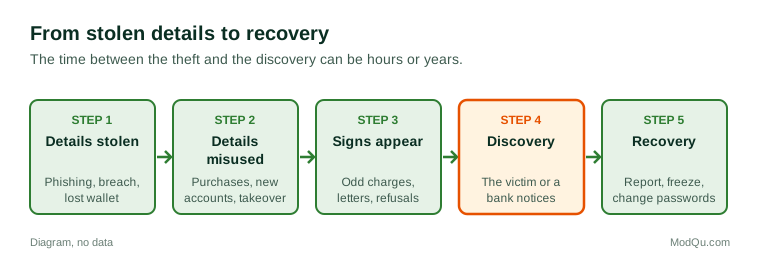
Some cases are spotted within hours; others go unnoticed for months or years.
How people find out
The figure below shows a typical path from the theft of details to recovery. Common ways people discover identity theft include:
- unfamiliar transactions on a bank or card statement;
- a bank, card company or online shop contacting them about suspicious activity;
- letters or calls about debts, loans or accounts they did not open;
- being refused credit unexpectedly;
- being locked out of an email or social media account;
- friends saying they received strange messages from them;
- a credit report showing accounts or searches they do not recognise;
- a tax or benefits office contacting them about a claim they did not make.
Recovering from identity theft
Recovery steps depend on what was misused and where the victim lives, but often include:
- Contacting banks and card companies to freeze or cancel accounts and dispute transactions.
- Changing passwords and turning on two-step verification.
- Reporting to the police or a national fraud reporting centre, where one exists, to get a reference number.
- Checking credit reports with the credit bureaus that operate in their country, and asking for a fraud alert or a freeze where these are offered.
- Contacting government bodies if identity documents or benefits were affected.
- Warning contacts if an email or social media account was taken over.
- Keeping a record of every call, letter and reference number.
Recovery can be quick for a single misused card, but long and stressful when new accounts were opened or a criminal record was created in the victim's name.
Example (hypothetical figures)
A victim learns that someone opened two phone contracts and a store credit account in their name. They spend about 4 hours in the first week making calls and reports, then about 1 hour a week for the next 10 weeks following up, a total of 14 hours. The fraudulent debts of $2,300 are removed, and they pay nothing, but they are refused a car loan during that period because of the fraud on their credit file.
How people protect themselves
Common steps people take include:
- using different, strong passwords for important accounts, often with a password manager;
- turning on two-step verification;
- being wary of unexpected messages asking for details, and contacting organisations through their official numbers instead;
- checking bank statements and alerts regularly;
- checking credit reports where these are available;
- shredding documents with personal details before throwing them away;
- limiting what is shared publicly on social media;
- keeping phones and computers updated;
- locking cards through banking apps when they are not in use.
Example
After a friend's email is hacked and used to send fake requests for money, a person reviews their own accounts. They had used the same password for email, shopping and their bank. They spend an afternoon setting up a password manager, giving each account its own password and adding two-step verification to email and banking. They say the hardest part was remembering all the accounts they had opened over the years.
The emotional cost
Identity theft is not only a financial problem. Victims often report stress, anger, embarrassment, trouble sleeping and a loss of trust in online services. Some feel blamed, even though criminals use sophisticated methods that fool many careful people. Older people, people new to a country and people who are less confident online are often targeted, but anyone can be affected.
What people disagree about
- Who should bear the loss? Views differ on how much banks, businesses and governments should refund and protect against identity fraud.
- Data collection: some argue organisations collect more personal data than they need, which increases the harm from breaches.
- Digital identity schemes: some see national digital ID systems as safer; others worry about privacy and the harm if such a system is breached.
Questions that public bodies and businesses want answered here include how many people have experienced identity theft, how they found out, how long recovery took and what protection people use.
Key terms
- Identity theftGetting hold of another person's personal details without permission.
- Identity fraudUsing stolen personal details to commit a crime.
- PhishingMessages pretending to be from a trusted organisation to trick people into giving details.
- Data breachAn incident in which personal data held by an organisation is accessed or stolen.
- Account takeoverGetting into someone's existing account and acting as the owner.
- Two-step verificationA login that needs a second check, such as a code sent to a phone.
- Credit freezeA block that stops new credit being opened in a person's name.
- SkimmingUsing a hidden device to copy card details at a cash machine or terminal.
Full glossary: identity fraud prevention terms on EditingTests.com.
Identity theft vocabulary test
How well do you know the language of this topic? Try 8 quick questions. Your score is shown straight away and is not saved.
What the identity theft survey asks
This survey is part of ModQu's Safety and Emergencies survey. The identity theft part takes about five minutes and covers:
- Whether your identity has been stolen or misused, and what was affected.
- How you found out, and how long after it started.
- What steps you took to recover, and how long it took.
- Whether you lost money, and whether it was refunded.
- What you do to protect your personal details.
- How worried you are about identity theft in future.
After that you can choose to continue with other short parts of the Safety and Emergencies survey, such as emergency preparedness or fire safety at home, or stop.
Ready to take part?
Your answers help show what people really think and do. Results are only ever reported as totals; no one can see your individual answers.
Start the surveyQuestions about this survey
Who can take part?
Adults.
Do I have to give my name?
No. You may be asked for your age group, region and similar details so results can be broken down, but not your name. ModQu never asks for passwords, card numbers or account numbers.
How are the results used?
Answers are combined into totals and percentages and published in ModQu reports. Individual answers are never shown.
Is the vocabulary test part of the survey?
No. It is optional and separate, and your score is not stored.