
Share your experience of where you stay
Tell us where you stayed on your last trip, how you chose it and whether you belong to a loyalty program. Your answers are combined with other people's and reported only as totals.
Start the hotels and short-term rentals surveyAbout 5 minutes. No account needed. You can stop at any time.
What this topic covers
This topic covers paid places to stay away from home:
- Hotels, from budget to luxury, including chains and independent hotels.
- Motels and roadside inns, often used on road trips.
- Resorts, including all-inclusive resorts.
- Short-term rentals: apartments, houses, cottages and rooms rented for days or weeks, usually through online platforms.
- Bed and breakfasts, guest houses and country inns.
- Hostels, with shared or private rooms at lower prices.
- Campgrounds, cabins and glamping sites.
It covers how people choose, book and rate these places, and what they think of the rules around them.
Hotels or short-term rentals?
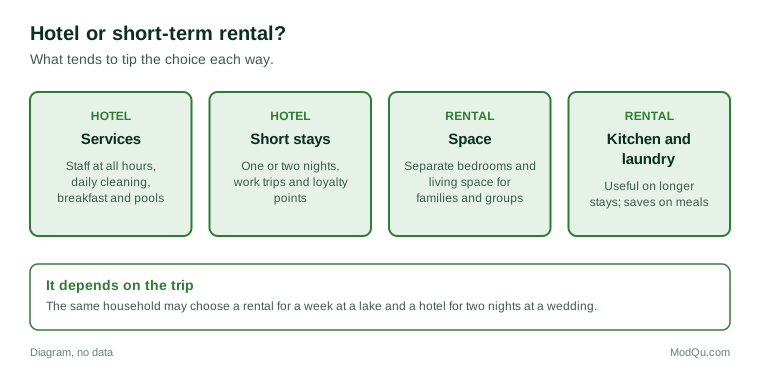
The choice between a hotel and a rental depends on the trip and the travellers.
Hotels are often chosen for:
- reliability: a consistent standard and staff available at all hours;
- services: daily cleaning, breakfast, pools, gyms, restaurants and parking;
- short stays of one or two nights;
- business travel, where employers may require it;
- loyalty points and status.
Short-term rentals are often chosen for:
- space: separate bedrooms and a living area for families and groups;
- kitchens and laundry, which help on longer stays and save money on meals;
- location in residential neighbourhoods or places without hotels;
- the feel of living like a local;
- pets, since some rentals allow them.
Example
Three generations of one family, nine people in all, plan a week at a lake. Three hotel rooms would split them up and leave nowhere to cook together. They rent a large cottage with a kitchen and a dock instead. On a later two-night trip for a wedding, the same family books hotel rooms near the venue.
How much reviews matter
Online reviews are one of the main ways travellers choose a place to stay. People typically look at:
- the overall rating;
- the number of reviews;
- recent reviews, which may reflect current conditions;
- photos posted by guests;
- comments on cleanliness, noise, location, beds and staff;
- how the owner or hotel responds to complaints.
Travellers also know reviews can be unreliable. Fake reviews, reviews posted in return for discounts, and a reluctance among some guests to leave bad reviews for a host they met in person can all affect ratings. Many people read the negative reviews first.
Example
A traveller narrows a city break to two rentals with similar ratings. One has 40 reviews, with recent comments about street noise at night. The other has 12 reviews, all positive but mostly from more than a year ago. They choose the first one and bring earplugs, because they trust the larger number of recent, detailed reviews.
Prices and fees
The advertised price is often not the final price. Extra costs may include:
- cleaning fees for short-term rentals;
- service fees charged by booking platforms;
- resort or destination fees at some hotels, added for amenities whether or not guests use them;
- parking, which can be expensive in cities;
- taxes, including municipal accommodation taxes in some cities;
- security deposits held on a credit card.
Comparing a hotel and a rental fairly means comparing the total price for the whole stay.
Example (hypothetical figures)
A couple compares two options for three nights. A hotel room is $180 a night plus $25 a night for parking, a total of $615 before tax. A rental is $140 a night with a $90 cleaning fee and a $60 service fee, and free street parking, a total of $570. The rental is $45 cheaper, so they choose it for the kitchen as well as the price.
Loyalty programs
Hotel chains run loyalty programs that give points for stays, which can be used for free nights and upgrades. Members may receive benefits such as late checkout, free Wi-Fi and better rooms. Business travellers often collect points through work trips and use them for holidays. Some short-term rental platforms and booking sites have their own reward programs.
Many people belong to programs they rarely use, and some choose hotels mainly to collect points. Questions businesses want answered include how many travellers belong to a program, how much it affects their choice, and whether they would switch for a better price.
Short-term rentals in communities
Short-term rentals have become a major public issue in many cities and tourist areas. Debates centre on:
- housing supply: whether homes used as full-time rentals for visitors reduce housing for residents and raise rents;
- neighbourhood effects, such as noise, parties, parking and strangers coming and going;
- fairness, since hotels pay taxes and follow rules that some rentals have avoided;
- income for owners, for whom renting part of a home or a cottage helps with costs.
Many Canadian cities and provinces now require hosts to register, limit rentals to a host's main home, or collect accommodation taxes. British Columbia and Quebec have passed provincial rules, and the federal government has limited tax deductions for short-term rentals that do not follow local rules.
Example
A homeowner rents out a basement suite to visitors in summer to help pay the mortgage. When their city requires a business licence and limits rentals to a host's main home, they register, since they live upstairs. A neighbour who owned two condos used only as visitor rentals decides to rent them long term instead.
Safety and accessibility
Guests consider safety in choosing where to stay, including the neighbourhood, door locks, smoke and carbon monoxide alarms, and whether staff are on site. Solo travellers, women travelling alone and families with young children may weigh these more heavily. Accessible rooms, step-free entrances, elevators and roll-in showers are often harder to find in rentals than in hotels, and accessibility descriptions are not always accurate.
What people disagree about
Opinion is divided on whether short-term rentals should be limited, whether hotels offer better value, whether fees should be included in advertised prices, how far to trust reviews, and whether loyalty programs are worth the effort.
Key terms
- Short-term rentalA home or room rented to visitors for days or weeks.
- Cleaning feeA one-time charge added to a rental stay for cleaning.
- Resort feeA mandatory hotel charge for amenities, added to the room rate.
- HostThe person who rents out a short-term rental.
- Loyalty programA scheme that rewards repeat stays with points and benefits.
- Accommodation taxA tax added to the price of a stay, often by a city.
- Late checkoutPermission to leave the room later than the normal time.
- HostelLower-cost accommodation, often with shared rooms.
Full glossary: short term rental management terms on EditingTests.com.
Hotels and short-term rentals vocabulary test
How well do you know the language of this topic? Try 8 quick questions. Your score is shown straight away and is not saved.
What the hotels and short-term rentals survey asks
This survey is part of ModQu's Travel and Hospitality survey. The hotels and short-term rentals part takes about five minutes and covers:
- Where you stayed on your last trip: hotel, rental, bed and breakfast, hostel or other.
- How you chose it, and how much reviews affected your choice.
- What you paid, including fees and taxes.
- Whether you belong to a hotel or booking loyalty program, and how you use it.
- What you think about rules for short-term rentals in your community.
- What would make you choose a hotel over a rental, or the reverse.
After that you can choose to continue with other short parts of the Travel and Hospitality survey, such as holiday and leisure travel or air travel, or stop.
Ready to take part?
Your answers help show what people really think and do. Results are only ever reported as totals; no one can see your individual answers.
Start the surveyQuestions about this survey
Who can take part?
Adults who stayed away from home overnight.
Do I have to give my name?
No. You may be asked for your age group, region and similar details so results can be broken down, but not your name. ModQu never asks for passwords, card numbers or account numbers.
How are the results used?
Answers are combined into totals and percentages and published in ModQu reports. Individual answers are never shown.
Is the vocabulary test part of the survey?
No. It is optional and separate, and your score is not stored.
Do stays with friends or family count?
The survey focuses on paid stays, but it asks how often you stay with friends or family instead.