
Share how you support health charities
Tell us whether you have given to a health charity in the last year, whether it was linked to someone you know and whether you take part in fundraising events. Your answers are combined with other people's and reported only as totals.
Start the giving to health and medical research surveyAbout 5 minutes. No account needed. You can stop at any time.
What health charities do
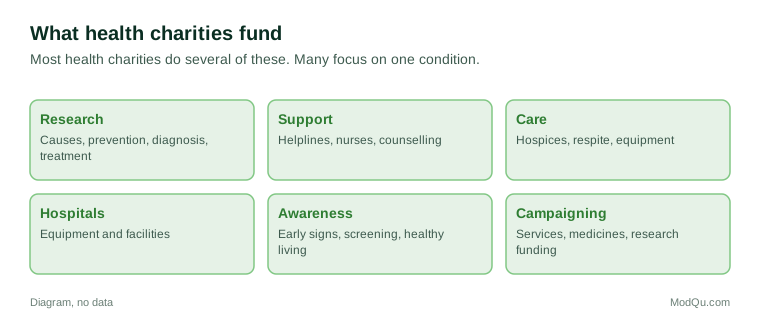
Health charities raise money and work to reduce the harm caused by illness and disability. Most focus on one condition or group of conditions, such as cancer, heart disease, dementia, diabetes, mental health or rare diseases. Others support hospitals, hospices or children's health. Their work usually includes some of these:
- Funding research into causes, prevention, diagnosis and treatment.
- Support services: helplines, nurses, counselling, information and support groups for patients and families.
- Care: hospices and end-of-life care, respite care and specialist equipment.
- Hospital charities that buy equipment and improve facilities beyond what public budgets cover.
- Awareness and prevention: campaigns about early signs, screening and healthy living.
- Campaigning for better services, access to medicines and funding for research.
Large research charities can be major funders of medical research in their countries, alongside governments and drug companies. Many small charities focus on support for a single rare condition.
Why people give
The most common reason people give to a health charity is personal experience:
- a family member or friend has the condition, or has died of it;
- the giver has the condition themselves;
- a charity's nurse, helpline or hospice cared for someone close to them;
- they want to thank a hospital or ward.
Other reasons include concern about a disease that is common in their community, the hope that research will lead to a cure, and being asked to sponsor a friend in an event.
Example
After their mother is cared for by a hospice in her last weeks, a person starts a monthly gift to the hospice. They say it is a way of thanking the nurses. Two years later they run a half marathon for the hospice and raise money from colleagues who remember their mother.
Fundraising events
Events are a large part of health fundraising. Common kinds include:
- sponsored runs, walks, cycles and swims;
- challenges such as climbing a mountain or a long-distance trek;
- growing a moustache, shaving one's head or giving up something for a month;
- coffee mornings, bake sales and quizzes;
- dinners and auctions;
- awareness days and weeks with badges, ribbons or wristbands.
Events bring in money from people who might not otherwise give to the charity, since most sponsors give because they know the participant.
Example (hypothetical figures)
A cyclist enters a 100 kilometre charity ride for a heart charity. The entry fee is 50 dollars, and the charity asks riders to raise at least 300 dollars. They raise 640 dollars from 22 sponsors, an average of about 29 dollars each. With the entry fee, the charity receives 690 dollars from this rider, before the costs of running the event.
Research giving: hopes and timescales
Giving to medical research means giving to work whose results may take many years. Most research does not lead directly to a new treatment, and progress is often made through many small steps by many teams. Charities explain this in different ways, from stories of individual patients to reports on research grants.
Givers often want to know:
- what kind of research the charity funds, such as laboratory science, clinical trials or care improvements;
- how research projects are chosen, often through expert review;
- what results have come from past funding;
- whether research involves animals, which some givers want to avoid.
Choosing between health charities
There are many health charities, and some work on the same condition. People choose based on:
- the specific condition and their connection to it;
- whether they want to fund research, care or support services;
- whether the charity is local, national or international;
- its reputation and how it reports on spending;
- whether a hospital or care team they know recommends it.
Some givers interested in global health compare charities by the number of lives saved or improved per dollar. This often leads them to fund causes such as malaria prevention, vaccinations or treatment of diseases common in low-income countries, rather than the conditions most common in their own country.
Example
A software developer with no personal link to any disease reads about cost-effectiveness research and gives to a charity that distributes insecticide-treated bed nets. Their sibling, whose child has a rare genetic condition, gives to a small charity for families affected by it. They discuss their choices, and each feels the other's reasons make sense.
Giving in memory and in wills
Health charities receive many gifts linked to someone's death. Families often ask mourners to give to a charity instead of sending flowers, and some set up an online tribute page that collects gifts over many years. Some charities also offer memorial events, such as a walk or a light-up evening, where families raise money together.
Gifts left in wills are another important source of income for many health charities, especially those that fund long-term research. People who leave such gifts often say they want to help future patients with the same condition as someone they loved.
Trust and transparency
Health charities hold a lot of public trust, but givers still ask questions:
- how much of each gift goes to research or care;
- whether money is spent on fundraising events that cost a lot to run;
- what links a charity has with drug companies;
- whether claims about cures and breakthroughs are realistic.
Many charities publish their research grants, annual reports and the results of independent review. Public charity registers in many countries also give basic financial information.
What people disagree about
Health giving raises several debates:
- whether research or patient care should come first;
- whether charities should fund work that governments or health systems should pay for;
- whether some conditions receive much more giving than others with similar impact;
- how charity funding should relate to drug company research;
- whether awareness campaigns change behaviour.
Questions charities and researchers want answered include why people give to health causes, how personal experience shapes giving, which events people join and what information givers want back.
Key terms
- Medical researchScientific study to understand, prevent, diagnose or treat illness.
- Clinical trialA study that tests a treatment or approach in people.
- HospiceA place or service that provides care at the end of life.
- Respite careShort-term care that gives family carers a break.
- GrantMoney given by a funder to a research team or project.
- Expert reviewAssessment of research proposals by specialists before funding.
- Sponsored eventAn activity where friends pledge money for the participant's charity.
- In memory giftA donation made to honour someone who has died.
Full glossary: health outcomes research terms on EditingTests.com.
Giving to health and medical research vocabulary test
How well do you know the language of this topic? Try 8 quick questions. Your score is shown straight away and is not saved.
What the giving to health and medical research survey asks
This survey is part of ModQu's Charities and Giving survey. The giving to health and medical research part takes about five minutes and covers:
- Whether you have given to a health charity or medical research fund in the last year.
- Which conditions or services you supported, and why.
- Whether the gift was linked to someone you know.
- Whether you take part in or sponsor fundraising events.
- What you want to know about how the money is used.
- How much you trust health charities and their research claims.
After that you can choose to continue with other short parts of the Charities and Giving survey, such as donating to charity or volunteering, or stop.
Ready to take part?
Your answers help show what people really think and do. Results are only ever reported as totals; no one can see your individual answers.
Start the surveyQuestions about this survey
Who can take part?
Adults.
Do I have to give my name?
No. You may be asked for your age group, region and similar details so results can be broken down, but not your name. ModQu never asks for passwords, card numbers or account numbers.
How are the results used?
Answers are combined into totals and percentages and published in ModQu reports. Individual answers are never shown.
Is the vocabulary test part of the survey?
No. It is optional and separate, and your score is not stored.