
Share how you help and are helped locally
Tell us whether you have helped a neighbour recently, whether you belong to a local support group and whether you use sharing schemes. Your answers are combined with other people's and reported only as totals.
Start the mutual aid and community support surveyAbout 5 minutes. No account needed. You can stop at any time.
What mutual aid means
Mutual aid is when people in a community help one another directly, on the basis that everyone may need help at some point. It is different from charity, where one group gives to another, because people both give and receive. It usually happens without formal staff or large budgets.
Community support is a wider term that includes:
- informal help between neighbours, such as shopping for someone who is ill;
- local groups that organize help, such as meal rotas or lift-sharing;
- sharing schemes, such as tool libraries and community fridges;
- savings and credit groups run by their members;
- faith, cultural and diaspora networks that support members;
- neighbourhood associations and tenant groups.
Mutual aid has a long history. Friendly societies, burial clubs and co-operatives were built on it, and many communities around the world have their own traditions of shared work and support.
Everyday help between neighbours
Most mutual aid is small and informal:
- taking in parcels or watching a house during a holiday;
- lending tools, ladders or a car;
- checking on an older neighbour during a heatwave or cold spell;
- cooking for a family with a new baby or a death in the family;
- helping with childcare or school runs;
- translating letters or helping fill in forms.
This help is rarely counted in official statistics, but people often say it matters to them as much as formal services.
Example
An older man living alone falls and breaks his wrist. Two neighbours set up a group chat with others on the street. For six weeks they take turns to do his shopping, collect his prescriptions and drive him to appointments. When he recovers, he starts helping the family next door with homework in maths, which he used to teach.
Mutual aid groups
Some communities form organized groups. Many mutual aid groups formed during the COVID-19 pandemic, when people organized by street or neighbourhood to deliver food and medicine to people who were isolating. Some closed when the emergency passed; others continued as food-sharing groups, tenant networks or support for new arrivals.
Mutual aid groups often:
- use messaging apps or social media to match requests with volunteers;
- avoid formal eligibility checks, helping anyone who asks;
- share decisions among members instead of having a single leader;
- rely on small cash donations and donated goods.
Savings groups and shared funds
In many countries, groups of people pool money to help each member in turn. These groups go by many names:
- rotating savings and credit associations, such as tontines in parts of West Africa, susus in parts of the Caribbean and West Africa, chit funds in South Asia and tandas in Mexico;
- village savings and loan associations, where members save regularly and borrow from the shared fund;
- burial societies, where members pay in so that funeral costs are covered when someone dies.
They are popular where banks are hard to reach, and among diaspora communities who use them alongside bank accounts.
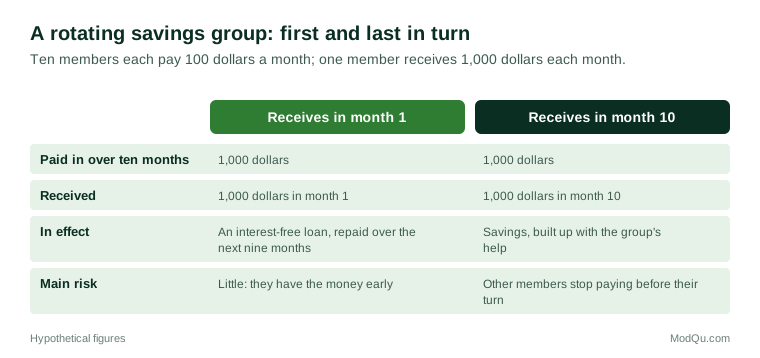
Example (hypothetical figures)
Ten friends each pay 100 dollars a month into a rotating savings group. Each month, one member receives the full 1,000 dollars. Over ten months everyone pays in 1,000 dollars and receives 1,000 dollars once. The member who receives first gets an early lump sum, like an interest-free loan; the member who receives last has, in effect, saved with the group.
Sharing schemes
Sharing schemes let people use things without buying them. Common examples include:
- tool and equipment libraries that lend drills, ladders and garden tools;
- community fridges and food-sharing points that redistribute surplus food;
- repair cafés, where volunteers help fix broken items;
- swap events and free-give groups for clothes, toys and furniture;
- time banks, where members trade hours of help, with every hour valued the same whatever the task.
Example
A family moves into a flat with no garden tools and little storage. They join a tool library for a small yearly fee and borrow a drill to put up shelves. They later volunteer at the library's monthly repair café, where they learn to mend a lamp.
Who gives and who receives
Informal help is not spread evenly. People who have lived in an area for a long time, who know their neighbours and who have time to spare often give the most. People who are new to an area, who work long or irregular hours, or who do not speak the local language may have fewer people to turn to.
Receiving help can also be hard. Many people find it easier to give than to ask, and some worry about being a burden or about what others will think. Groups that treat everyone as both a giver and a receiver say this makes asking easier, because help is seen as part of an exchange rather than as charity.
What makes community support last
Community groups often start with energy and then fade. People who run long-lasting groups often mention:
- a few reliable organizers, with tasks shared so no one burns out;
- clear ways to ask for and offer help;
- links with local services, so problems beyond the group's skills can be passed on;
- trust built over time, often through regular meetings or events;
- simple rules about money, safety and privacy.
Safety matters too. Groups that help vulnerable people may need to think about handling cash, sharing addresses and checking volunteers, especially when they work with children or people at risk.
What people disagree about
Mutual aid raises several debates:
- whether it should fill gaps in public services or campaign for those services to improve;
- whether informal groups should become registered charities, with more rules but more funding;
- whether help should go to anyone who asks or be checked against need;
- how online groups affect neighbours who are not online.
Questions councils, charities and researchers want answered include how many people give and receive informal help, which kinds of help are most common, who is left out, and how local support changes over time.
Key terms
- Mutual aidPeople in a community helping each other directly, as givers and receivers.
- Rotating savings groupMembers pay in regularly and each receives the pooled sum in turn.
- Burial societyA group whose members pay in to cover funeral costs.
- Time bankA scheme where members trade hours of help, each hour valued equally.
- Tool libraryA scheme that lends tools and equipment to members.
- Community fridgeA shared fridge where surplus food can be left and taken freely.
- Repair caféAn event where volunteers help people fix broken items.
- Friendly societyA traditional member-owned group that provides help in illness or old age.
Full glossary: community outreach terms on EditingTests.com.
Mutual aid and community support vocabulary test
How well do you know the language of this topic? Try 8 quick questions. Your score is shown straight away and is not saved.
What the mutual aid and community support survey asks
This survey is part of ModQu's Charities and Giving survey. The mutual aid and community support part takes about five minutes and covers:
- Whether you have helped a neighbour, or been helped, in the last month.
- What kinds of help you gave or received.
- Whether you belong to a local support, mutual aid or savings group.
- Whether you have used a sharing scheme such as a tool library or community fridge.
- What would make you more likely to take part in local support.
- How safe and fair you think informal help is.
After that you can choose to continue with other short parts of the Charities and Giving survey, such as donating to charity or volunteering, or stop.
Ready to take part?
Your answers help show what people really think and do. Results are only ever reported as totals; no one can see your individual answers.
Start the surveyQuestions about this survey
Who can take part?
Adults.
Do I have to give my name?
No. You may be asked for your age group, region and similar details so results can be broken down, but not your name. ModQu never asks for passwords, card numbers or account numbers.
How are the results used?
Answers are combined into totals and percentages and published in ModQu reports. Individual answers are never shown.
Is the vocabulary test part of the survey?
No. It is optional and separate, and your score is not stored.