
Share your views on charities
Tell us how much you trust charities, whether you check them before giving and what would make you give more. Your answers are combined with other people's and reported only as totals.
Start the trust in charities surveyAbout 5 minutes. No account needed. You can stop at any time.
What trust in charities means
Trust in charities is the confidence people have that a charity is honest, uses donations for the purposes it promises, and makes a real difference. People's trust can be in the charity sector as a whole, in a type of charity, or in a particular organization.
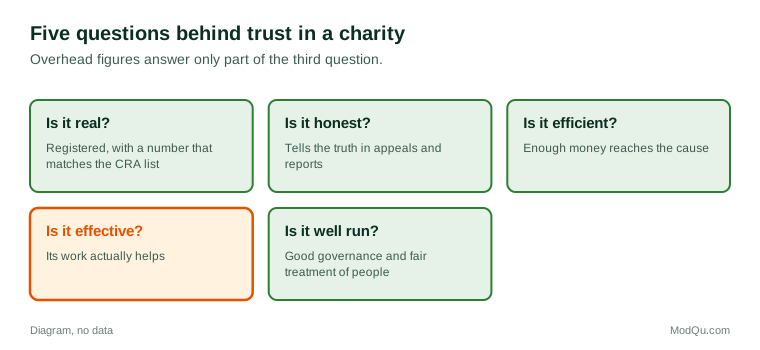
Trust tends to rest on a few questions:
- Is it real? Is the charity legitimate and registered?
- Is it honest? Does it tell the truth in its appeals and reports?
- Is it efficient? Does enough of the money reach the cause?
- Is it effective? Does its work actually help?
- Is it well run? Does it have good governance and treat staff, volunteers and the people it serves well?
What raises and lowers trust
Factors linked to higher trust include:
- personal experience of a charity's work, for example at a local food bank or hospital;
- clear, specific reports on what the charity has achieved;
- knowing people who work or volunteer there;
- being local, or working on a cause the donor understands;
- recommendations from friends and family.
Factors linked to lower trust include:
- news of scandals, fraud or misuse of funds at any charity, which can affect the whole sector;
- high executive pay;
- aggressive or frequent fundraising, such as repeated calls and mailings;
- sharing or selling donor information;
- not seeing results or hearing back after a gift.
Example
A donor gives to a national charity after a disaster appeal and then receives several mailings and phone calls asking for more. They feel the charity is spending their money on asking for more money. The next year they give to a local disaster relief group run by people they know, which sends one thank-you note with photos of the work.
The overhead debate
Many donors judge charities by how much they spend on overhead: administration, fundraising and other costs that are not direct program spending. A common view is that a good charity keeps overhead low.
Many people who work in and study the sector argue that this view can be misleading:
- Charities need staff, systems, training, accounting and buildings to do good work.
- Pressure to keep overhead very low can lead to underpaid staff, outdated systems and weaker programs, a pattern sometimes called the overhead myth or the non-profit starvation cycle.
- Overhead percentages can be calculated in different ways, so they are hard to compare.
- Some causes, such as research or advocacy, naturally have different cost structures from direct services.
Alternative ways to judge a charity include looking at its results, how open it is about its finances and whether it explains how it measures its impact.
Example (hypothetical figures)
Charity A raises $1,000,000 and spends $850,000 on programs and $150,000 on administration and fundraising, so 15% goes to overhead. Charity B raises $1,000,000 and spends $780,000 on programs and $220,000 on overhead, 22%. Judged on overhead alone, A looks better. But Charity B's reports show that its trained staff and tracking systems helped twice as many people complete its job training program. Overhead alone does not show which charity achieved more.
How people check a charity before giving
People who check a charity before giving tend to use some of the following:
- The CRA's list of charities, which shows whether an organization is a registered charity in Canada, its registration number and its annual information return, including revenue and spending.
- The charity's own website and annual report.
- Charity evaluators and rating websites, which assess financial transparency, results or both.
- News coverage and reviews.
- Asking people they know who have worked with or been helped by the charity.
Many people do not check at all, especially for small or spontaneous gifts, and rely on the name, the cause or the person asking.
Example
Before making a larger year-end gift, a donor looks up three animal welfare charities on the CRA's charities listing. One is not registered, so it cannot issue a tax receipt. Of the other two, the donor reads their annual reports and chooses the one that clearly explains how many animals it placed in homes and how it spends its budget.
Charity scams
Charity scams take advantage of people's generosity, especially after disasters and during holidays. Common warning signs include:
- pressure to give immediately;
- requests for payment by gift card, wire transfer or cryptocurrency;
- names that sound very similar to well-known charities;
- no registration number, or a number that does not match the CRA's list;
- door-to-door or phone canvassers who will not give written information;
- social media posts and crowdfunding pages that cannot be verified.
The Canadian Anti-Fraud Centre collects reports of fraud, including charity scams, and publishes warnings. Giving directly through a charity's official website, rather than through a link in an unexpected message, reduces the risk.
Example
After a major flood, a person receives a text asking for donations to "flood victims relief" with a link to a payment page. Unsure, they look up the charity name, find no registration and see a warning posted by the Canadian Anti-Fraud Centre about similar messages. They give through the website of a registered charity they already know instead.
Transparency and accountability
Registered charities in Canada must file an annual information return with the CRA, much of which is public. They must follow rules on how they use their resources and issue receipts, and the CRA can revoke registration for serious problems. Many charities also publish annual reports, audited financial statements and impact reports.
Governance matters too. A charity's board of directors is responsible for overseeing its finances, hiring and supervising the chief executive and making sure the charity follows the law. Some charities follow voluntary standards or accreditation programs for the sector.
What people disagree about
People disagree about how much charities should spend on overhead and fundraising, whether chief executives of large charities should earn high salaries, how much charities should take part in advocacy and public policy, and whether governments should regulate fundraising practices more closely. Questions that charities and foundations want answered include how much people trust charities to use money well, whether they check a charity before giving and what would make them give more.
Key terms
- OverheadCosts for administration, fundraising and running an organization, beyond direct programs.
- Program spendingMoney spent directly on a charity's services and activities.
- Annual information returnA yearly report that registered charities in Canada file with the CRA.
- Charity registration numberThe number the CRA assigns to a registered charity.
- GovernanceHow an organization is directed and overseen, mainly by its board.
- Impact reportA report showing what a charity's work has achieved.
- Charity scamA fraudulent request for donations that pretends to be for a good cause.
- RevocationCancellation of an organization's charitable registration.
Full glossary: nonprofit organizations terms on EditingTests.com.
Trust in charities vocabulary test
How well do you know the language of this topic? Try 8 quick questions. Your score is shown straight away and is not saved.
What the trust in charities survey asks
This survey is part of ModQu's Charities and Giving survey. The trust in charities part takes about five minutes and covers:
- How much you trust charities in general to use money well.
- Which kinds of charities you trust most and least.
- Whether you check a charity before giving, and how.
- How much overhead and fundraising costs matter to you.
- Whether you have received a charity request you thought was a scam.
- What would make you trust charities more and give more.
After that you can choose to continue with other short parts of the Charities and Giving survey, such as donating to charity or volunteering, or stop.
Ready to take part?
Your answers help show what people really think and do. Results are only ever reported as totals; no one can see your individual answers.
Start the surveyQuestions about this survey
Who can take part?
Adults.
Do I have to give my name?
No. You may be asked for your age group, region and similar details so results can be broken down, but not your name. ModQu never asks for passwords, card numbers or account numbers.
How are the results used?
Answers are combined into totals and percentages and published in ModQu reports. Individual answers are never shown.
Is the vocabulary test part of the survey?
No. It is optional and separate, and your score is not stored.