
Share how you give in your faith community
Tell us whether you give regularly to a faith community, how you give and whether you give to other charities too. Your answers are combined with other people's and reported only as totals.
Start the giving in religious communities surveyAbout 5 minutes. No account needed. You can stop at any time.
What religious giving covers
Most major religions teach that sharing money, food or time with others is a duty, a virtue or both. Giving through a faith community can take several forms:
- Regular gifts to support a place of worship, its leaders, buildings and activities.
- Gifts for people in need, through the community's own food banks, funds, schools and clinics.
- Special collections for disasters, missions, festivals or building projects.
- Religiously required giving, where a faith sets out a duty to give a share of income or wealth.
- Time and skills, such as volunteering, cooking for events or teaching.
Faith communities often run services that reach people outside their own membership, such as shelters, meal programmes, schools and hospitals.
Traditions of giving across faiths
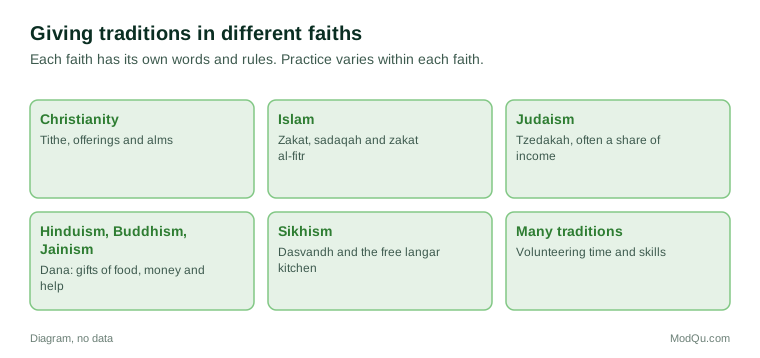
Each faith has its own words and rules for giving. A few examples:
- Christianity: many churches teach the tithe, traditionally a tenth of income, though practice varies widely. Offerings are gifts beyond the tithe, and alms are gifts to the poor.
- Islam: zakat is an obligatory annual payment, generally described as 2.5 percent of qualifying wealth held for a year above a minimum threshold called the nisab. Sadaqah is voluntary giving at any time, and zakat al-fitr is a small payment made before the end of Ramadan.
- Judaism: tzedakah means giving as a matter of justice and duty. Many people set aside a share of income, and some use a small home collection box.
- Hinduism, Buddhism and Jainism: dana means generous giving, including food and gifts to monks, temples and people in need.
- Sikhism: dasvandh is the practice of giving a tenth of earnings, and the langar is a free community kitchen open to all.
Within each faith, practice differs by country, denomination, school of thought and personal belief. Some people follow these rules closely, some give in their own way, and some do not give at all.
How people give
The way people give has changed. Passing a collection plate or putting coins in a box is still common, but many communities now also use:
- envelopes with a member number, so gifts can be recorded for tax receipts;
- standing orders and direct debits for regular giving;
- card readers and tap-to-give terminals at the entrance;
- online giving pages and apps, which grew quickly when buildings closed during the COVID-19 pandemic;
- text-to-give numbers and payment links in newsletters.
Digital giving has raised new questions. Some members like the convenience and the record it creates. Others feel that giving through an app removes the sense of an offering made in person, or worry about fees taken by payment companies. Many communities now offer several ways side by side.
Example
An older member of a congregation has given cash in an envelope every week for forty years. When the church installs a card reader, they keep using envelopes. Their adult child, who attends a different church, gives by monthly bank transfer and rarely carries cash.
How much people give and how they decide
People decide how much to give in different ways. Some follow a fixed share of income, such as a tenth. Some give a set amount each week. Others give what they can at the time. In some traditions the amount is calculated, as with zakat, and people may use a calculator provided by a mosque or charity.
Example (hypothetical figures)
A person has savings of 12,000 dollars that they have held for a full lunar year, above the local nisab threshold, and no qualifying debts. Following the 2.5 percent rule their mosque uses, they calculate zakat of 300 dollars. They pay part through the mosque's fund for local families and part to an international relief charity that accepts zakat.
Many people are reluctant to talk about how much they give. Some traditions teach that giving should be private, and this affects how people answer questions about it.
Giving to the community and beyond
Religious givers often also give to charities outside their faith community. Some studies in different countries have found that people who attend religious services regularly are more likely to give to charity in general, though the reasons are debated. Others give mainly through their community and see that as their main charitable giving.
Example
A family belongs to a gurdwara where they help serve the langar each month. They also give to a local hospital appeal and to a children's charity at work. When asked which giving matters most to them, they say the langar, because it is where they give time as well as money.
Accountability and trust
Members of faith communities often want to know how money is spent. Questions they ask include whether accounts are published, who decides on spending, and how much goes to buildings, staff and outreach. In many countries, places of worship can register as charities, which brings reporting rules, while in others they are exempt or regulated differently.
Common practices that help members trust how gifts are used include:
- an annual meeting where accounts are presented to members;
- a finance committee of volunteers who count and record collections;
- two people present whenever cash is counted;
- separate funds for buildings, staff, outreach and special appeals;
- receipts for gifts, where tax relief is available.
Problems do occur. Members may lose trust after a dispute over a building project, the misuse of funds by a leader, or a lack of clear information. Some people then give directly to people in need or to outside charities instead.
Example
A small temple committee decides to publish a one-page summary of income and spending each year. Members who had stopped giving because they did not know where the money went start giving again, and several offer to help with the accounts.
What people disagree about
Religious giving raises several debates:
- whether a fixed share, such as a tithe, should be expected of all members or left to each person;
- how much should support the community's own buildings and staff, and how much should go to people in need;
- whether giving should be private or public;
- how tax relief for religious organizations should work.
Questions faith organizations and charities want answered include how people give, whether they give regularly, how they would like to give in future and what makes them confident their gift is used well.
Key terms
- TitheA traditional gift of a tenth of income, mainly in Christian practice.
- OfferingA gift to a place of worship beyond any regular giving.
- AlmsGifts given to people who are poor.
- ZakatAn obligatory annual payment in Islam, based on qualifying wealth.
- SadaqahVoluntary charitable giving in Islam.
- TzedakahGiving as an act of justice and duty in Judaism.
- DanaGenerous giving in Hindu, Buddhist and Jain traditions.
- LangarA free community kitchen run at Sikh gurdwaras.
Full glossary: faith based organizations terms on EditingTests.com.
Giving in religious communities vocabulary test
How well do you know the language of this topic? Try 8 quick questions. Your score is shown straight away and is not saved.
What the giving in religious communities survey asks
This survey is part of ModQu's Charities and Giving survey. The giving in religious communities part takes about five minutes and covers:
- Whether you give regularly to a faith community, and how often.
- How you give: cash, envelope, card, bank transfer or online.
- How you decide how much to give.
- What you understand your gifts are used for.
- Whether you also give to other charities, and which kinds.
- How you would prefer to give in future.
After that you can choose to continue with other short parts of the Charities and Giving survey, such as donating to charity or volunteering, or stop.
Ready to take part?
Your answers help show what people really think and do. Results are only ever reported as totals; no one can see your individual answers.
Start the surveyQuestions about this survey
Who can take part?
Adults who belong to a faith community.
Do I have to give my name?
No. You may be asked for your age group, region and similar details so results can be broken down, but not your name. ModQu never asks for passwords, card numbers or account numbers.
How are the results used?
Answers are combined into totals and percentages and published in ModQu reports. Individual answers are never shown.
Is the vocabulary test part of the survey?
No. It is optional and separate, and your score is not stored.