
Share your experience of gig and freelance work
Tell us what kind of freelance or gig work you do, how much of your income it provides and what protections you would want. Your answers are combined with other people's and reported only as totals.
Start the gig and freelance work surveyAbout 5 minutes. No account needed. You can stop at any time.
What gig and freelance work mean
"Gig work" and "freelance work" overlap, and the terms are used in different ways. Broadly, they cover work done for a client or a platform without a regular job with one employer.
The main kinds are:
- App-based or platform work: tasks arranged through an app, such as ride-hailing, food and grocery delivery, errands, home repairs or pet care. The platform matches workers with customers and usually sets prices.
- Online freelance work: writing, design, programming, translation, marketing, data entry and similar tasks found through freelance marketplaces or directly with clients.
- Independent professional work: consultants, contractors, photographers, tutors, bookkeepers and others who run their own practice.
- Short-term contracts: fixed-term roles through staffing agencies or directly with an employer.
- Creative and cultural work: musicians, actors, artists and others paid by the performance, project or commission.
Some people do this work full-time; many do it alongside a regular job, studies, caregiving or retirement, often called a side hustle.
Why people do it
People give a range of reasons for gig and freelance work:
- Flexibility: choosing when, where and how much to work.
- Extra income: topping up wages or pensions, paying off debt, or saving for something.
- Independence: being one's own boss and choosing clients and projects.
- Lack of other options: difficulty finding a regular job, recent arrival in a country, or a job loss.
- Fitting around other duties: school, caregiving, health conditions or another job.
- Trying a business idea before committing to it.
The same work can feel very different depending on why someone does it. A retired professional who consults a few days a month by choice has a different experience from someone delivering food late at night because it is the only work available.
Example
A graphic designer was laid off and began taking freelance projects while looking for a new job. A year later they have six regular clients and decide not to return to a salaried role. They enjoy choosing their projects, but they find chasing late payments and working without paid vacation harder than they expected.
How work is found and paid
Freelancers and gig workers find work through:
- apps and platforms, which assign tasks or let workers bid on them;
- freelance marketplaces, where clients post projects and freelancers apply;
- referrals and repeat clients;
- personal websites, portfolios and social media;
- agencies and staffing firms.
Pay may be per task, per hour, per project, or a retainer for ongoing work. Platforms usually take a commission or service fee from each job. Many freelancers set their own rates; app-based workers usually cannot, because the platform sets prices.
A common challenge is that income varies from month to month. Busy periods are followed by slow ones, and clients may pay 30, 60 or more days after an invoice is sent.
Income, costs and taxes
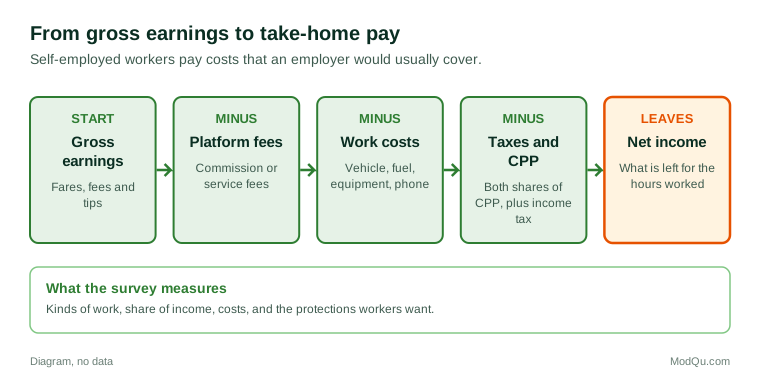
Gig and freelance workers who are self-employed pay their own costs and taxes. Their net income is what remains after these.
Common costs include:
- equipment, software, a vehicle, fuel and phone;
- platform fees and commissions;
- insurance, such as liability or commercial vehicle insurance;
- a home office, or rent for a workspace;
- professional fees, such as an accountant;
- unpaid time spent finding work, invoicing and handling admin.
In Canada, self-employed people report business income and expenses on their personal income tax return. They usually pay both the employee and employer shares of Canada Pension Plan contributions (or Québec Pension Plan contributions in Québec), and they generally must register for and charge GST/HST once their revenue passes a set threshold. They may need to make tax instalment payments during the year. The Canada Revenue Agency publishes guidance, and many self-employed people use an accountant.
Example (hypothetical figures)
A delivery worker earns $2,400 in a month on two apps, including tips. They drive about 3,000 km, and estimate fuel, maintenance and depreciation at $0.35 per km, or $1,050. Their phone and data plan cost $70. That leaves $1,280 before tax for about 130 hours logged in, or roughly $9.85 an hour before tax, well below what the $2,400 alone would suggest.
Benefits and protections
Most gig and freelance workers are treated as independent contractors, not employees. That means they usually do not receive many of the things employees get:
- minimum wage and overtime under employment standards;
- paid vacation and statutory holiday pay;
- employer health and dental benefits;
- employer pension contributions;
- employment insurance coverage, unless they opt into the special benefits program for self-employed people in Canada, which covers maternity, parental, sickness and caregiving benefits but not job loss;
- workers' compensation, depending on the province and type of work;
- protection from unjust dismissal.
When asked what protections they would want, gig workers often mention minimum pay rates, clear rules on how pay is calculated, insurance for injuries on the job, access to benefits that move with them between platforms (portable benefits), and a way to appeal if an app deactivates their account.
Worker status and the law
Whether a gig worker is an employee or an independent contractor depends on the real relationship, not just on what a contract says. Courts and labour boards look at questions such as who controls how the work is done, who owns the tools, whether the worker can work for others, and who takes the financial risk.
In Canada, there have been court and labour board cases on app-based workers' status, and several provinces have made rules for platform work. Ontario passed a law setting a minimum wage for time spent on assigned tasks and other rights for digital platform workers, and British Columbia introduced minimum pay and workers' compensation coverage for ride-hail and delivery workers. Some workers have also organized to bargain collectively. Rules continue to develop.
Example
A freelance writer has worked for one agency, 40 hours a week, for three years. The agency sets their schedule, gives them a company email address and reviews their work daily, but calls them a contractor. When the agency ends the arrangement without notice, the writer seeks advice on whether, in practice, they were an employee entitled to notice or severance.
What people disagree about
Gig and freelance work is the subject of strong debate:
- Flexibility versus security: supporters say gig work gives people freedom and access to income; critics say it shifts risk and costs from companies to workers.
- Status: should app-based workers be employees, contractors, or a new category with some protections?
- Pay: is pay fair once costs and waiting time are counted?
- Algorithms: should workers be able to see and challenge the rules apps use to assign work and set pay?
- Effect on other workers: does gig work undercut wages in traditional jobs, or fill needs that would otherwise go unmet?
Questions that businesses want answered here include what share of income gig and freelance work provides, what workers value most about it, and which protections matter most to them.
Key terms
- Gig workShort tasks or jobs, often arranged through an app or platform.
- FreelancerA self-employed person who works for several clients on projects.
- Independent contractorA self-employed worker who is not an employee of the client.
- Side hustlePaid work done alongside a main job or other activities.
- PlatformAn app or website that connects workers with customers or clients.
- DeactivationWhen a platform removes or suspends a worker's account.
- Portable benefitsBenefits that follow a worker across clients or platforms.
- InvoiceA bill sent to a client asking for payment for work done.
Full glossary: contingent workforce management terms on EditingTests.com.
Gig and freelance work vocabulary test
How well do you know the language of this topic? Try 8 quick questions. Your score is shown straight away and is not saved.
What the gig and freelance work survey asks
This survey is part of ModQu's Work and Careers survey. The gig and freelance work part takes about five minutes and covers:
- What kind of freelance, contract or gig work you do, and through which channels.
- How many hours you work and what share of your income it provides.
- Why you do it, and what you like and dislike about it.
- Your main costs and how you handle taxes.
- What protections or benefits you would want.
- Whether you would prefer a regular job, and why.
After that you can choose to continue with other short parts of the Work and Careers survey, such as job satisfaction or remote and hybrid work, or stop.
Ready to take part?
Your answers help show what people really think and do. Results are only ever reported as totals; no one can see your individual answers.
Start the surveyQuestions about this survey
Who can take part?
Adults who did freelance or app-based work in the last year.
Do I have to give my name?
No. You may be asked for your age group, region and similar details so results can be broken down, but not your name. ModQu never asks for passwords, card numbers or account numbers.
How are the results used?
Answers are combined into totals and percentages and published in ModQu reports. Individual answers are never shown.
Is the vocabulary test part of the survey?
No. It is optional and separate, and your score is not stored.
I only do gig work occasionally. Can I take part?
Yes. Anyone who did freelance or app-based work in the past year can take part, however little.