
Share your gym and class experience
Tell us which gym or studio you use, what kind of classes you take and why you last changed gyms. Your answers are combined with other people's and reported only as totals.
Start the fitness classes and gyms surveyAbout 5 minutes. No account needed. You can stop at any time.
This page describes gyms and fitness classes as a consumer topic. It is not health or exercise advice. People with health concerns should speak to a health professional before starting a new exercise program.
What gyms and fitness classes cover
Places where people pay to exercise include:
- Full-service clubs, with weights, cardio machines, classes and often pools, courts and change rooms with saunas.
- Budget gyms, with low monthly fees, many machines and fewer extras.
- Boutique studios that specialize in one format, such as cycling, yoga, Pilates, barre, boxing or high-intensity interval training.
- Strength and functional training gyms, focused on free weights and coached group sessions.
- Community and recreation centres run by municipalities, often with lower prices, pools and drop-in classes.
- Non-profit organizations offering fitness and community programs.
- Workplace, university and condominium gyms.
- Personal training studios offering one-to-one sessions.
Membership types and contracts
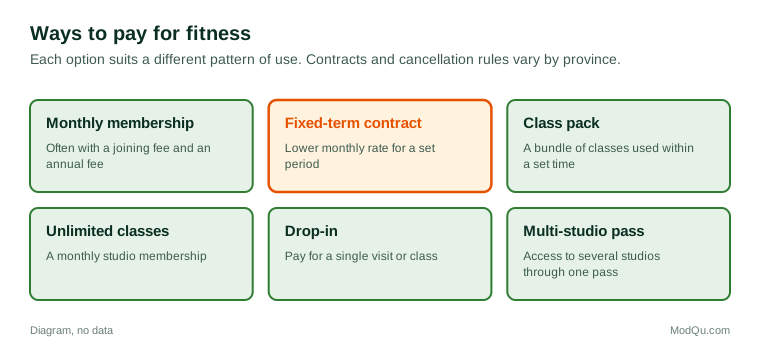
People pay for fitness in several ways:
- Monthly memberships, often with a joining fee and sometimes an annual maintenance fee.
- Fixed-term contracts, such as 12 months, sometimes at a lower monthly rate.
- Class packs, such as 10 classes to use within a set period.
- Unlimited class memberships at studios.
- Drop-in fees for a single visit or class.
- Multi-location or app-based passes that give access to many studios.
- Personal training packages.
Contracts and cancellation rules are a common source of frustration. Several provinces have consumer protection rules for gym and fitness contracts, for example limits on contract length or rights to cancel within a short period after signing. Rules differ by province.
Example (hypothetical figures)
A person compares two options. A budget gym costs $15 a month plus a $50 joining fee and a $40 annual fee, which is $270 in the first year. A boutique cycling studio sells 10-class packs for $220. If they would take 3 classes a week, or about 150 a year, the studio would cost $3,300. They join the budget gym and buy one 10-class pack to try the studio for a few months.
Popular class formats
Group classes are a large part of the fitness industry. Common formats include:
- Indoor cycling, on stationary bikes, usually set to music.
- Yoga, in many styles, from gentle to vigorous and heated.
- Pilates, on mats or on machines called reformers.
- High-intensity interval training (HIIT), short bursts of hard exercise with rest periods.
- Strength and circuit classes, using weights, kettlebells and body weight.
- Dance-based classes.
- Boxing and martial arts-based fitness.
- Aquafit and swimming lessons.
- Classes for specific groups, such as older adults, pre- and post-natal, and people recovering from injury.
People choose classes for the workout, the instructor, the music, the social atmosphere and the structure: a class at a set time makes it easier to show up.
Example
A person who rarely used the weights at their gym starts taking a 7 a.m. strength class three times a week. They say they go more often now because the class starts at a set time, the instructor notices when they miss a session and they have made friends with other regulars.
What people look for in a gym
When choosing a gym or studio, people commonly weigh:
- Location and hours, near home or work, and open when they can go.
- Price and contract terms.
- Equipment and classes, and whether the equipment they want is available at busy times.
- Cleanliness and the change rooms.
- Atmosphere: whether it feels welcoming, crowded, intimidating or friendly.
- Instructors and trainers, and their qualifications.
- Extras, such as a pool, child minding, parking or towel service.
Many gyms and studios offer free trial classes or passes so people can try before joining.
Why people switch or quit
Gym membership is known for high turnover. Many people join with good intentions, especially in January, and stop going within months. Reasons people give for switching gyms or quitting include:
- Moving home or job.
- Cost, or a price increase.
- Crowding at peak times.
- Changing interests, such as moving from machines to classes or from one class format to another.
- A better offer from another gym.
- An instructor leaving.
- Not going often enough to justify the cost.
- Injury, illness or life changes, such as having a baby.
- Poor service, or difficulty cancelling.
Example
A member leaves a large club after two years because the classes they like are always full and the club has added more members. They join a smaller studio closer to home, even though it costs more per month, because they can book a spot in class in advance.
Online and at-home fitness
Fitness at home has grown with online classes, apps, streaming workouts and connected equipment such as bikes, rowers and mirrors. Many people now mix:
- workouts at a gym or studio;
- online classes at home;
- walking, running and cycling outdoors;
- free videos and apps.
Some people prefer home workouts for convenience and privacy; others say they need the structure and social side of a gym or class. Gyms and studios increasingly offer hybrid memberships with both in-person and online classes.
Example
A parent of two young children cancels their gym membership because they cannot get there often enough. They buy a used stationary bike and use a low-cost streaming app for 30-minute workouts after the children are in bed. On weekends, they go to a drop-in class at the community centre when a partner can watch the children.
What people disagree about
People disagree about whether long gym contracts are fair, whether budget gyms or boutique studios offer better value, whether fitness classes should be more affordable and accessible, and whether at-home fitness can replace a gym. Questions that gyms, studios and recreation centres want answered include which gym or studio people use, what kind of classes they take and why they last changed gyms.
Key terms
- Joining feeA one-time charge paid when starting a gym membership.
- Class packA bundle of classes bought in advance and used within a set period.
- Drop-inPaying for a single visit or class without a membership.
- Boutique studioA small fitness business that specializes in one or a few class formats.
- HIITHigh-intensity interval training: short bursts of hard exercise followed by rest.
- ReformerA Pilates machine with a sliding platform, springs and straps.
- Personal trainerA fitness professional who designs and leads individual workouts.
- Membership freezePausing a membership for a period, sometimes for a fee.
Full glossary: fitness terms on EditingTests.com.
Fitness classes and gyms vocabulary test
How well do you know the language of this topic? Try 8 quick questions. Your score is shown straight away and is not saved.
What the fitness classes and gyms survey asks
This survey is part of ModQu's Arts, Culture and Sport survey. The fitness classes and gyms part takes about five minutes and covers:
- Which gym, studio or recreation centre you use, if any, and how often.
- What kind of membership or pass you have and what you pay.
- What kind of classes you take, and what you like about them.
- Why you last changed gyms or cancelled a membership.
- Whether you also exercise at home, online or outdoors.
- What would make you go more often.
After that you can choose to continue with other short parts of the Arts, Culture and Sport survey, such as museums and galleries or live events and theatre, or stop.
Ready to take part?
Your answers help show what people really think and do. Results are only ever reported as totals; no one can see your individual answers.
Start the surveyQuestions about this survey
Who can take part?
Adults who use a gym or class.
Do I have to give my name?
No. You may be asked for your age group, region and similar details so results can be broken down, but not your name. ModQu never asks for passwords, card numbers or account numbers.
How are the results used?
Answers are combined into totals and percentages and published in ModQu reports. Individual answers are never shown.
Is the vocabulary test part of the survey?
No. It is optional and separate, and your score is not stored.
Can I cancel a gym contract early?
It depends on the contract and the consumer protection rules in your province. Many provinces give a short cooling-off period after signing, and some allow cancellation for reasons such as moving or illness. Read the contract terms before signing.