
Share how your home is protected from fire
Tell us about your smoke alarms, when you last tested them and whether you have an escape plan. Your answers are combined with other people's and reported only as totals.
Start the fire safety at home surveyAbout 5 minutes. No account needed. You can stop at any time.
Why home fire safety matters
A fire in a home can spread very quickly. Smoke, which contains poisonous gases, is often more dangerous than the flames, and it can overcome people while they sleep. Fire services in many countries stress that people may have only a few minutes to get out once a fire takes hold. That is why fire safety at home focuses on three things: preventing fires, finding out early that one has started, and getting everyone out fast.
Rules on fire safety in homes differ widely. In some countries smoke alarms are required by law in every home; in others they are required only in new buildings or rented homes; in some there is no requirement at all. Building codes, the use of open flames for cooking and heating, and access to fire services also vary greatly between places.
How home fires start
Common causes of home fires include:
- Cooking, especially when food is left unattended, oil overheats, or a tea towel touches a hot element.
- Heating: portable heaters placed too close to curtains or bedding, open fires, wood stoves and chimneys that have not been cleaned.
- Electrical faults: damaged cords, overloaded sockets and extension leads, old wiring, and faulty or poorly made chargers.
- Smoking materials, particularly cigarettes dropped on furniture or bedding.
- Candles, oil lamps and incense left burning or placed near things that can catch fire.
- Lithium-ion batteries in phones, e-bikes and scooters, which can overheat and catch fire if damaged or charged with the wrong charger.
- Children playing with matches or lighters.
In homes that cook or heat with open flames, kerosene or charcoal, the risks are different again, and burns and smoke inhalation are a serious concern.
Smoke alarms
A smoke alarm senses smoke and sounds a loud alarm to wake and warn people. It is widely regarded by fire services as one of the most important pieces of home safety equipment. The main types are:
- Ionisation alarms, which tend to react quickly to fast, flaming fires.
- Photoelectric (optical) alarms, which tend to react quickly to slow, smouldering fires and are less prone to false alarms from cooking.
- Combined alarms with both sensors.
- Interconnected alarms, which all sound together when one detects smoke, so people hear the alarm wherever they are in the home.
- Alarms for people who are deaf or hard of hearing, using flashing lights or vibrating pads.
Fire services generally advise testing alarms regularly using the test button, replacing batteries as needed, and replacing the whole alarm after the period the maker states, often around ten years. Common problems are alarms with dead or removed batteries, alarms disabled because of false alarms from cooking, and alarms that are simply too old.
Example
A tenant takes the battery out of the hallway smoke alarm because it goes off whenever they make toast. Months later, a neighbour mentions that the landlord is required to provide working alarms. The tenant asks the landlord, who replaces the old alarm with a photoelectric one placed further from the kitchen. It has not gone off from toast since.
Extinguishers, fire blankets and other equipment
Other equipment some households keep includes:
- Fire extinguishers, which come in types for different kinds of fire. Using the wrong type, such as water on burning oil or electrical equipment, can make a fire worse.
- Fire blankets, often kept in kitchens to smother small pan fires.
- Heat alarms for kitchens and garages, where smoke alarms give false alarms.
- Escape ladders for upper floors.
- Sprinkler systems, common in some new buildings and required in some places, which spray water automatically on a fire.
Fire services usually stress that equipment is for very small fires only, and that getting out and calling the emergency number comes first.
The home fire escape plan
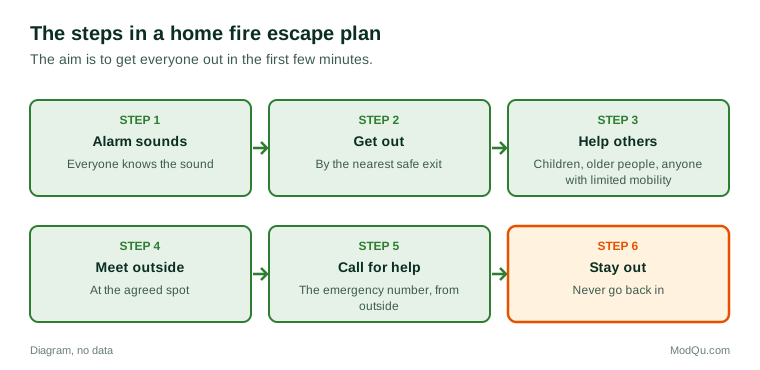
An escape plan is an agreed way for everyone in the home to get out quickly. The figure below shows the main steps. A plan usually covers:
- Two ways out of every room where possible, such as a door and a window.
- Keeping exits clear, with keys for locked doors and windows kept where everyone can reach them.
- A meeting place outside, such as a lamp post or a neighbour's gate.
- Who helps whom: babies, young children, older people and anyone with limited mobility.
- Getting out and staying out: not going back in for belongings or pets.
- Calling the emergency number once outside.
Practising the plan, including at night, helps everyone, especially children, know what to do.
Example (hypothetical figures)
A family times a practice escape from a two-storey house. On the first try at 7 p.m., it takes 3 minutes 10 seconds for everyone to reach the meeting point, mostly because a back door key could not be found. They hang the key on a hook by the door. On the second try it takes 1 minute 25 seconds, 1 minute 45 seconds faster than the first.
How often people test and check
Many people do not know when their smoke alarms were last tested or how old they are. Testing is easy to forget because nothing seems wrong. Some households tie it to a regular event, such as the first day of each month or the change to or from daylight saving time where that applies.
Surveys can measure how many homes have working alarms, how often people test them, and how many have an escape plan, which helps fire services decide where to focus.
Who is most at risk
People at higher risk from home fires include older people living alone, people with limited mobility, people who smoke, people affected by alcohol or certain medicines, young children, people in homes without working alarms and people in crowded or poorly built housing. Many fire services offer free home safety visits, and some fit smoke alarms for free for households at higher risk.
Example
An older man who lives alone and uses a walking frame has a home fire safety visit from the local fire service. They fit an interconnected alarm in his bedroom and living room, move a heater away from the curtains and suggest keeping a phone by the bed. He says he had not thought about how long it would take him to get out.
What people disagree about
- Should alarms be required in all homes? Many support laws requiring them; others prefer to leave it to owners.
- Who is responsible in rented homes? Landlords, tenants and governments share responsibility in different ways in different places.
- E-bike and battery rules: views differ on how strictly charging of e-bikes and scooters in homes and shared buildings should be controlled.
Questions that public bodies and businesses want answered here include how many homes have working alarms, how often they are tested and whether households have escape plans.
Key terms
- Smoke alarmA device that senses smoke and sounds a loud warning.
- Photoelectric alarmA smoke alarm that reacts quickly to slow, smouldering fires.
- Ionisation alarmA smoke alarm that reacts quickly to fast, flaming fires.
- Interconnected alarmsAlarms linked so that all sound when one detects smoke.
- Heat alarmAn alarm that reacts to a rise in temperature rather than smoke.
- Fire blanketA sheet of fire-resistant material used to smother a small fire.
- Escape planAn agreed way for everyone in a home to get out quickly in a fire.
- Smoke inhalationBreathing in smoke and poisonous gases from a fire.
Full glossary: fire safety terms on EditingTests.com.
Fire safety at home vocabulary test
How well do you know the language of this topic? Try 8 quick questions. Your score is shown straight away and is not saved.
What the fire safety at home survey asks
This survey is part of ModQu's Safety and Emergencies survey. The fire safety at home part takes about five minutes and covers:
- Whether you have working smoke alarms, how many and where.
- When you last tested them, and how old they are.
- Whether you have a fire extinguisher, fire blanket or other equipment.
- Whether your household has a fire escape plan, and whether you have practised it.
- Which fire risks you think about at home, such as cooking, heaters or batteries.
- Whether you have had a fire or near miss, and what changed afterwards.
After that you can choose to continue with other short parts of the Safety and Emergencies survey, such as emergency preparedness or identity theft, or stop.
Ready to take part?
Your answers help show what people really think and do. Results are only ever reported as totals; no one can see your individual answers.
Start the surveyQuestions about this survey
Who can take part?
Adults.
Do I have to give my name?
No. You may be asked for your age group, region and similar details so results can be broken down, but not your name. ModQu never asks for passwords, card numbers or account numbers.
How are the results used?
Answers are combined into totals and percentages and published in ModQu reports. Individual answers are never shown.
Is the vocabulary test part of the survey?
No. It is optional and separate, and your score is not stored.