
Share how you support environmental causes
Tell us whether you have given to an environmental charity in the last year, what made you give and how you judge their impact. Your answers are combined with other people's and reported only as totals.
Start the environmental charities surveyAbout 5 minutes. No account needed. You can stop at any time.
What environmental charities do
Environmental charities work to protect the natural world and reduce harm to it. Their work is wide-ranging, and many organizations do several of these things:
- Conservation of land and sea: buying, managing or protecting forests, wetlands, grasslands, coasts and marine areas.
- Species protection: work to save endangered plants and animals, including breeding programmes and anti-poaching patrols.
- Tree planting and restoration: restoring forests, peat bogs, mangroves and other damaged habitats.
- Climate action: research, education and campaigns to cut greenhouse gas emissions and help communities adapt.
- Pollution and waste: cleaning beaches and rivers, reducing plastic and campaigning for cleaner air and water.
- Local green spaces: looking after parks, community gardens and nature reserves.
- Education: nature programmes for schools and families.
- Law and policy: legal action and campaigns for stronger environmental rules.
Some are large international organizations, some are national trusts that own land, and many are small local groups. In some countries, environmental groups that focus mainly on political campaigning cannot register as charities, so gifts to them do not get tax relief.
Why people give
People who give to environmental causes often mention:
- Concern about climate change and the world their children and grandchildren will inherit;
- Love of a place, such as a coastline, forest or local park;
- A specific species, often one they have seen or learned about in documentaries;
- Disasters such as oil spills, wildfires and floods;
- Wanting to balance their own impact, for example after a long flight;
- Membership benefits, such as free entry to nature reserves or a magazine.
Example
A couple who walk on the same stretch of coast every weekend notice more litter after storms. They join a local beach-clean group, then start a small monthly gift to a national marine conservation charity. They say their giving started with the place they love, not with global issues.
How people give
Common ways of supporting environmental groups include:
- Membership: a yearly fee, often with benefits such as access to reserves.
- Regular gifts by direct debit or card.
- Adopt-a-species or adopt-an-acre schemes, which give a certificate or updates about an animal or area.
- Tree-planting gifts, often bought as presents.
- Volunteering: tree planting, surveys of wildlife, clean-ups and practical work on reserves.
- Gifts in wills, including gifts of land.
- Carbon offsetting, which some people treat as a form of environmental giving, although offsets are usually bought from companies rather than charities.
Example (hypothetical figures)
A household pays a 60 dollar yearly membership to a land trust and gives 15 dollars a month to a climate charity, 180 dollars a year. As a birthday present, they pay 30 dollars for a tree-planting gift. Their environmental giving for the year comes to 270 dollars, of which two-thirds goes to the climate charity.
Judging impact
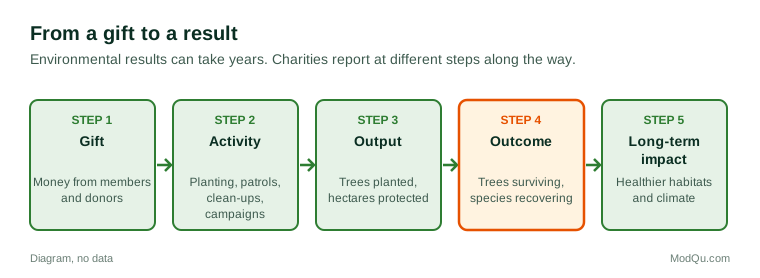
Many givers find it harder to judge the impact of environmental giving than of other causes. A shelter can say how many animals it rehomed, but the results of conservation or climate work may take decades and be hard to separate from other factors.
People use several kinds of evidence:
- Concrete outputs, such as hectares protected, trees planted or kilograms of litter removed;
- Outcomes, such as a species population recovering or a river becoming cleaner;
- Policy wins, such as a new protected area or a change in law;
- Independent evaluations and audits;
- Seeing it in person, by visiting a reserve or joining a work day.
Tree planting shows why this matters. Planting a tree is easy to count, but its value depends on whether it survives, whether it suits the local area, and whether the land would otherwise have been cleared. Some charities now report survival rates and monitor sites for years.
Volunteering for the environment
Many people support environmental causes with time rather than money. Common volunteer roles include:
- planting trees and hedges, and removing invasive plants;
- counting birds, butterflies, plants or other wildlife for citizen science projects;
- litter picks on beaches, rivers and streets;
- helping run nature reserves, visitor centres and community gardens;
- teaching children about nature at schools and events.
Volunteers often say that practical work helps them feel their effort makes a visible difference, which is harder to see with a monthly gift. Wildlife counts run by volunteers also provide data that scientists use to track changes in nature over time.
Trust and greenwashing
Environmental givers are often wary of exaggerated claims. Some worry that a charity accepts money from companies whose activities harm the environment, or that partnerships let those companies appear greener than they are. Others question tree-planting and offset schemes that promise to cancel out emissions.
Example
A student buys a tree-planting gift for a friend. Later they read that some schemes count saplings planted but not saplings that survive. They check the charity's website, find that it publishes survival rates and photos from its planting sites, and decide to keep giving to it but avoid schemes that do not report survival.
Local and global causes
Givers often choose between local environmental work they can see and international work where they believe their money might go further, such as protecting tropical forests. Many give to both. Local giving builds a sense of connection; international giving is often driven by the scale of the problem.
What people disagree about
Environmental giving raises a number of debates:
- whether to fund practical conservation or campaigning for laws and policy;
- whether charities should take money from companies with large environmental footprints;
- whether carbon offsets are a useful step or a way to avoid cutting emissions;
- whether protected areas should exclude people or be run with local and Indigenous communities;
- how to compare the impact of very different kinds of environmental work.
Questions environmental charities and researchers want answered include who gives, what motivates them, how they judge impact, and what information would make them give more or more often.
Key terms
- ConservationProtecting and managing nature, including habitats and species.
- HabitatThe natural home of a plant or animal species.
- RestorationReturning damaged land or water to a healthier natural state.
- Endangered speciesA species at high risk of dying out in the wild.
- Carbon offsetA payment intended to balance emissions by reducing or removing them elsewhere.
- Land trustA charity that owns or protects land for nature or public use.
- Survival rateThe share of planted trees that are still alive after a set time.
- Adopt-a-species schemeA gift that supports work for one species, often with updates for the giver.
Full glossary: conservation biology terms on EditingTests.com.
Environmental charities vocabulary test
How well do you know the language of this topic? Try 8 quick questions. Your score is shown straight away and is not saved.
What the environmental charities survey asks
This survey is part of ModQu's Charities and Giving survey. The environmental charities part takes about five minutes and covers:
- Whether you have given to an environmental charity in the last year.
- Which causes you supported: land, sea, species, climate, pollution or local green spaces.
- What made you give, and how you gave.
- How you judge whether your gift made a difference.
- How much you trust environmental charities and their claims.
- Whether you volunteer for environmental work.
After that you can choose to continue with other short parts of the Charities and Giving survey, such as donating to charity or volunteering, or stop.
Ready to take part?
Your answers help show what people really think and do. Results are only ever reported as totals; no one can see your individual answers.
Start the surveyQuestions about this survey
Who can take part?
Adults.
Do I have to give my name?
No. You may be asked for your age group, region and similar details so results can be broken down, but not your name. ModQu never asks for passwords, card numbers or account numbers.
How are the results used?
Answers are combined into totals and percentages and published in ModQu reports. Individual answers are never shown.
Is the vocabulary test part of the survey?
No. It is optional and separate, and your score is not stored.