
Share how prepared your household is
Tell us whether you have an emergency kit and plan, and what supplies you keep. Your answers are combined with other people's and reported only as totals.
Start the emergency preparedness surveyAbout 5 minutes. No account needed. You can stop at any time.
What emergency preparedness means
Emergency preparedness is the set of things a household does in advance so it can cope if something goes wrong. It usually covers three areas:
- Supplies: water, food, light, medicines and other items to get through a period without normal services.
- Plans: knowing where to go, how to contact each other and who does what.
- Knowledge and skills: knowing the risks where one lives, how warnings are given, how to turn off utilities and basic first aid.
The emergencies people prepare for vary by place. They include storms, floods, earthquakes, wildfires, heat waves, severe cold, long power cuts, water supply problems, disease outbreaks and incidents such as chemical spills. Many emergency agencies suggest that households be ready to look after themselves for at least three days, because help may take time to arrive when many people are affected at once.
The emergency kit
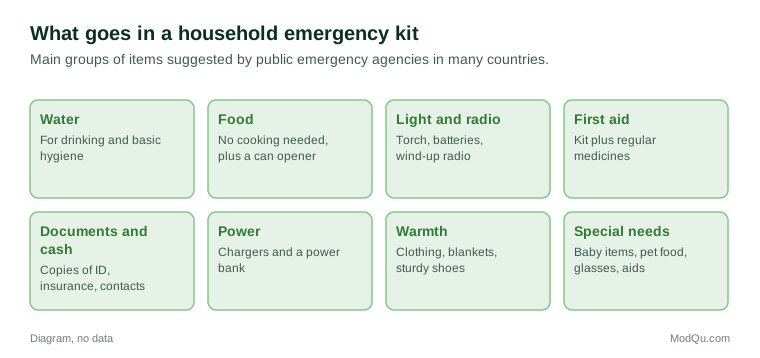
An emergency kit is a collection of supplies kept together so it can be used at home or carried if the household must leave. The figure below shows the main groups of items that public emergency agencies in many countries suggest. Common contents include:
- Water for drinking and basic hygiene.
- Food that does not need cooking or refrigeration, and a manual can opener.
- Light: a torch or flashlight, spare batteries, and sometimes a wind-up or solar lamp.
- A radio that runs on batteries or a hand crank, for news when power and phone networks are down.
- First aid kit and a supply of any regular medicines.
- Copies of important documents: identification, insurance, medical information, contact numbers.
- Cash in small amounts, since card payments may not work in a power cut.
- Phone chargers and a power bank.
- Warm clothing, blankets and sturdy shoes.
- Hygiene items: soap, hand sanitizer, toilet paper, rubbish bags.
- Items for specific needs: baby supplies, pet food, spare glasses, hearing aid batteries, mobility aids.
Many people also keep a smaller "grab bag" by the door and a kit in the car.
How much water and food people keep
Water is often the item people are least prepared with, because it is heavy and bulky. Agencies commonly suggest storing water by the number of people and days, and replacing it periodically. Food should be things the household will actually eat, checked for expiry dates and rotated into everyday meals.
Example (hypothetical figures)
A household of three adults and one child wants enough water for three days at 4 litres per person per day. That is 4 people times 4 litres times 3 days, or 48 litres. They have 12 litres in bottles in a cupboard. They buy three 12-litre containers, bringing their total to 48 litres, and set a reminder to change the water every six months.
The household emergency plan
A plan helps a household act quickly when it is stressed. Common parts include:
- Contact list: phone numbers for each household member, a relative or friend outside the area, schools, workplaces and the doctor.
- Meeting places: one near home, such as a neighbour's door, and one outside the neighbourhood.
- Exit routes from the home and from the area.
- Who does what: who collects the children, who checks on an older neighbour, who takes the pets.
- Utilities: where the water shut-off valve, electrical panel and gas meter are, and when they should be turned off.
- Special needs: medicines, medical equipment that needs power, and help for anyone with limited mobility.
Plans work better when everyone in the household knows them and has practised at least once.
Example
A family living in a coastal town writes a one-page plan after a storm cuts power for two days. They agree that if phone networks fail, everyone will go to the grandparents' house on higher ground. They pin the plan inside a kitchen cupboard and walk the route once with the children. The next winter, when a storm warning is issued, the children know where to go without being told.
Why many households are not prepared
Surveys in many countries have found that many people know they should prepare but have not done much. Common reasons include:
- It feels unlikely: "It won't happen here" or "It hasn't happened before."
- Cost, especially for low-income households.
- Space, particularly in small apartments.
- Time and effort: preparing never feels urgent until an emergency is close.
- Not knowing what to do, or finding advice confusing.
- Relying on others: assuming the government, a landlord or neighbours will help.
Preparation tends to rise after a major event, either locally or one widely covered in the news, and then fade again over the following months.
Who is most at risk
Some people are more affected by emergencies and may find it harder to prepare:
- older people living alone;
- people with disabilities or medical conditions that depend on electricity or regular treatment;
- families with babies and young children;
- people with low incomes or insecure housing;
- people who do not speak the local language well and may miss warnings;
- people without a car who cannot easily leave.
Community efforts, such as neighbours checking on each other, local emergency groups and lists of people who need help, aim to fill some of these gaps.
Example
A volunteer in a block of flats starts a simple list of residents who would like a knock on the door during a power cut, including two older tenants who use oxygen machines. When a heat wave causes outages, volunteers check on everyone on the list within an hour and call for help for one resident whose backup battery is running low.
Warnings, information and technology
Many countries now send emergency alerts directly to mobile phones in an affected area, alongside radio, television, sirens and official websites. Apps from public agencies and weather services give warnings and advice. People differ in which sources they trust and check, and in whether they act on a warning straight away or wait to see what others do.
Technology also creates new needs: households that depend on phones, electric heating, electric cars or home medical devices may be more affected by long power cuts than in the past.
What people disagree about
- Whose responsibility? Some see preparation mainly as a personal duty; others say governments and utilities should do more.
- How much is enough? Some keep a few days' supplies; others store weeks or months. Views differ on what is sensible and what is excessive.
- Fear or reassurance? Some worry that preparedness campaigns cause anxiety; others say knowing what to do reduces fear.
Questions that public bodies and businesses want answered here include how many households have a kit and plan, what supplies they keep, and what would help them prepare more.
Key terms
- Emergency kitSupplies kept together for use during an emergency.
- Grab bagA small bag of essentials ready to take if you must leave quickly.
- Household emergency planAn agreed plan for how a household will act and stay in touch in an emergency.
- Meeting placeAn agreed spot where household members gather if separated.
- Out-of-area contactA person living elsewhere who household members can call to pass on messages.
- Shelter in placeStaying indoors during an emergency instead of leaving.
- EvacuationLeaving an area because of danger, often on official instruction.
- Emergency alertAn official warning sent to phones, radio, television or sirens.
Full glossary: emergency management terms on EditingTests.com.
Emergency preparedness vocabulary test
How well do you know the language of this topic? Try 8 quick questions. Your score is shown straight away and is not saved.
What the emergency preparedness survey asks
This survey is part of ModQu's Safety and Emergencies survey. The emergency preparedness part takes about five minutes and covers:
- Whether you have an emergency kit at home or in the car, and what is in it.
- Whether your household has an emergency plan, and whether you have practised it.
- How many days of water and food you keep.
- Which emergencies you think are most likely where you live.
- What stops you from preparing more.
- Where you would get information and warnings in an emergency.
After that you can choose to continue with other short parts of the Safety and Emergencies survey, such as fire safety at home or identity theft, or stop.
Ready to take part?
Your answers help show what people really think and do. Results are only ever reported as totals; no one can see your individual answers.
Start the surveyQuestions about this survey
Who can take part?
Adults.
Do I have to give my name?
No. You may be asked for your age group, region and similar details so results can be broken down, but not your name. ModQu never asks for passwords, card numbers or account numbers.
How are the results used?
Answers are combined into totals and percentages and published in ModQu reports. Individual answers are never shown.
Is the vocabulary test part of the survey?
No. It is optional and separate, and your score is not stored.