
Share how you give after disasters
Tell us whether you gave after a recent disaster, who you gave to and how sure you are that the help arrived. Your answers are combined with other people's and reported only as totals.
Start the disaster relief and humanitarian aid surveyAbout 5 minutes. No account needed. You can stop at any time.
What disaster relief and humanitarian aid cover
Humanitarian aid is help given to people whose lives, health or safety are at risk because of a crisis. The crisis may be sudden, such as an earthquake, cyclone, flood or wildfire, or slow, such as a drought that leads to food shortages. It may also be caused by people, as with war, mass displacement and the collapse of public services.
Aid workers usually separate three phases:
- Emergency relief: search and rescue, first aid, clean water, food, shelter and protection in the first days and weeks.
- Recovery: rebuilding homes, schools and clinics, restoring livelihoods and helping people return home.
- Preparedness and risk reduction: early warning systems, stronger buildings, stored supplies and training before the next disaster.
Public appeals focus mostly on the first phase, because that is when the news coverage is greatest. Many aid groups say that recovery and preparedness are where funding is hardest to find.
Who delivers aid
Aid reaches people through a mix of organizations, and most large responses involve all of them working together:
- National governments and local authorities in the affected country, which usually lead the response.
- United Nations agencies, such as the World Food Programme and the UN Refugee Agency (UNHCR), which coordinate and supply aid at large scale.
- The International Red Cross and Red Crescent Movement, with national societies in almost every country.
- International charities and non-governmental organizations (NGOs) that specialize in health, water, food, shelter or children.
- Local charities, faith groups and community organizations, which are often first on the scene and stay longest.
- Diaspora communities, people from the affected country living abroad, who often send money directly to family and home towns.
Many countries also have national bodies that run joint appeals on behalf of several charities after a major disaster, so the public can give through one channel.
How people decide to give
Most disaster giving is a quick response to news. People see images of destroyed homes or families in camps and want to do something. The decision to give, and how much, is shaped by several things:
- Closeness: a disaster in a country where the giver has family, roots or has travelled.
- Media coverage: crises that are on television and social media for weeks tend to raise more money than those that are not.
- The type of disaster: sudden natural disasters often attract more public giving than long conflicts or slow famines, even when needs are similar.
- Trust: whether the giver believes an organization will use the money well.
- Ease: a text-to-give number, a bank appeal, a collection at work or a link shared by a friend.
- Matching: some governments and employers match public donations for a period, which can encourage people to give sooner.
Example
After a strong earthquake in a country where their grandparents were born, a nurse living abroad gives to an international medical charity, sends money to a cousin whose house was damaged, and joins a collection at a community centre that is shipping blankets. Six months later, when the news has moved on, they set up a small monthly gift to the same medical charity.
Money or goods
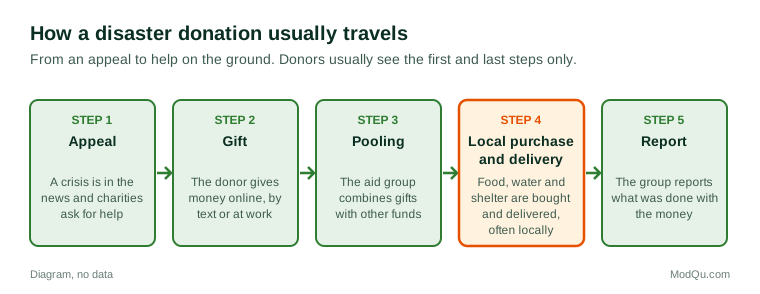
Aid organizations almost always ask for money rather than donated goods in the early stages. Money can be spent quickly on exactly what is needed, often bought locally, which also supports the local economy. Shipping donated clothes, tinned food or bottled water across the world costs money, takes time and may not match what people need.
There are exceptions. Some local groups do ask for specific items, and blood donations are needed in some emergencies. The general advice from aid bodies is to check what an appeal is asking for before collecting goods.
Example (hypothetical figures)
A school class collects 200 kilograms of clothing for flood survivors. A shipping quote for the clothing comes to 600 dollars, more than the 450 dollars the clothes would cost to buy new in the affected region. After talking to an aid group, the class sells some items at a jumble sale, gives the 450 dollars plus the money saved on shipping, and donates the rest of the clothing to a local shelter.
Trust, overheads and scams
Trust is the biggest concern people raise about disaster giving. Common questions include how much of a donation reaches people in need, whether aid is stolen or blocked in conflict zones, and what happens to money raised after the emergency phase ends.
Many people judge charities by their overhead, the share spent on administration and fundraising. Aid experts often point out that some overhead is needed to deliver aid well: trained staff, logistics, security and accounting all cost money. Some donors now prefer to look at results and reports instead of overhead alone.
Disasters also bring scams. Fake appeals appear on social media, by text message and by phone within hours of a major event. Common warning signs include pressure to give at once, requests for gift cards or cryptocurrency, and organizations with names close to a well-known charity. Many countries keep a public register of charities, such as the national charity regulators in England and Wales, Australia and New Zealand, which givers can use to check that a charity exists.
Example
A retired teacher receives a text asking for urgent help for cyclone victims, with a payment link. The name is similar to, but not the same as, a large aid agency. They look up the agency's own website through a search engine instead of the link, find the real appeal and give there. They report the text to their phone provider.
Restricted and unrestricted gifts
A gift to a named appeal, such as a specific earthquake, is usually restricted: the charity must spend it on that response. An unrestricted gift can be used where the need is greatest, including forgotten crises that are not in the news, preparedness work and the core costs of being ready to respond. Givers often prefer to know exactly where their money goes, while many aid groups say unrestricted funds let them act faster next time.
What people disagree about
Disaster aid raises questions on which people hold different views:
- Whether to give to large international agencies or to small local groups in the affected country.
- Whether governments should spend more or less on foreign aid when there are needs at home.
- How to balance urgent relief with longer-term work that prevents future disasters.
- Whether giving directly to individuals, through cash transfers, is better than giving through programmes.
- How much media coverage should decide which crises get help.
Survey research on this topic asks who gives, how often, through which channels, and what would increase their confidence that aid reaches people. Questions businesses and charities want answered include which appeals reach new donors, how many people keep giving after the emergency, and what information givers want afterwards.
Key terms
- Humanitarian aidHelp given to save lives and reduce suffering during and after a crisis.
- Emergency reliefThe first phase of aid: rescue, food, water, shelter and medical care.
- RecoveryRebuilding homes, services and livelihoods after the emergency phase.
- Disaster risk reductionWork done before disasters to make them less harmful, such as early warnings.
- Joint appealOne fundraising appeal run on behalf of several charities.
- Restricted giftA donation that must be spent on a named purpose or appeal.
- OverheadThe share of a charity's spending on administration and fundraising.
- Cash transferAid given as money so people can buy what they need themselves.
Full glossary: disaster response terms on EditingTests.com.
Disaster relief and humanitarian aid vocabulary test
How well do you know the language of this topic? Try 8 quick questions. Your score is shown straight away and is not saved.
What the disaster relief and humanitarian aid survey asks
This survey is part of ModQu's Charities and Giving survey. The disaster relief and humanitarian aid part takes about five minutes and covers:
- Whether you gave money, goods or time after a disaster in the last year.
- Which kind of organization you gave to, and how you heard about the appeal.
- What made you decide to give, and how much.
- How sure you are that your gift reached people in need.
- Whether you have seen or been targeted by a fake appeal.
- What information you would like from aid groups after you give.
After that you can choose to continue with other short parts of the Charities and Giving survey, such as donating to charity or volunteering, or stop.
Ready to take part?
Your answers help show what people really think and do. Results are only ever reported as totals; no one can see your individual answers.
Start the surveyQuestions about this survey
Who can take part?
Adults.
Do I have to give my name?
No. You may be asked for your age group, region and similar details so results can be broken down, but not your name. ModQu never asks for passwords, card numbers or account numbers.
How are the results used?
Answers are combined into totals and percentages and published in ModQu reports. Individual answers are never shown.
Is the vocabulary test part of the survey?
No. It is optional and separate, and your score is not stored.
Is it better to give to one large agency or several small ones?
ModQu does not advise on where to give. The survey asks what people choose and why.
Does the survey ask how much I gave?
It asks for a range, not an exact amount, and you can skip the question.