
Share your experience of online fundraisers
Tell us whether you have given to an online fundraiser, what it was for and how you decided to trust it. Your answers are combined with other people's and reported only as totals.
Start the crowdfunding and online fundraising surveyAbout 5 minutes. No account needed. You can stop at any time.
What crowdfunding and online fundraising cover
Crowdfunding means raising money from many people, each giving a small amount, usually through a website or app. Online fundraising is a wider term that also includes giving through a charity's own website, social media fundraisers and donation links shared in messages.
There are four main kinds of crowdfunding:
- Donation-based: people give money and expect nothing back. Personal appeals for medical costs, funerals, emergencies and community projects fall here.
- Reward-based: backers receive a product, a thank-you gift or early access, often for creative projects or new products.
- Equity-based: investors receive a small share in a business. This is regulated as investment in most countries.
- Lending-based: people lend money to individuals or businesses and expect it back, sometimes with interest.
This page is mainly about donation-based fundraising, which is the kind most members of the public meet. In many countries it has become a common way to give to friends, family and strangers, alongside traditional charities.
Personal appeals and charity fundraisers
Online fundraisers fall into two broad groups.
Personal appeals are set up by an individual for themselves or someone they know: a family facing medical bills, a funeral, a house fire, a sports club that needs new kit, or a student raising money to study abroad. Money usually goes to the person who set up the page or to a named beneficiary. In most countries this money is a gift, not a charitable donation, so it does not qualify for tax relief.
Charity fundraisers are pages that collect money for a registered charity. A person might run a marathon, shave their head or give up a habit for a month and ask friends to sponsor them. The money goes to the charity, and in some countries the charity can claim tax relief on it.
Example
A parent's colleague is diagnosed with a serious illness and has to stop working. A group of coworkers sets up a fundraising page for rent and travel to treatment, shares it in the office chat and on social media, and posts updates on how the money is spent. Most gifts come from people who know the family directly or through one other person.
Why people give
People give to online fundraisers for reasons that are partly the same as other giving and partly different:
- A personal link: most gifts come from friends, family, coworkers and their networks.
- A clear story: a named person with a photo and a specific need is easier to respond to than a general cause.
- Social pressure and visibility: many pages show who gave and how much, which can encourage others to match.
- Speed: a page can be shared and funded within hours.
- Reciprocity: people sponsor friends who sponsored them last year.
Researchers have noted that the stories that raise the most money are not always the cases with the greatest need. People with large social networks, good writing skills and access to media tend to raise more. Some see this as a fairness problem when crowdfunding is used to pay for health care or basic needs.
Fees and where the money goes
Fundraising platforms make money in different ways, and givers are often unsure how much reaches the person or charity:
- a platform fee, a percentage taken from each gift;
- a payment processing fee charged by the card or payment company;
- an optional tip to the platform, which some sites suggest at checkout;
- all-or-nothing rules on some reward sites, where money is only collected if the target is reached.
Example (hypothetical figures)
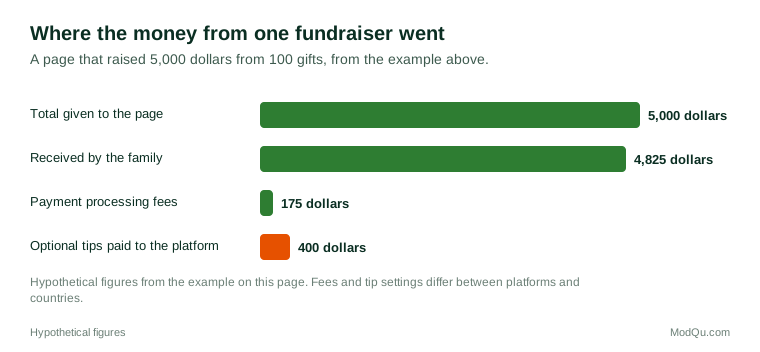
A page raises 5,000 dollars from 100 people. The platform charges no platform fee but asks each donor for an optional tip, and the payment processor takes 2.9 percent plus 30 cents per gift. Processing costs come to 145 dollars plus 30 dollars, or 175 dollars, so the family receives 4,825 dollars. Donors also added 400 dollars in tips, which went to the platform, not the family.
Checking that a fundraiser is genuine
Most fundraisers are honest, but fake and misleading pages do appear, especially after disasters and news stories. Givers use a mix of checks:
- knowing the organizer personally, or through someone they trust;
- whether the page names the beneficiary and explains how the money will reach them;
- whether there are updates, photos and receipts;
- whether a registered charity is involved, and whether it can be found on a public charity register;
- the platform's own guarantee or refund policy, if it has one.
Warning signs include stories that change, pages set up by people with no clear link to the beneficiary, and pressure to give through a private payment method instead of the page.
Example
After a fire destroys a family home in their town, a resident sees three fundraising pages for the same family. One is set up by the family's sister and linked from the local school's newsletter. The other two have no updates and organizers nobody recognizes. They give only to the first page and report the others to the platform.
Running a fundraiser
People who set up a fundraiser usually find that sharing it takes more work than creating the page. Organizers often:
- write a short, specific story that says who the money is for and what it will pay for;
- set a realistic target, sometimes raising it later;
- share the page first with close friends and family, whose early gifts encourage others;
- post updates, thank-you messages and, where possible, receipts;
- explain what will happen to any money left over.
Most of the money for a typical personal fundraiser tends to arrive soon after it is first shared. Pages that stop posting updates often stop receiving gifts.
What people disagree about
Online fundraising raises several debates:
- Whether crowdfunding for medical care and other basic needs fills a gap or hides one that public services should fill.
- Whether platforms should take a share of gifts, and whether tips should be suggested by default.
- Whether people with large networks and good stories get help that others with the same need do not.
- How much platforms should check stories before a page goes live.
- Whether giving to individuals reduces giving to charities.
Questions charities, platforms and researchers want answered include how often people give through fundraising pages, what they give for, how they decide whether to trust a page, and whether this giving adds to or replaces other donations.
Key terms
- CrowdfundingRaising money from many people, each giving a small amount, usually online.
- Donation-based crowdfundingFundraising where givers expect nothing back.
- Reward-based crowdfundingBackers receive a product or thank-you gift for their money.
- Equity crowdfundingInvestors receive a share in a business, usually under investment rules.
- BeneficiaryThe person or group the money is raised for.
- Platform feeA share of each gift kept by the fundraising website.
- All-or-nothingA rule where money is only collected if the target is reached.
- Sponsorship pageA page where friends pledge money to a charity for a challenge someone completes.
Full glossary: crowdfunding platforms terms on EditingTests.com.
Crowdfunding and online fundraising vocabulary test
How well do you know the language of this topic? Try 8 quick questions. Your score is shown straight away and is not saved.
What the crowdfunding and online fundraising survey asks
This survey is part of ModQu's Charities and Giving survey. The crowdfunding and online fundraising part takes about five minutes and covers:
- Whether you have given to an online fundraiser or sponsorship page, and how often.
- What the fundraisers were for, and how you knew the person or cause.
- How much you usually give, as a range.
- How you check that a fundraiser is genuine.
- Whether you have set up a fundraiser yourself, and how it went.
- Your views on fees, tips and how platforms check pages.
After that you can choose to continue with other short parts of the Charities and Giving survey, such as donating to charity or volunteering, or stop.
Ready to take part?
Your answers help show what people really think and do. Results are only ever reported as totals; no one can see your individual answers.
Start the surveyQuestions about this survey
Who can take part?
Adults.
Do I have to give my name?
No. You may be asked for your age group, region and similar details so results can be broken down, but not your name. ModQu never asks for passwords, card numbers or account numbers.
How are the results used?
Answers are combined into totals and percentages and published in ModQu reports. Individual answers are never shown.
Is the vocabulary test part of the survey?
No. It is optional and separate, and your score is not stored.