
Share your views on companies and good causes
Tell us whether a company's conduct affects what you buy and whether you trust what companies say about their good works. Your answers are combined with other people's and reported only as totals.
Start the corporate social responsibility surveyAbout 5 minutes. No account needed. You can stop at any time.
What corporate social responsibility means
Corporate social responsibility (CSR) is the idea that companies should consider their effects on people, communities and the environment, not only on profits. In practice it covers a wide range of actions, from donations and volunteering to how a company makes its products and treats its staff.
Related terms are often used in the same way:
- ESG (environmental, social and governance) is used mainly by investors to rate how companies manage these issues.
- Sustainability usually refers to environmental impact, such as emissions, waste and use of resources.
- Corporate citizenship and social impact describe a company's role in society more broadly.
- Purpose-led or mission-driven brands put a social or environmental aim at the centre of what they sell.
Rules differ by country. Some governments require large companies to report on environmental and social matters, and a few require companies to spend a share of profit on social projects, as India does for companies above set size thresholds.
The main kinds of CSR
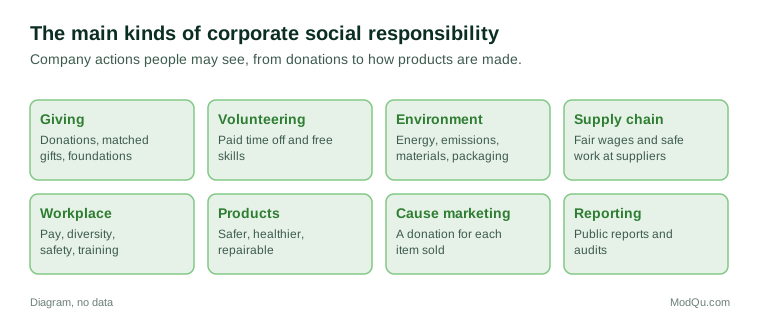
Company actions usually fall into a few groups:
- Giving: donations to charities, matched employee giving, and company foundations.
- Volunteering: paid time off for staff to volunteer, and skills given free to charities.
- Environment: cutting energy use and emissions, using recycled materials, and reducing packaging.
- Supply chain: checking that suppliers pay fair wages, avoid child and forced labour, and work safely.
- Workplace: fair pay, diversity, health and safety, and training.
- Products: making products safer, healthier or easier to repair.
- Cause marketing: promising a donation for each product sold.
How CSR affects what people buy
When asked in surveys, many people say they prefer to buy from companies that behave well. Their actual shopping is often different, because price, quality and convenience usually come first. Researchers call this the attitude-behaviour gap or intention-action gap.
CSR tends to matter more when:
- the product is similar in price and quality to alternatives;
- the issue is close to the buyer, such as a cause they support or an industry they know;
- the information is clear and easy to check, such as a certification label;
- the buyer has heard bad news about a company.
Example
A shopper says they care about fair treatment of farmers. At the supermarket they usually buy the cheapest coffee, but they choose a certified fair-trade brand when it is on offer or when they are buying a gift. When a news story reports poor conditions at a supplier of their usual brand, they switch for several months, then drift back as the price gap grows.
Boycotts and buycotts
People also use their spending to reward or punish companies:
- A boycott is a refusal to buy from a company because of its conduct.
- A buycott is a deliberate choice to buy from a company because of its conduct.
Boycotts can be organized campaigns or private decisions. Many people say they have stopped buying from a firm at some point because of something it did, though they may not keep it up.
Example (hypothetical figures)
A family spends about 60 dollars a month at a clothing chain. After reports about unsafe factories in its supply chain, they stop shopping there and move their spending to a second-hand shop and a smaller local brand. Over a year, this moves about 720 dollars of spending away from the chain. A year later, when the chain publishes a list of its factories and new safety audits, they start buying basics there again.
Trust and greenwashing
People are often unsure whether to believe company claims. Greenwashing means making a company or product sound more environmentally friendly than it is. Similar terms include purpose-washing and social washing.
Common reasons for doubt include:
- vague words like "eco-friendly" or "natural" with no explanation;
- small donations promoted heavily in advertising;
- claims about one product while the rest of the business is unchanged;
- labels and badges that the company created itself.
Regulators in several regions, including the European Union, the United Kingdom and Australia, have introduced or tightened rules on environmental claims. Independent certifications and third-party audits are one way people try to judge claims.
Example
An office worker sees an advert in which a drinks company says it is "planet positive". They search the claim and find that it refers to one product line that uses recycled bottles. They decide the claim is not false but is overstated, and say in a survey that they now pay less attention to environmental claims in adverts.
CSR at work
CSR also affects employees. Many people say they would rather work for an employer whose values match their own, and some companies use CSR to attract and keep staff. Common workplace programmes include:
- matching staff donations to charities, often up to a yearly limit;
- payroll giving, where staff give to charity directly from their pay;
- one or more paid days a year for volunteering;
- staff votes on which charities the company supports;
- green teams that suggest ways to cut waste and energy use.
Staff can also be the first to notice when a company's claims do not match how it operates, and some speak out in public or leave.
Example
An engineer chooses between two job offers with similar pay. One company offers two paid volunteering days a year and matches donations; the other does not. The engineer chooses the first, but says later that the work itself and the manager mattered more than the volunteering days.
What people disagree about
CSR is debated from several sides:
- Some argue that a company's job is to make a profit within the law and that social goals belong to governments and charities.
- Others argue that companies have a duty to the communities and environment they affect.
- Some say CSR is mostly marketing; others say even partial action helps.
- People disagree about whether companies should take public positions on political and social issues.
Questions companies, charities and researchers want answered include which actions people notice, which claims they trust, and whether company conduct changes what people buy.
Key terms
- Corporate social responsibilityA company's actions to consider its effects on people, communities and the environment.
- ESGEnvironmental, social and governance factors used to rate companies.
- Cause marketingA promise to donate to a cause for each product sold.
- Supply chainThe firms and workers that make and move a product before it is sold.
- GreenwashingMaking a company or product sound greener than it is.
- BoycottRefusing to buy from a company because of its conduct.
- BuycottChoosing to buy from a company because of its conduct.
- Attitude-behaviour gapThe difference between what people say they value and what they buy.
Full glossary: corporate sustainability reporting terms on EditingTests.com.
Corporate social responsibility vocabulary test
How well do you know the language of this topic? Try 8 quick questions. Your score is shown straight away and is not saved.
What the corporate social responsibility survey asks
This survey is part of ModQu's Charities and Giving survey. The corporate social responsibility part takes about five minutes and covers:
- Whether you prefer brands that support good causes, and how much it matters next to price.
- Whether you have stopped buying from a company because of its conduct.
- Whether you have chosen a product because of a company's conduct.
- How much you trust company claims about charity and the environment.
- Which labels or sources you use to check claims.
- Which company actions you notice most.
After that you can choose to continue with other short parts of the Charities and Giving survey, such as donating to charity or volunteering, or stop.
Ready to take part?
Your answers help show what people really think and do. Results are only ever reported as totals; no one can see your individual answers.
Start the surveyQuestions about this survey
Who can take part?
Adults.
Do I have to give my name?
No. You may be asked for your age group, region and similar details so results can be broken down, but not your name. ModQu never asks for passwords, card numbers or account numbers.
How are the results used?
Answers are combined into totals and percentages and published in ModQu reports. Individual answers are never shown.
Is the vocabulary test part of the survey?
No. It is optional and separate, and your score is not stored.