
Share your experience of child sponsorship
Tell us whether you sponsor a child, why you started and how you hear from the charity. Your answers are combined with other people's and reported only as totals.
Start the child sponsorship surveyAbout 5 minutes. No account needed. You can stop at any time.
What child sponsorship is
Child sponsorship is a form of regular giving in which a donor, the sponsor, is linked to a named child. The sponsor pays a fixed amount each month or year, and the charity sends a photo, information about the child and updates, often once or twice a year. Many charities let sponsors write letters and receive replies, and some allow visits.
Sponsorship has been used by charities for many decades. It began with programmes for children affected by war and poverty and is now run by many international development and faith-based charities. Sponsored children may live in Africa, Asia, Latin America, the Middle East, Eastern Europe or in poorer communities of wealthy countries.
Where the money usually goes
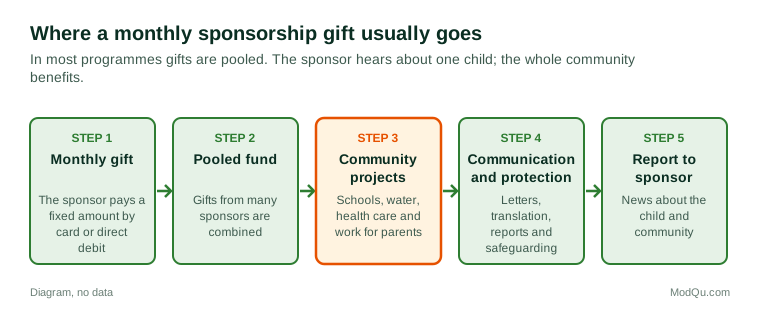
A common misunderstanding is that sponsorship money is given directly to the child or family. In most modern programmes it is not. The money is pooled and used for projects that benefit the child's whole community, such as:
- schools, teachers and school supplies;
- clean water and toilets;
- health clinics, vaccinations and nutrition;
- training and small loans for parents to earn a living;
- child protection and birth registration.
Charities usually say this is fairer, because it helps children who are not sponsored too, and safer, because it avoids singling out one family. Some programmes do give part of the money to the family or school, or allow sponsors to send a small extra gift for the child's birthday or a special need.
Charities that run sponsorship also have costs for linking sponsors and children, translating and posting letters, producing reports and protecting children's information. These are part of what the monthly gift pays for.
Why people start sponsoring
People give many reasons for starting to sponsor a child:
- A personal connection: seeing one child's face and name makes the gift feel real.
- Faith: many sponsorship charities are linked to churches or other faith groups, and sponsors may hear about them at services.
- Family values: some parents sponsor a child close in age to their own so their children can write letters and learn about another country.
- Travel: some sponsors start after visiting a country.
- Being asked: street and door-to-door fundraisers, events and adverts often recruit sponsors.
Example
A couple with two primary-school children start sponsoring a girl of the same age in a rural district abroad. The family writes a letter together each year and sends drawings. When the sponsored child writes back about her new school building, their own children ask to put part of their pocket money towards a class project in her village.
Letters, visits and communication
Communication is the part of sponsorship that sets it apart from other giving. Most charities send:
- an introduction pack with a photo and basic facts;
- one or two progress reports a year;
- letters or drawings from the child, often translated by staff;
- news about community projects.
Many charities now offer letters through an app or website. Rules usually protect the child's privacy and safety: sponsors are not given the family's address, and gifts and direct contact outside the charity are not allowed. Visits are usually possible only when arranged through the charity, with staff present.
Example
A sponsor who has written to the same boy for eight years is told he has finished secondary school and the programme is leaving his village because the community now runs its own projects. The charity offers to link the sponsor with a younger child in a new area. The sponsor agrees but says the final letter, describing the boy's plans to train as an electrician, was the best news they had received.
Costs and how long people sponsor
Sponsorship is usually a fixed monthly amount set by the charity, often paid by direct debit or card. Sponsors commit to no fixed term and can stop at any time, but charities encourage long-term giving because projects run for years.
Example (hypothetical figures)
A sponsor gives 35 dollars a month. Over a year that is 420 dollars. They also send a 20 dollar birthday gift and a 50 dollar extra gift at the end of the year, so their total giving to the programme is 490 dollars. In a country where gifts to registered charities attract tax relief, some of this may be claimed back, depending on local rules.
People stop sponsoring for several reasons: a change in their own finances, a feeling that they hear too little, a child leaving the programme, or doubts about how the money is used.
Choosing a sponsorship charity
People who are thinking about sponsoring often compare charities on a few points:
- How the money is used: pooled community projects, direct support to the family or a mix.
- Faith links: whether the charity is religious, and whether programmes include religious activity.
- Where it works: some sponsors want a particular country or region.
- Communication: how often they will hear, and whether letters can be sent online.
- Reporting: whether the charity publishes annual accounts and results from its projects.
- Registration: whether it appears on the public charity register in the sponsor's country.
Some people choose sponsorship because it feels personal, then later move to general monthly giving to the same charity, which usually carries lower administration costs because no individual reports are needed.
What people disagree about
Child sponsorship has long been debated:
- Accuracy of the message: some critics say adverts can suggest the money goes straight to one child when it is pooled.
- Dignity and privacy: using children's photos and stories to raise money raises questions about consent and how families are shown.
- Dependency: some ask whether long-term outside funding helps communities stand on their own; charities point to exit plans when communities can continue projects themselves.
- Faith-based programmes: some sponsors want to know whether programmes include religious teaching.
- Effectiveness: researchers have studied whether sponsored children do better at school and work, with mixed and debated findings.
Questions charities want answered include why people start and stop sponsoring, how often sponsors want to hear from the charity, and what information helps them trust that the money is well used.
Key terms
- SponsorA person who gives regularly and is linked to a named child.
- Community developmentProjects that improve life for a whole area, not one family.
- Pooled fundingGifts combined and spent on shared projects.
- Progress reportAn update from the charity about the child and community.
- Direct debitA regular payment taken from a bank account by agreement.
- Child safeguardingRules and practices that protect children from harm.
- Exit planA charity's plan to hand projects over to the community and leave.
- Faith-based charityA charity linked to a religion or religious group.
Full glossary: charitable giving management terms on EditingTests.com.
Child sponsorship vocabulary test
How well do you know the language of this topic? Try 8 quick questions. Your score is shown straight away and is not saved.
What the child sponsorship survey asks
This survey is part of ModQu's Charities and Giving survey. The child sponsorship part takes about five minutes and covers:
- Whether you sponsor a child now or have done in the past.
- How you heard about the programme and why you started.
- How much you give and how you pay.
- How often you hear from the charity and whether you write letters.
- What you understand about where the money goes.
- Whether you have stopped sponsoring, and why.
After that you can choose to continue with other short parts of the Charities and Giving survey, such as donating to charity or volunteering, or stop.
Ready to take part?
Your answers help show what people really think and do. Results are only ever reported as totals; no one can see your individual answers.
Start the surveyQuestions about this survey
Who can take part?
Adults.
Do I have to give my name?
No. You may be asked for your age group, region and similar details so results can be broken down, but not your name. ModQu never asks for passwords, card numbers or account numbers.
How are the results used?
Answers are combined into totals and percentages and published in ModQu reports. Individual answers are never shown.
Is the vocabulary test part of the survey?
No. It is optional and separate, and your score is not stored.