
Share how your beliefs have changed
Tell us whether your religious belief has changed since childhood, how, and what caused it. Your answers are combined with other people's and reported only as totals.
Start the changing religious belief surveyAbout 5 minutes. No account needed. You can stop at any time.
Kinds of change
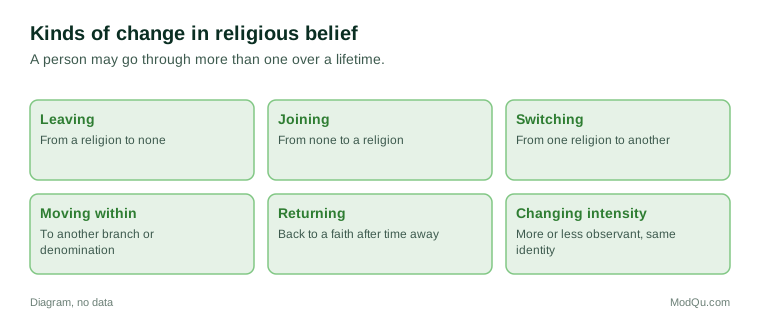
Changes in religious belief come in several forms:
- Leaving a religion to become non-religious, sometimes called disaffiliation.
- Joining a religion after being raised with none.
- Switching from one religion to another, often called conversion.
- Moving within a religion, such as changing denomination, branch or congregation.
- Returning to a faith after years away.
- Changing intensity: becoming more or less observant without changing identity.
- Changing the content of belief: keeping a religious label while believing different things.
The figure below sets these out. Many people experience more than one change over a lifetime.
How common change is
The share of people who change religion differs greatly between countries. In some places most adults keep the religion they were raised in; in others a large share describe themselves differently from their parents. Surveys find these patterns by comparing a person's religion in childhood with their religion today. Because such questions rely on memory, researchers know that people sometimes recall their childhood religion through the lens of their current views.
Common reasons
People give many reasons for changing belief:
- Doubts about teachings, such as questions about science, suffering or scripture.
- Disagreement with leaders or institutions, including over scandals or rules.
- Relationships, such as marrying someone of another faith.
- Life events, such as illness, loss, migration or having children.
- Spiritual experiences that a person sees as a calling.
- Community: finding a welcoming group or feeling excluded by one's own.
- Study and travel: learning about other traditions.
- Drifting away: gradually stopping practice without a clear decision.
Example
A woman raised in a religious family stops attending services at university and, by her thirties, describes herself as having no religion. She did not make a single decision: practice fell away during years of shift work and moving cities. When asked when she left, she says she is not sure that she ever "left" at all.
What people go through
Changing belief can be quiet or very public. For some it is a private process that family barely notices. For others it means:
- difficult conversations with parents, partners and children;
- loss of friendships or community roles;
- changes in food, dress, holidays and daily habits;
- learning new prayers, practices or a new language for worship;
- formal steps such as a ceremony of entry, or a request to leave a membership record.
In a small number of countries, leaving or changing religion carries legal penalties or serious social risk. International human rights standards, such as the Universal Declaration of Human Rights, include the freedom to change one's religion or belief.
Example
A man who joins a new faith in his forties takes a year of classes, goes through a ceremony of entry and changes his diet. His parents are upset at first but come to the ceremony. He says the hardest part was explaining the change to his children, who chose to keep the family's previous traditions for holidays.
Returning to faith
Some people return to a faith after years away. Common triggers include having children, the death of a parent, a health crisis, retirement or a move to a new place where a faith community offers friendship. Returners often describe their faith as different from what they had as children, with more personal choice.
Example
A father who had not attended services for fifteen years begins taking his young son to a weekly children's service, because he wants the boy to know the stories he heard growing up. He starts staying for the adult service afterwards and joins a study group.
How researchers study change
Studying belief change raises methodological problems:
- Recall: people may remember their childhood religion inaccurately.
- Labels: a person may still use a religious label while no longer believing, or drop the label while still praying.
- Survivorship: studies of a congregation only reach people who stayed, not those who left.
- Sensitivity: some people do not want to say they have left a faith, especially if family or community might disapprove.
Good surveys ask about identity, belief and practice separately, ask about childhood and today, and assure respondents that answers are confidential and grouped.
What people disagree about
- Whether falling religious identity in some countries is a lasting decline or a change in the form of belief.
- Whether it is right to encourage people of other faiths to convert.
- How religious communities should treat members who leave.
- How states should protect people who change religion.
- Whether children should be raised in a faith or left to choose as adults.
Why surveys ask about changing belief
Questions that faith bodies, researchers and public agencies want answered include how many people hold different beliefs from childhood, in which direction, at what age and why. Every question can be skipped and answers are reported only as grouped results.
Change across generations
Belief change is often visible between generations. Grandparents, parents and children in the same family may hold quite different views: one generation strongly observant, the next less so, and the next returning to some practices or choosing a different faith. Migration can speed up these changes, as children grow up in a country with different religious patterns from their parents' homeland. Families often find ways to share important occasions, such as weddings and funerals, even when their beliefs differ. Researchers who study change across generations compare surveys taken years apart, follow the same people over time, or ask respondents about their parents' religion as well as their own.
Key terms
- ConversionChanging from one religion to another, or joining a religion.
- DisaffiliationLeaving a religion or ceasing to identify with it.
- DenominationA branch or group within a larger religion.
- ApostasyA term some religions use for abandoning the faith.
- ReturnerA person who comes back to a faith after time away.
- Religious switchingA research term for changing religious identity between childhood and adulthood.
- Freedom of religion or beliefThe right to hold, practise and change a religion or belief, or none.
- Recall biasErrors in survey answers caused by inaccurate memory of the past.
Full glossary: faith based organizations terms on EditingTests.com.
Changing religious belief vocabulary test
How well do you know the language of this topic? Try 8 quick questions. Your score is shown straight away and is not saved.
What the changing religious belief survey asks
This survey is part of ModQu's Religion and Spirituality survey. The changing religious belief part takes about five minutes and covers:
- Which religion, if any, you were raised in.
- Which religion, if any, you identify with today.
- Whether your beliefs or practice have changed, and in what way.
- At what age the change happened.
- What caused or influenced the change.
- How family and community responded.
After that you can choose to continue with other short parts of the Religion and Spirituality survey, such as religion in daily life or places of worship, or stop.
Ready to take part?
Your answers help show what people really think and do. Results are only ever reported as totals; no one can see your individual answers.
Start the surveyQuestions about this survey
Who can take part?
Adults.
Do I have to give my name?
No. You may be asked for your age group, region and similar details so results can be broken down, but not your name. ModQu never asks for passwords, card numbers or account numbers.
How are the results used?
Answers are combined into totals and percentages and published in ModQu reports. Individual answers are never shown.
Is the vocabulary test part of the survey?
No. It is optional and separate, and your score is not stored.
Will anyone be told if I say I have left a faith?
No. Answers are confidential and reported only as grouped results, and every question can be skipped.
Can I take the survey if my beliefs have never changed?
Yes. People whose beliefs stayed the same are an important part of the results.